
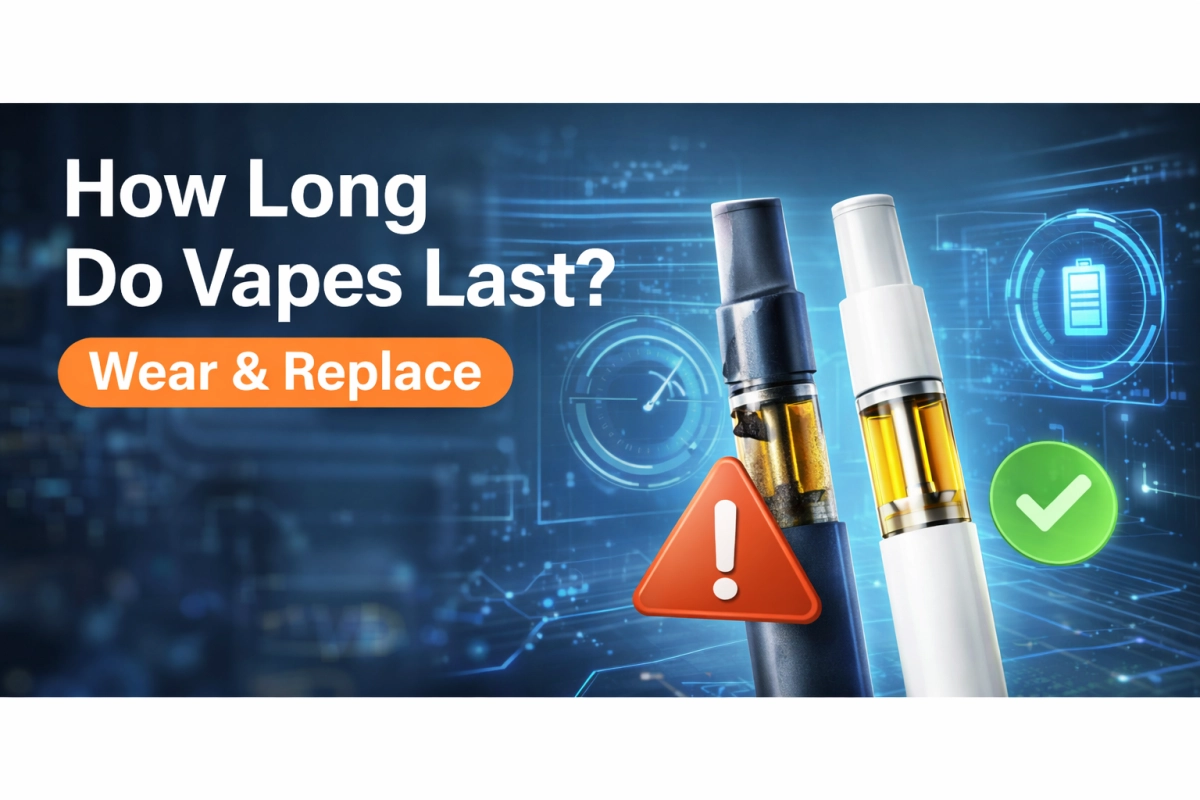
If you’ve asked how long do vapes last, the most accurate answer is: it depends on which part you mean. A vape is a system—airflow, seals, contacts, and the heating module age at different rates—so “lifespan” is best measured by performance signals and replace thresholds, not a single number.
Scope: This article is written for empty only pens, pods, and cartridges. It avoids discussion of filled substances, dosing, or health claims.
If you notice unusual heat, sharp odor, visible damage, or leaking into the contact area, stop use and replace the affected part. Avoid risky “hacks” or opening sealed sections.
What “last” means (3 lifespans)
Most lifespan disagreements come from people measuring different things. For clear analysis, separate lifespan into three buckets:
- Functional lifespan: the system still triggers consistently and produces stable output.
- Performance lifespan: it still works, but output becomes weaker, draw becomes inconsistent, or the experience changes.
- Replace threshold: a specific symptom indicates a part has aged past a safe or reliable operating window.
For consistent terminology (pod, cartridge, mouthpiece, etc.), the CDC’s visual dictionary is a handy reference for definitions and part naming.
Why lifespan follows how it works
Lifespan is easiest to predict when you understand the system flow: air enters → passes through the airflow path → crosses the heating module → vapor exits through the mouthpiece. If any link in that chain degrades, you’ll feel it as tighter draw, weaker output, or intermittent triggering.
If you want the fundamentals in one place, start with this internal explainer: how do vapes work. This article builds on that “system view” and maps wear to replace decisions.
The wear drivers that shorten lifespan
Across formats, the biggest durability drivers are not mysterious—they’re basic stressors that cause airflow restriction, seal fatigue, contact instability, and heating-module aging.
1) Heat cycling and residue buildup
Repeated heating cycles encourage buildup around the heating surface and airflow channel. Over time this can reduce output and increase inconsistency. Research also shows that emissions profiles can change across a product’s use-life, which supports replacing worn parts rather than “pushing through” persistent symptoms.
2) Airflow restriction and condensation
Tight draw is often a physical airflow issue: lint, condensation, or partial blockage. These are “fast wins” because airflow checks are simple and non-invasive.
3) Seal fatigue (compression + time)
Seals and gaskets slowly deform under compression. Once a seal loses its rebound, the system becomes more sensitive to orientation, temperature swings, and vibration.
4) Contact oxidation and micro-movement
Contact points age through oxidation and repeated micro-movement. Slightly unstable contact can look like “random failures” or intermittent output.
Component-by-component: what wears out first
Rather than guessing a blanket timeline, assess the parts most likely to fail first. This list is ordered by how often the part drives real-world complaints.
Airflow path and mouthpiece
- Primary wear driver: lint/condensation, minor blockage, residue.
- Early signs: tight draw, “muted” output, gurgle-like airflow changes.
- Replace threshold: repeated tight-draw episodes that return soon after cleaning.
Seals, O-rings, and gaskets
- Primary wear driver: compression set over time, heat exposure, vibration during transport.
- Early signs: inconsistent airflow, repeated seepage around joints, sensitivity to orientation.
- Replace threshold: visible deformation, cracking, or persistent leakage into non-airflow areas.
Contacts and connection points (including 510)
- Primary wear driver: oxidation, residue transfer, repeated removal/reattachment.
- Early signs: intermittent triggering, “works only when tightened just right,” output drops mid-session.
- Practical next step: review 510 connector problems for a safe inspection checklist (no aggressive methods).
Heating module (replaceable vs sealed formats)
- Primary wear driver: heating cycles + buildup, plus airflow restrictions that force harder pulls.
- Early signs: steady output becomes weak; flavor/heat profile changes; consistency drops.
- Replace threshold: swapping to a known-good empty pod/cartridge restores output immediately (see the one-variable test).
- For a structured overview of heating-module types and upkeep, see 510 atomizer guide.
MoFu takeaway: if you’re optimizing durability, don’t chase a single “days” number. Build a replace rule per component based on early signs and confirm tests.
Replace vs clean: a decision matrix
Use the matrix below to decide whether you should clean, re-seat, or replace. It’s written to be practical and conservative for empty only setups.
| Component | Early signs | Confirm test | Replace trigger | Habit that extends lifespan |
|---|---|---|---|---|
| Airflow path / mouthpiece | Tight draw, muted output | Clear visible debris; rest upright 2–3 minutes; retest | Symptoms return quickly after cleaning | Avoid lint-heavy pockets; keep intakes unobstructed |
| Seals / gaskets | Inconsistent draw, seepage around joints | Visual inspection for deformation; compare to a new part if available | Deformation, cracking, or persistent leakage into contact area | Reduce heat exposure in storage; minimize vibration during transport |
| Contacts / connection points | Intermittent triggering, “sweet spot” tightening | Dry wipe contacts; re-seat once; swap test with known-good part | Failure repeats across multiple known-good parts | Hand-tight only; keep contacts dry and clean |
| Heating module | Weak, inconsistent output | Swap to known-good empty pod/cartridge | Swap restores output immediately (module aged out) | Pace pulls to reduce condensation and airflow stress |
If your symptom is “works sometimes, then stops,” a structured troubleshooting hub can help you map symptoms to likely causes: vape pen not working.
The one-variable test (fast isolation)
When output drops, people often change three things at once: tighten more, pull harder, and clean aggressively. That makes it harder to identify the true cause. Instead, use a simple MoFu-friendly method:
- Change only one variable. Example: swap only the empty pod/cartridge and keep everything else identical.
- Compare outcomes. If output returns, you’ve isolated the fault to the swapped part.
- Stop repeating a failed action. If re-seating doesn’t help once, move on—don’t force more cycles.
Technique can also mimic “wear” symptoms. If you’re unsure whether draw pattern is the driver, reset with a gentle approach and compare: MTL vs DTL.
Storage & transport aging
Lifespan isn’t only about usage—it’s also about storage stress. For empty only inventory, aging is often driven by environment:
- Heat swings: accelerate seal relaxation and increase sensitivity to leakage and airflow changes.
- UV exposure: can degrade some plastics and elastomers over time.
- Vibration and impact: can stress joints, shift seating, and worsen micro-movement at contacts.
- Dust exposure: raises the odds of airflow restriction and mouthpiece contamination.
A practical habit: store upright where possible, keep intakes covered from lint/dust, and avoid leaving inventory in high-heat environments.
Sourcing & QA levers that extend lifespan
For buyers and operators, durability improvements usually come from boring, measurable controls—not marketing claims. Prioritize these levers when evaluating an empty only line:
Contact reliability
- Consistent plating and contact geometry reduce “intermittent” complaints.
- Incoming inspection should include basic fit checks and repeatable connection seating checks.
Sealing consistency
- Gasket material and compression design determine whether seals rebound after storage stress.
- Transport packaging should limit vibration and joint shear.
Airflow tolerance and debris resistance
- Airflow path design that resists lint intrusion helps keep draw consistent over time.
- Clear, repeatable intake geometry makes it easier to diagnose blockages without guesswork.
For standards context, UL 8139 is commonly referenced as a safety framework for electronic vaping products and can be used as a due-diligence anchor in supplier discussions (avoid treating it as proof of certification unless you can verify documentation).
FAQ
How long do vapes last if I’m careful?
“Careful” helps most with airflow and contact stability: keeping intakes clear, avoiding lint, and maintaining clean seating reduces preventable failures. But some parts still age from heat cycling and seal compression, so replace thresholds matter more than a single timeline.
What usually wears out first?
In real-world complaints, airflow restriction and contact instability often show up before anything else. Heating modules can also age out, especially when airflow is restricted and pulls become harder.
What’s the safest way to decide whether to replace a part?
Use the one-variable test: swap only one empty component at a time and compare outcomes. If a swap restores stable output immediately, you’ve identified the part that reached its replace threshold.
References (external)
- FDA: ENDS overview and definitions
- CDC: visual dictionary (parts and terminology) (PDF)
- UL: UL 8139 overview (standards context)
- UC Davis: report on toxic metals observed in popular disposable products
- PubMed: indexed study record related to lifecycle metal emissions
- ACS Central Science: peer-reviewed publication (lifecycle metals)
Editorial note: External references are provided for definitions and research context. This page is informational and does not provide medical advice.





3 Comments
Straight to the point. Appreciate it.
Helpful information, explained well.
Helpful information, explained well.