
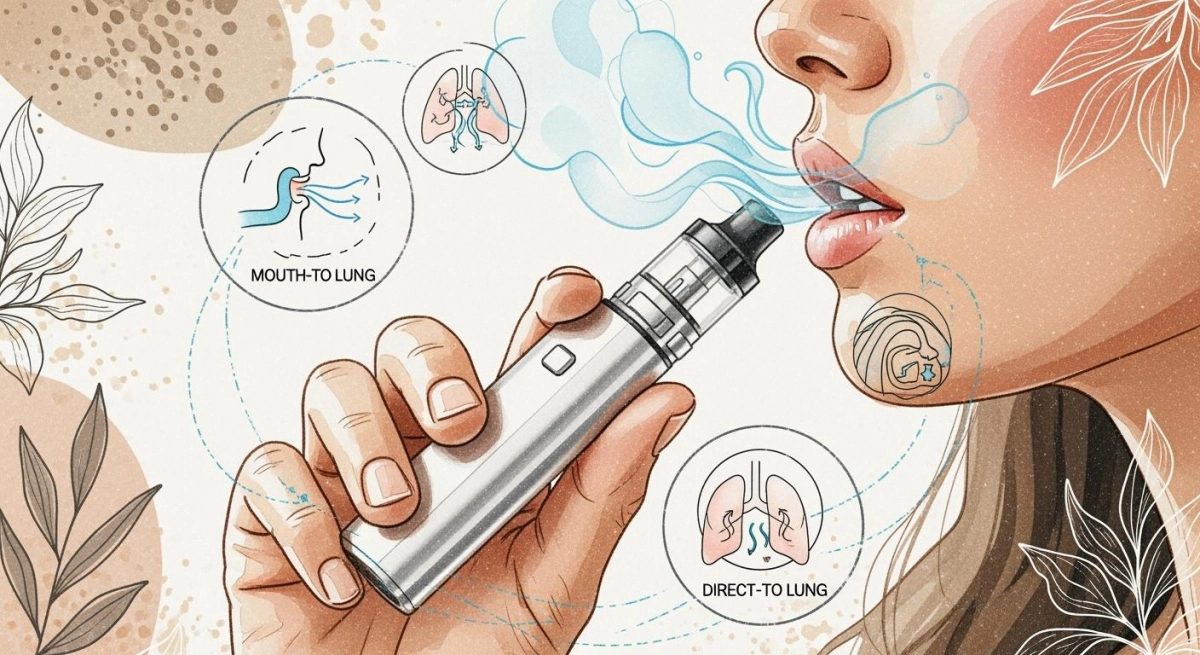
If you’re searching “how to inhale a vape,” the simplest beginner answer is: start with gentle mouth-to-lung (MTL) draws. MTL is the most forgiving technique for new users because it uses a tighter draw, smaller intake, and slower pacing. Once MTL feels comfortable, you can experiment with restricted direct-to-lung (RDL) and direct-to-lung (DTL) depending on your device airflow and your comfort.
If you want the “why” behind airflow, draw resistance, and how aerosol forms, read the pillar page how do vapes work</a >.
MTL vs RDL vs DTL: which draw method should beginners use?
Think of draw methods as “how open the airflow is” + “how directly aerosol goes into your lungs.” Beginners usually succeed fastest with MTL, because it feels closer to sipping through a straw. RDL is the middle ground, and DTL is the most intense because it uses more airflow and deeper inhalation.
|
Method |
What it feels like |
Airflow |
Best beginner use-case |
|---|---|---|---|
|
MTL |
Gentle, controlled, “sip then breathe” |
Tight / restricted |
First-time technique, avoiding cough |
|
RDL |
Smoother than DTL, more open than MTL |
Moderately restricted |
Step-up after MTL feels easy |
|
DTL |
Deep inhale, larger volume per draw |
Open / airy |
Only after technique is stable |
Tip: If you’re unsure which you’re doing, you’re probably doing MTL. That’s fine—MTL is the safest “starter” technique for comfort and control.
How to inhale a vape: step-by-step (MTL first, then DTL)
Before you start, make sure you know the basics of your device (activation, airflow control, and how to take the first puffs). If you need a quick setup checklist, use use a vape pen</a >.
MTL steps (recommended for beginners)
-
Seal: Close your lips around the mouthpiece (no air gaps).
-
Draw: Pull slowly for ~2–4 seconds (like sipping, not sucking hard).
-
Pause: Hold aerosol in your mouth for 1 second (optional but helpful).
-
Inhale: Breathe in gently to move aerosol into the lungs.
-
Exhale: Exhale softly. Don’t “force” it out.
-
Rest: Wait 20–40 seconds before the next puff while you learn comfort.
DTL steps (only after MTL feels easy)
-
Airflow: Use a more open airflow setting (if your device supports it).
-
Inhale: Inhale steadily into your lungs in one continuous breath (no “mouth-hold”).
-
Exhale: Exhale immediately and gently (don’t hold aerosol in your lungs).
-
Pace: Keep the first DTL inhales short and stop if you feel irritation.
Common mistakes (and quick fixes)
|
What happens |
Most likely cause |
Quick fix |
|---|---|---|
|
Coughing on the first puff |
Draw too fast / too strong, or technique mismatch |
Switch to MTL, slow draw, increase rest time |
|
Harsh “hot” hit |
Overheating or too little airflow for your draw |
Shorter puffs, gentler draw, adjust airflow (if available) |
|
Gurgling / wet mouthpiece |
Condensation or flooding from hard pulls |
Use softer draws, wipe mouthpiece, pause between puffs |
|
Spitback (droplets) |
Flooded chamber or pulling too hard |
Stop, clear mouthpiece, restart with gentle MTL puffs |
If your device is a 510 setup and you want the hardware context for airflow and compatibility, see 510 threaded devices</a >.
Troubleshooting cough, harsh hits, spitback, leaks & gurgles
How to inhale a vape without coughing (most common beginner fixes)
-
Slow down: reduce draw speed before changing anything else.
-
Downshift to MTL: beginners tolerate MTL best because volume is smaller.
-
Shorten the puff: try 1–2 seconds at first, then increase gradually.
-
Take breaks: irritation accumulates when you chain-puff.
-
Hydrate: dry throat can amplify harshness.
If you want evidence-based context on vaping harms and respiratory symptoms (and why this topic is treated as YMYL), start with public health sources like CDC</a > and broader evidence reviews like the National Academies report</a >. For a research example on symptoms, see PMC evidence</a >.
Fixing gurgles, leaks, and “wet hits” (technique + maintenance)
-
Stop hard pulls: “vacuum-style” inhales can pull excess liquid/condensation.
-
Wipe + rest: wipe mouthpiece, then wait 2–3 minutes before retrying.
-
Puff pacing: avoid back-to-back pulls while learning (condensation builds).
-
Check airflow: blocked airflow can worsen flooding and spitback.
For more troubleshooting patterns, visit Care & troubleshooting</a >.
Match technique to device airflow (and comfort)
Comfort improves when your inhalation style matches how your device is designed to deliver airflow. In plain terms:
-
MTL: tighter airflow + gentle draw = smoother learning curve.
-
RDL: medium airflow + steady draw = balanced feel.
-
DTL: open airflow + deep inhale = higher intensity (not ideal for first-timers).
Safety note (authoritative sources)
Vaping produces an aerosol that can contain nicotine and other harmful or potentially harmful substances. Public health agencies emphasize that no tobacco product is safe and that nicotine is highly addictive. Read: CDC</a >, WHO</a >, FDA</a >, and the National Academies evidence review</a > for the most authoritative baseline.
You now have a clean framework for how to inhale a vape: start with MTL, use RDL as a bridge, and only try DTL when you’re comfortable and your device airflow supports it. For the full “mechanics” context, return to the pillar page: how do vapes work</a >.
FAQ
What is the best draw method for beginners?
Mouth-to-lung (MTL). It’s the easiest technique to control, and it typically reduces coughing because you inhale smaller volume per puff.
Why do beginners cough when vaping?
Most often it’s draw speed and intensity. Slow down, shorten the puff, switch to MTL, and add longer breaks between puffs while your throat adapts.
Is it “vapor” or “smoke”?
It’s an aerosol (many people casually call it “vapor”). Public health agencies explain that aerosol can contain nicotine and other substances, so treat inhalation guidance seriously.
Where can I learn device basics quickly?
Start with use a vape pen</a > and the pillar page how do vapes work</a >.





2 Comments
Good content! I’ll check out your other posts too.
Appreciate the info here. Very straightforward.