
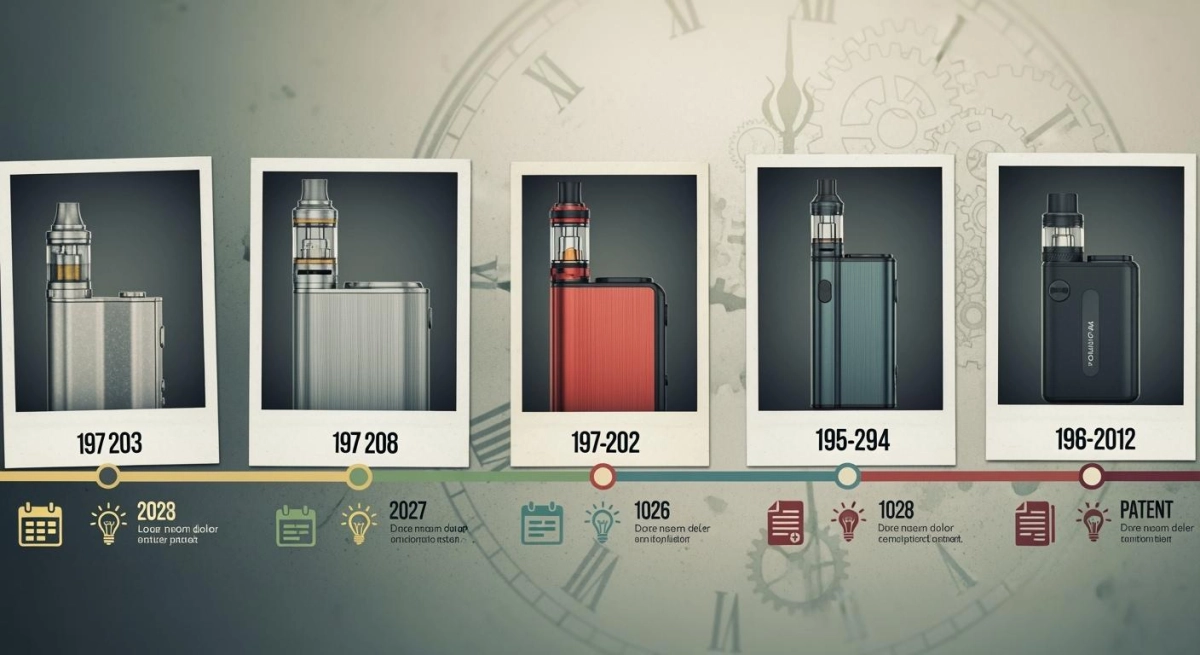
Direct answer (two-layer definition): If “invented” means the first documented technical concept, the vape-like idea appears in early patent records—most notably Joseph Robinson’s “electric vaporizer” (patented in 1930) and Herbert A. Gilbert’s “smokeless non-tobacco cigarette” (filed 1963, granted 1965). If “invented” means the modern commercial e-cigarette era, most histories point to Hon Lik’s early-2000s breakthrough (commonly cited as 2003).
In public health and regulatory language, you’ll often see “e-cigarette” or “ENDS” (electronic nicotine delivery systems). This post is neutral, educational, and evidence-based, and it anchors key milestones to primary sources like patent records and major regulators/public health agencies. For the device-level explanation, read: How vapes work.
TL;DR
- “Invention” can mean first patent milestone (1963/1965) or modern commercial era (early 2000s, commonly cited as 2003).
- Early records include Robinson (electric vaporizer, patented 1930) and Gilbert (smokeless non-tobacco cigarette, filed 1963; patented 1965).
- Modern adoption drove regulatory frameworks in the EU and U.S., and public health monitoring intensified after EVALI (2019).
Timeline at a Glance (primary-source anchored)
| Year | Milestone | What changed | Why it mattered | Primary source |
|---|---|---|---|---|
| 1930 | Robinson “Electric vaporizer” patent | A patented electrically heated vaporizing device for inhalation (medicinal compounds) | Early documented foundation for vaporization by heating (not combustion) | US1775947A |
| 1963 / 1965 | Gilbert “Smokeless non-tobacco cigarette” (filed/granted) | A patented concept replacing burning tobacco with heated, flavored air | Often cited as the first clear “e-cigarette-like” patent blueprint | US3200819A |
| Early 2000s | Modern e-cigarette era (commonly cited as 2003) | Commercially viable e-cigarettes accelerate development and global adoption | Marks the practical starting point for the modern market and device families | NASEM 2018 consensus report |
| 2014 | EU rules for consumer e-cigarettes (TPD Article 20) | EU-wide requirements for consumer e-cigarettes and refill containers | One of the largest regulatory frameworks shaping product requirements | European Commission (TPD Article 20) |
| 2016 | FDA “Deeming Rule” takes effect (U.S.) | ENDS are brought under FDA tobacco product authority | Establishes U.S. federal oversight of e-cigarettes as tobacco products | FDA overview | Federal Register rule text |
| 2019 | EVALI public health emergency (U.S.) | Intensive investigation and public health communication around vaping-associated lung injury | Creates a lasting turning point in surveillance, messaging, and policy discussions | CDC MMWR |
Early Concepts and Patents
1) Robinson (patented 1930): vaporization as a “no flame” inhalation method
Joseph Robinson’s patent describes an “electric vaporizer” designed to heat compounds into vapors for inhalation. It’s not the same as a modern nicotine vape, but it matters historically because it documents the core technical idea: using controlled heating to create an inhalable vapor rather than relying on burning material. US1775947A.
2) Gilbert (filed 1963, patented 1965): a clear e-cigarette-like blueprint
Herbert A. Gilbert’s “smokeless non-tobacco cigarette” is often referenced in modern histories because it explicitly frames a cigarette-like alternative that avoids combustion by producing heated, flavored air. US3200819A. Importantly, this was a patent milestone—not a mass-market breakthrough—so it should be read as foundational design documentation rather than proof of widespread adoption at the time.
Modern E-Cigarettes and Global Development
Hon Lik and the “modern era” definition (commonly cited as 2003)
If your question is “when did vapes become the modern products people recognize today?” the answer is usually anchored in the early 2000s. Major evidence reviews and consensus summaries describe this period as the inflection point when modern e-cigarette designs and commercialization accelerated. NASEM’s consensus report is a strong reference for the modern landscape and how it is evaluated in public health research.
Standardization as “evolution,” not just invention
After the modern era began, devices evolved through standardization and ecosystem growth—not just new shapes. A practical example is 510 threading and the broader 510 standard, which helped make parts and devices more cross-compatible. For a deeper dive into the cartridge ecosystem, see 510 cartridge systems.
How modern vapes work (in 90 seconds)
At a high level, vapes use a power source and a heating element to create an aerosol from a liquid, which is then inhaled through a mouthpiece. The difference between early prototypes and modern devices is mostly about reliability, manufacturing consistency, and product ecosystems. If you want the technical breakdown (components + process), read: How vapes work.
Regulation and Public Health Milestones
EU consumer rules: Tobacco Products Directive (TPD) Article 20
In the EU, Article 20 of the Tobacco Products Directive sets a framework for electronic cigarettes sold as consumer products, covering requirements such as product rules and reporting expectations. European Commission overview.
United States: FDA Deeming Rule (effective 2016)
In the U.S., FDA’s Deeming Rule expanded FDA’s authority to cover additional tobacco products, including ENDS. For a primary overview, use the FDA’s explainer and the Federal Register rule text: FDA and Federal Register.
EVALI (2019): a major surveillance and communication turning point
The 2019 outbreak of vaping-associated lung injury (EVALI) became a key public health milestone. CDC’s Morbidity and Mortality Weekly Report (MMWR) is a primary source documenting investigation findings and the evolving understanding during the event: CDC MMWR.
Helpful definitions and terminology reference: WHO Q&A on e-cigarettes.
FAQ
When were vapes invented?
It depends on your definition. If you mean the earliest patent foundation, key references include Robinson’s electric vaporizer (patented 1930) and Gilbert’s smokeless non-tobacco cigarette (filed 1963; patented 1965). If you mean the modern commercial era, most histories cite the early 2000s (commonly 2003) as the modern inflection point.
Is an e-cigarette the same as a vape (ENDS)?
In everyday language, “vape” and “e-cigarette” are often used interchangeably. In regulatory and public health contexts you’ll also see “ENDS.” For definitions and terminology, the WHO Q&A is a useful baseline reference. WHO.
When did governments begin regulating vapes more formally?
Large frameworks that shaped consumer e-cigarette regulation include the EU’s Tobacco Products Directive (TPD) provisions for electronic cigarettes and the U.S. FDA’s Deeming Rule bringing ENDS under tobacco product authority. EU, FDA.
Why is EVALI part of vaping’s “development” story?
EVALI (2019) is a major milestone because it changed surveillance, public health communication, and policy attention around vaping-associated harms. CDC’s MMWR is a primary record of the investigation and findings during the event. CDC MMWR.
Primary sources used in this article
- US1775947A (Robinson) — electric vaporizer
- US3200819A (Gilbert) — smokeless non-tobacco cigarette
- NASEM 2018 — Public Health Consequences of E-Cigarettes
- European Commission — electronic cigarettes (TPD Article 20)
- FDA — Deeming Regulations overview
- Federal Register — 2016 Deeming Rule text
- CDC MMWR — EVALI investigation report
- CDC archive — 2016 Surgeon General e-cigarette report page
- WHO — e-cigarettes Q&A


3 Comments
This was useful and easy to follow. Great job.
Nice post! Thanks for sharing your thoughts.
Clear and helpful. I enjoyed reading this.