
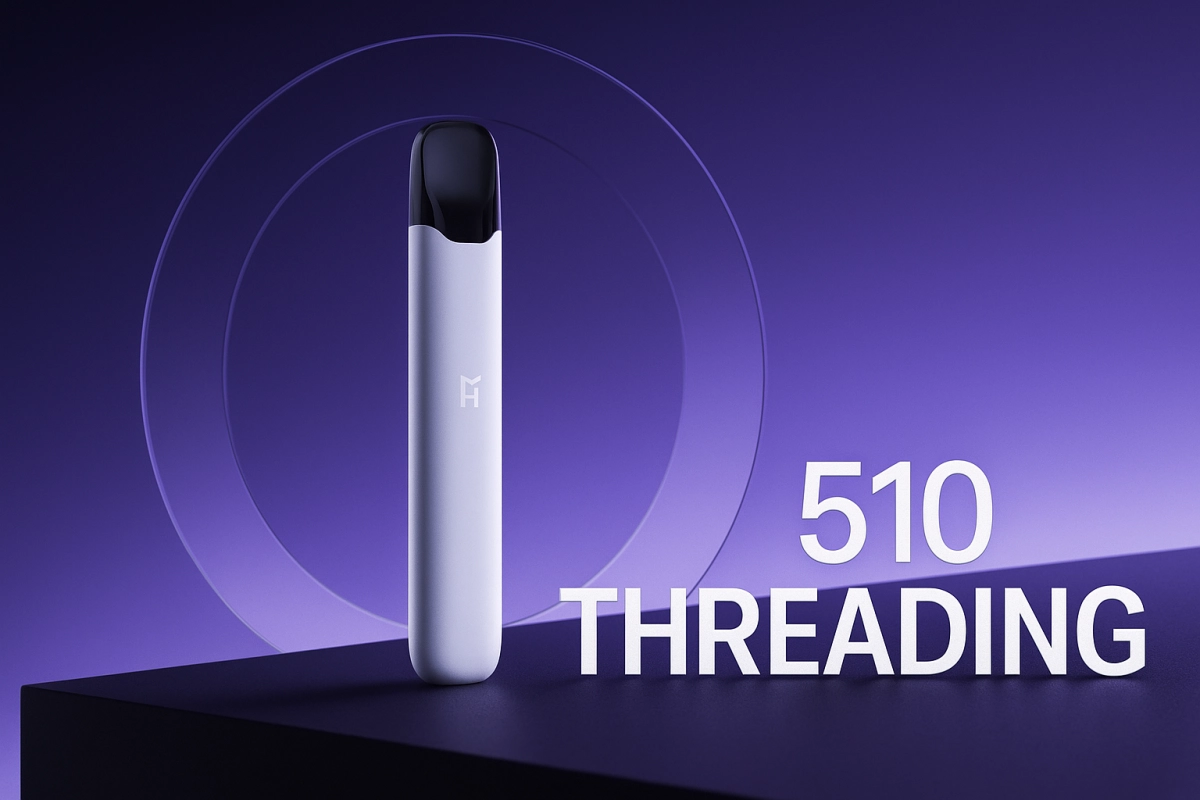

What Is 510 Threading?
510 threading is the most common threaded connector used to attach a cartridge or tank to a compatible battery. It’s considered “universal” in real-world hardware sourcing because a large portion of the industry follows the same basic thread geometry and contact layout. When teams say a product is a 510 vape, they generally mean it uses this connector ecosystem for cross-brand compatibility.
Practical takeaway: “510” tells you a cartridge will likely screw into many devices, but true compatibility still depends on connector depth, center-pin contact, and airflow design—which is why buyers should test across multiple battery styles.
Why It Is Called “510”
The “510” name is rooted in the connector’s thread convention and how it was popularized in early e-cig hardware. In manufacturing and tooling contexts, many suppliers treat 510 as a fine-thread geometry that maps closely to a metric thread form (often discussed in the vicinity of ~7 mm diameter with a fine pitch).
For B2B programs, the exact nickname matters less than what you can measure: thread pitch consistency, plating quality, connector seating depth, and center-pin height. Those factors are the difference between a connector that “fits” and a connector that performs reliably at scale.
How a 510 Connection Works (Mechanical + Electrical)

1) The thread: mechanical alignment and retention
The threaded portion provides a stable screw fit that centers the cartridge/tank and holds it against the battery’s top surface. Good machining creates a smooth start, consistent seating torque, and minimal wobble. Poor machining increases cross-thread risk and can create “loose fit” complaints even when the unit is fully tightened.
2) The contacts: center pin + ground path complete the circuit
Electrically, a 510 interface behaves like a two-contact system: the outer metal body/threads typically act as the ground path, while the center pin acts as the positive contact. A heat-resistant insulator separates these two parts so current flows only through the proper path.

Fixed vs spring-loaded (floating) center pins
Some devices use fixed pins; others use spring-loaded or floating pins. In high-volume programs, spring-loaded designs often improve real-world compatibility because they maintain contact despite small manufacturing tolerances and cartridge base variations.
Why 510 Became the De Facto Universal Connector
Supply-chain flexibility
A shared connector reduces “single-factory lock-in.” Brands can qualify alternate cartridge sources while keeping the battery ecosystem consistent—critical for seasonal demand and multi-warehouse fulfillment.
Faster QA learning curve
Because the failure modes repeat (pin height, thread damage, contamination), QA teams can build standardized inspection and troubleshooting workflows that apply across multiple SKUs.
End-user familiarity
The connector is recognizable to many customers and retailers, which reduces confusion and support friction—useful for ToFu education and pre-sale clarification.
If you’re sourcing empty hardware, start by browsing a structured set of compatible options like 510 vape and then narrow by capacity and materials.
Where “Universal” Compatibility Can Still Fail
Connector recess depth vs cartridge base geometry
Many batteries recess the connector for aesthetics or protection. If a cartridge base is too wide or the thread section is too short, it can “bottom out” on the housing instead of seating properly—leading to weak center-pin contact.
Center pin height and spring travel limits
A cartridge may screw in cleanly but still fail electrically if the battery pin sits too low, the cartridge contact pad is too shallow, or contamination prevents reliable contact. This is one of the most frequent “fits but won’t fire” scenarios.
Airflow path conflicts (especially side-air designs)
Some cartridges rely on side-air channels. Housing shapes and connector recesses can block these paths, causing restricted draw even when the thread spec matches.
Common 510 Problems (Fast Diagnosis)
| Symptom | Most likely 510 cause | What to check (B2B/QA) |
|---|---|---|
| Won’t fire / “no atomizer” | Center-pin contact issue | Pin height, spring travel, residue, insulator deformation |
| Wobbly fit after tightening | Thread or seating variance | Thread quality, shoulder flatness, connector cup stability |
| Hard to start threading | Cross-thread risk or burrs | First-thread damage, plating build-up, machining burrs |
| Restricted draw | Airflow blocked by recess | Side-air inlets alignment, housing interference |
B2B Buyer Checklist (Spec + QC)
Define “510” in your spec sheet (don’t rely on the label)
For purchasing and factory alignment, specify measurable connector requirements: thread pitch consistency, plating type, seating depth, and center-pin height tolerance. Also define whether your target battery ecosystem uses fixed or spring-loaded pins.
Cross-test against multiple battery styles
In pilot, test your cartridge lots against at least three battery formats: flush connector, recessed connector, and a device with a spring-loaded pin. This quickly exposes borderline connector depths and pin-contact sensitivity.
Use category-based sourcing to reduce mismatch risk
Many teams start with capacity buckets for early qualification: 1ml Vape Cartridges and 0.8ml Vape Cartridges, then narrow by core type such as CCELL vape cartridges. For a deeper buying framework, see How to Choose and Fill Empty Vape Cartridges (CCELL vs Other Options).
Tip for conversion-friendly ToFu: keep the body educational, and place your internal links only where they logically answer “what should I look at next?” (capacity → materials → core type). That keeps the article informative while still guiding intent.
510 Vape vs Proprietary Pod Connections
| Factor | 510-thread ecosystem | Proprietary pod connectors |
|---|---|---|
| Cross-brand compatibility | Often high | Usually low |
| Backup sourcing | Easier (multiple factories) | Harder (locked to platform) |
| QA workflow reuse | Strong (repeatable checks) | Limited to each platform |
If your business model depends on flexible sourcing and consistent compatibility across regions, 510 threading remains the safest default starting point—then validate with cross-testing rather than assumptions.
FAQ
Is 510 threading truly universal?
It’s best described as a de facto universal connector. Many products follow similar geometry, but real-world compatibility can still fail due to connector recess, pin height, airflow path, or contamination.
Why does a 510 cartridge screw in but not fire?
Most often it’s a center-pin contact problem (pin height, spring travel, residue, or insulator deformation). The mechanical fit can be correct while the electrical contact is inconsistent.
What should wholesalers verify first?
Start with connector consistency: thread quality, plating uniformity, seating depth, and center-pin tolerance—then confirm performance across multiple battery connector styles.
References (External)
Below are widely used industry explainers and connector-focused guides you can cite for general 510 concepts (definitions, connection layout, and common compatibility issues). Add or swap references based on your editorial policy.
- Innokin – What is a 510 thread?
- Zone Vapor – What is a 510 thread battery?
- Creme de Vape – What is 510 thread?
- KMG Imports – Hardware/connector education (site)
- Wikipedia – Electronic cigarette (background context)
Don’t over-claim: it’s safer to write “widely adopted industry convention” rather than “official ISO standard” when describing 510 threading.

3 Comments
This article was really interesting. Looking forward to more posts like this.
I love the way you explained this topic. Very clear and helpful!
Great post! I learned a lot from this, thank you for sharing.