
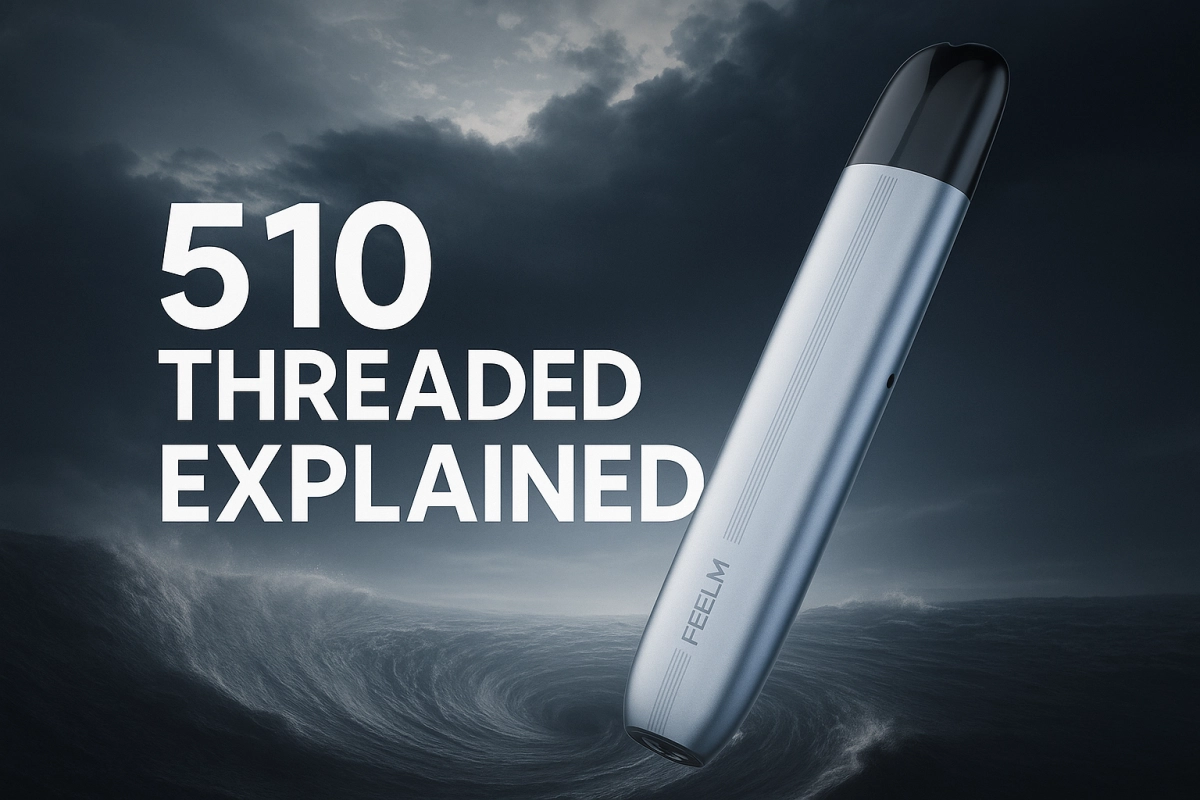
ToFu · Informational / Why · Pillar: 510 vape · Keyword: 510 threaded
“Industry standard” is a strong phrase. In practice, 510 threaded has become a de facto standard because it minimizes ecosystem friction: parts fit across brands more often than not, sourcing stays flexible, and support/QC can be standardized. This guide explains what that really means, where the “universal” promise breaks, and how B2B teams can verify compatibility without guesswork.
What “510 threaded” actually means
At its simplest, 510 threaded describes a connector interface that combines: (1) a threaded metal shell for mechanical alignment and retention, and (2) a center contact insulated from the outer shell to complete electrical contact. If you’ve ever seen a cartridge, tank, or atomizing module that screws into a compatible top connection, you’ve likely interacted with this interface.
For a practical, visual breakdown of the connection and what to inspect, see our in-depth explainer: 510 threaded.
Why threads matter in real-world hardware sourcing
Threads are not just “how parts screw together.” They are a repeatable alignment mechanism that helps manufacturers and buyers standardize fit criteria: smooth start, consistent engagement, stable seating, and predictable contact behavior when tolerances are controlled. In engineering terms, threaded systems succeed when geometry, surface condition, and engagement depth are consistent across batches—otherwise you get intermittent contact, wobble complaints, or premature wear.
Why 510 became the de facto industry standard
It’s important to be precise: 510 is widely treated as an “industry standard,” but it’s better described as a de facto standard—adopted broadly because it works well enough across many suppliers and product lines, not because one single modern standards body “certified” it as the only official interface. The result is a shared ecosystem where many attachments and host devices can interoperate, and that network effect compounds over time.
1) Network effects: one connector, many compatible parts
A connection format becomes “standard” when it reduces decision friction. Buyers can mix compatible parts across brands and factories, and end markets quickly recognize the connector type. Over time, accessory and component availability reinforces the same choice: a bigger ecosystem makes the connector more attractive, and that attractor keeps the ecosystem growing.
2) Supply-chain flexibility: less platform lock-in
From a B2B perspective, the biggest value of a common connector is optional sourcing. When you’re not locked into a proprietary platform, you can:
- qualify more than one supplier for similar form factors,
- use a consistent compatibility test plan across SKUs,
- recover faster from factory capacity constraints or MOQ changes,
- reduce “single point of failure” risk in replenishment cycles.
3) Standardizable QC vocabulary
A mature connector ecosystem creates shared QC language—seating depth, pin contact, thread start feel, and fit stability—so teams can compare apples-to-apples across factories and lots. This is one reason 510 programs scale more smoothly: the checklist becomes reusable.
If you want a broader wholesale-oriented framework for evaluating empty hardware beyond just the connector, use our QC checklist.
Why it’s called “510” (and why explanations differ)
You’ll see more than one explanation for the “510” name in the market. Two reasons are common:
- Dimension-style explanations (often repeated in educational posts): some sources describe “510” in terms of thread count/length conventions.
- Product lineage explanations (often discussed in enthusiast communities): “510” is linked to early product naming and the connector popularized by early e-cig designs.
What matters for buyers is not the folklore—it’s what you can measure and control: thread consistency, connector seating, and contact reliability. If your sourcing workflow depends on tool-level specification, treat “510” as a compatibility family and validate with a repeatable test plan (see the checklist section below).
Where “universal” compatibility still fails
A key point for ToFu education is honesty: “510” improves the odds of compatibility, but it doesn’t guarantee it. Most returns and support tickets happen in the gap between “it screws in” and “it works reliably.”
Failure mode A: tolerance stack (fit feels OK, performance is inconsistent)
Even if the thread engagement feels normal, small variations in connector recess, seating surfaces, and contact travel can create intermittent behavior. This is classic tolerance stacking: each component can be “within spec,” yet the assembled system drifts toward the edge of reliable contact.
Failure mode B: contact contamination and surface condition
Electrical contact performance depends on real contact area and pressure—not just “touching.” Oils, oxidation, residue, or plating inconsistencies can raise contact resistance and create intermittent behavior. This is why incoming inspection should include both visual checks and functional sampling, not only a thread-fit check.
Failure mode C: cross-thread damage and early wear
If a connector starts poorly (rough lead-in, burrs, soft materials, inconsistent plating), cross-thread events become more likely—especially in high-volume retail handling. Once threads deform, subsequent fit and seating torque become unpredictable.
For a focused guide on the attachment side—including common 510 module types and what to standardize—see our 510 atomizer overview.
A B2B verification checklist for 510-thread programs
If you buy at scale, the goal is not “it works once.” The goal is repeatable compatibility across lots, factories, and regional fulfillment. Below is a practical checklist you can standardize.
1) Incoming visual + fit checks (fast, low-cost)
- Thread start: should engage smoothly with minimal wobble and no “gritty” feel.
- Seating: confirm the attachment seats consistently (no rocking, no unexpected gap).
- Insulator condition: look for deformation, tearing, or misalignment around the center contact.
- Plating consistency: uneven finish can correlate with early wear and intermittent contact.
2) Functional sampling (what most teams skip, and then regret)
- Multi-host testing: test across more than one host style from your target ecosystem (not just one unit).
- On/off cycling: repeated attach/detach cycles to surface early wear or unstable contact.
- Intermittency screening: gently apply lateral load after seating to check for cut-outs.
3) Lot discipline and traceability
When a connector issue shows up in the field, you need to isolate it fast. That means lot-level labeling, carton-level tracking, and a sampling record that ties failures to a specific production run—not just a SKU name.
| Check | Pass criteria (example) | Why it matters |
|---|---|---|
| Thread engagement feel | Smooth start, consistent torque, no wobble | Reduces cross-thread risk and seating variability |
| Seating & gap | Uniform seat; no rocking; stable base contact | Prevents intermittent behavior tied to geometry |
| Contact stability under light side-load | No cut-outs after seating | Surfaces tolerance-stack and contact issues early |
| Lot labeling consistency | Unit/carton identifiers match PO + inspection log | Speeds root-cause isolation and supplier action |
510 ecosystem vs proprietary connections (operational view)
The connector decision is rarely only “engineering.” It is an operations decision: sourcing flexibility, SKU risk, and support cost. Here’s a simplified B2B comparison.
| Factor | 510-thread ecosystem | Proprietary connection |
|---|---|---|
| Cross-brand interchange | Often high (with validation) | Usually limited to one platform |
| Backup sourcing | Easier to qualify multiple suppliers | Harder; higher lock-in |
| QC reuse | Reusable checklist across many SKUs | New checklist per platform |
| Support complexity | Lower once rules are documented | Higher when platform variance changes |
Where to start on Vapehitech
If you want a clean learning path (and a safe internal-link path for this ToFu article), use these pages in order:
- Start with the concept-level explanation of 510 threaded.
- Then go deeper on ecosystem anatomy with 510 vape.
- If you are comparing attachment formats, read the 510 atomizer guide.
- For a product browsing starting point (hardware-only), explore empty vape cartridges.
- For scalable buying, sampling, and packaging workflow guidance, use the QC checklist.
FAQ
Is 510 threaded truly universal?
It’s best described as a “high-compatibility ecosystem,” not a guarantee. Many parts interoperate, but real-world outcomes still depend on connector geometry, contact stability, and manufacturing consistency.
Why does something screw in but act inconsistent?
Mechanical fit and contact reliability are different problems. A unit can seat and still suffer from tolerance stacking, contact contamination, or limited contact travel. That’s why multi-host functional sampling is essential for B2B programs.
What’s the fastest way to reduce 510-related returns?
Standardize a short incoming checklist: thread engagement feel, seating stability, contact stability under light side-load, and lot-level traceability. Catching instability at receiving is dramatically cheaper than processing returns downstream.
References
- Joyetech (announcement): “In Sep. 2008, Joyetech developed ‘Joye 510’…” — Joyetech news archive
- Joyetech: Company history
- Innokin (manufacturer educational): What is the 510 thread, and how does it work?
- NIST (legacy handbook): Screw-thread standards for federal services (Handbook 25)
- NASA (fastener thread engagement guidance): NASA-STD-5020
- Bolt Science (ISO 68-1 overview and revision note): ISO 68-1 metric thread profile basics
- TE Connectivity (connector reliability overview): Reliability Solutions Guide (contacts)




3 Comments
Nice work! Looking forward to your next update.
I really enjoyed reading this. Very helpful information.
Great post! Thanks for sharing your insights.