
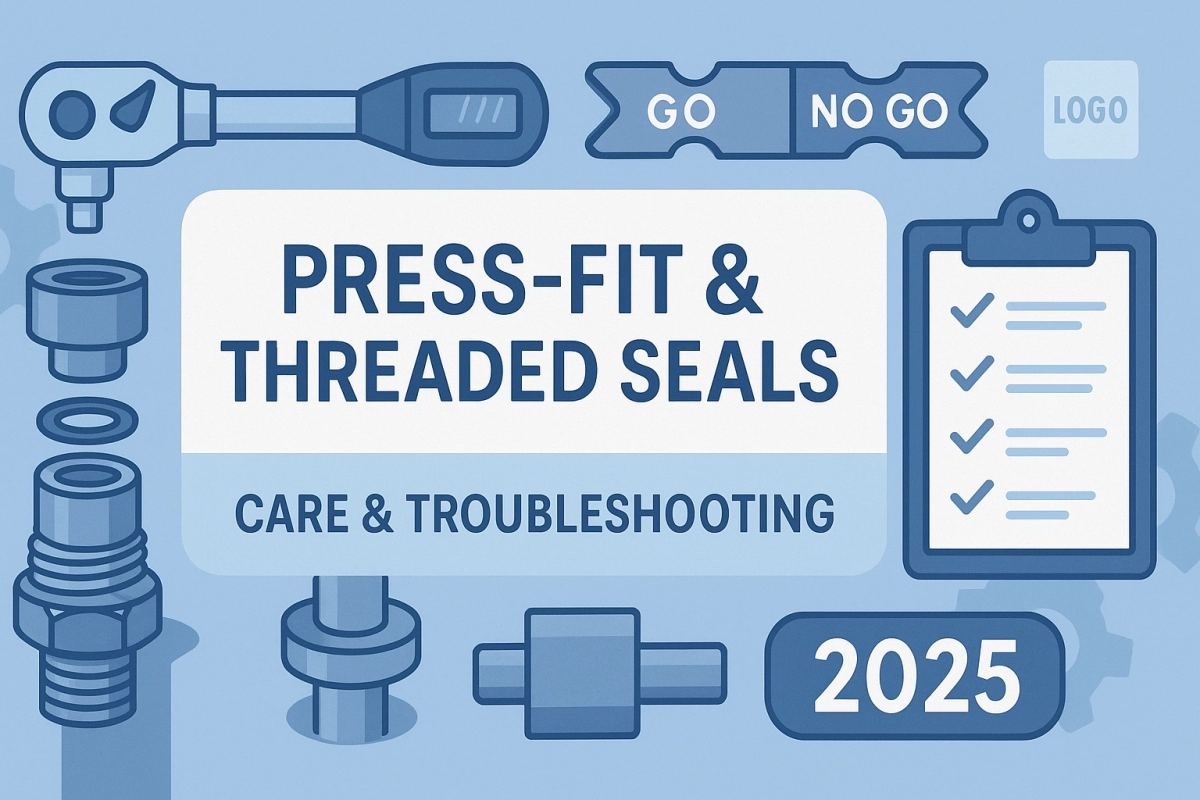
Press-Fit & Threaded Seals: Torque Windows, Go/No-Go Gauges, and Leak-Risk Controls (2025)
Scope: Practical troubleshooting for empty hardware (no battery topics). We focus on joints that seal the vapor path—threaded mouthpiece bases, press-fits, and O-ring interfaces—to stop leaks, prevent harsh draw, and keep lots consistent.
1) Map the symptom → likely cause
| Symptom | Likely Cause | What to check first |
|---|---|---|
| Oil seepage at thread/press-fit | Under-torque; O-ring undersized or high compression set; surface scratch; dry install | Actual torque vs spec; O-ring OD/CS; hardness; visual for nicks; add a micro-film of approved lubricant |
| Harsh/whistling draw | Over-torque choking air path; misaligned press-fit; burrs in air inlet | Draw resistance (mbar) vs baseline; inspect air ports; review torque histogram |
| Intermittent leaks only after shipping | Press-fit not seated to depth; vibration; O-ring spiral twist | Seat depth gauge; shipping vibration pre-test; inspect O-ring twist marks |
| Thread back-out during use | Over-lubricated thread; low prevailing torque; missing thread-locker (if designed) | Prevailing torque check; friction condition; review build record |
2) Set torque/press-fit windows (how-to)
- Define function — leak-tight seal without choking air path; no damage to threads/O-rings.
- Establish trial curve — run stepped torque on sample units (e.g., small increments) and record:
- Leak result after dwell (visual + weight gain or bubble test)
- Draw resistance vs baseline
- Cosmetic/part damage
- Pick a provisional window — the range that passes all criteria with margin.
- Validate on real line — 30–50 pcs per station/operator; build a histogram.
- Freeze the window — document tool, bit, speed, dwell, and re-hit policy.
For press-fits, control insertion force and seat depth. Specify tooling nose shape and stop height; log max force and end-of-stroke confirmation.
3) Go/No-Go gauges & quick checks
Threaded joints
- Go/No-Go ring/plug for thread class and pitch.
- Prevailing torque check: measure torque to initiate back-off after dwell.
- Torque audit: 1 per 50 pcs per head per hour, log to histogram.
Press-fits
- Seat-depth gauge: mechanical stop or depth probe.
- Insertion-force trace: spot-check curve shape (stall, snap-in).
- Burr check: swab test on ports; burrs raise draw resistance.
4) O-ring compression & lubrication
- Compression target: choose a mid-range compression that seals without excessive friction (set by your design; verify with leak and draw tests).
- Material & cure: silicone (platinum cure) vs FKM; watch compression set after heat/aging.
- Lubrication: a micro-film of approved lubricant reduces twist and damage; avoid over-lube that lowers prevailing torque on threads.
- Handling: use tapered leads and chamfers; install with a mandrel to prevent spiral-twist.
5) Capability (Cp/Cpk) sanity check
After freezing the window, confirm your process can hit it repeatably. For torque, track mean, σ, and % inside window by station/operator. Investigate drifts caused by tool wear, bit contamination, or fixture slack.
| Metric | Why it matters | Action if off-track |
|---|---|---|
| Inside-window rate | Direct predictor of leak fallout | Retrain operator; service tools; tighten window only with evidence |
| Draw resistance mean | Detects choking from over-compression | Back off torque or adjust O-ring hardness/CS |
| Re-hit rate | Multiple hits may damage threads/seals | Fix first-pass tooling and stop allowing re-hits |
6) Line SOP: assembly & rework controls
- Tools: calibrated torque drivers/presses; locked programs; daily verification.
- Fixtures: hard stops for seat depth; alignment to avoid cross-threading.
- Checks: torque or force trace saved to lot record; seat-depth probe every 50 pcs.
- No re-hit policy: if out-of-window, scrap or controlled rework with full retest.
- Sampling: leak and draw tests per lot; visually audit O-ring condition.
Documentation: keep a one-page build sheet at the station with the torque/force window, tool ID, and rejection flowchart.
7) Troubleshooting FAQ
Q: Leak passes at room temp but fails after warm storage?
A: Re-check O-ring compression set and surface finish; add an aging step in validation and tighten the upper torque bound if air path narrows at heat.
Q: Units squeal after assembly?
A: Over-compression or burrs near the inlet. Reduce torque or deburr ports; compare draw resistance to baseline.
Q: Threads feel gritty and torque scatter increases?
A: Contaminated bits or plating debris. Clean bits, change lot, and add a quick air-blast at the station.
8) Useful internal references
- Seal Integrity & Leak Prevention: O-Rings, Press-Fit & Torque Windows
- Incoming QC for Empty Vape Hardware: AQL & Airflow Tests
- Mouth-Contact & Seal Materials Compliance (2025)
- Buyer’s Safety & Compliance Checklist (UL/IEC | UN 38.3 | RoHS/REACH)
This article is technical guidance for empty hardware assembly and troubleshooting. It does not cover batteries or finished, filled products.





1 Comments
I learned something new today.