
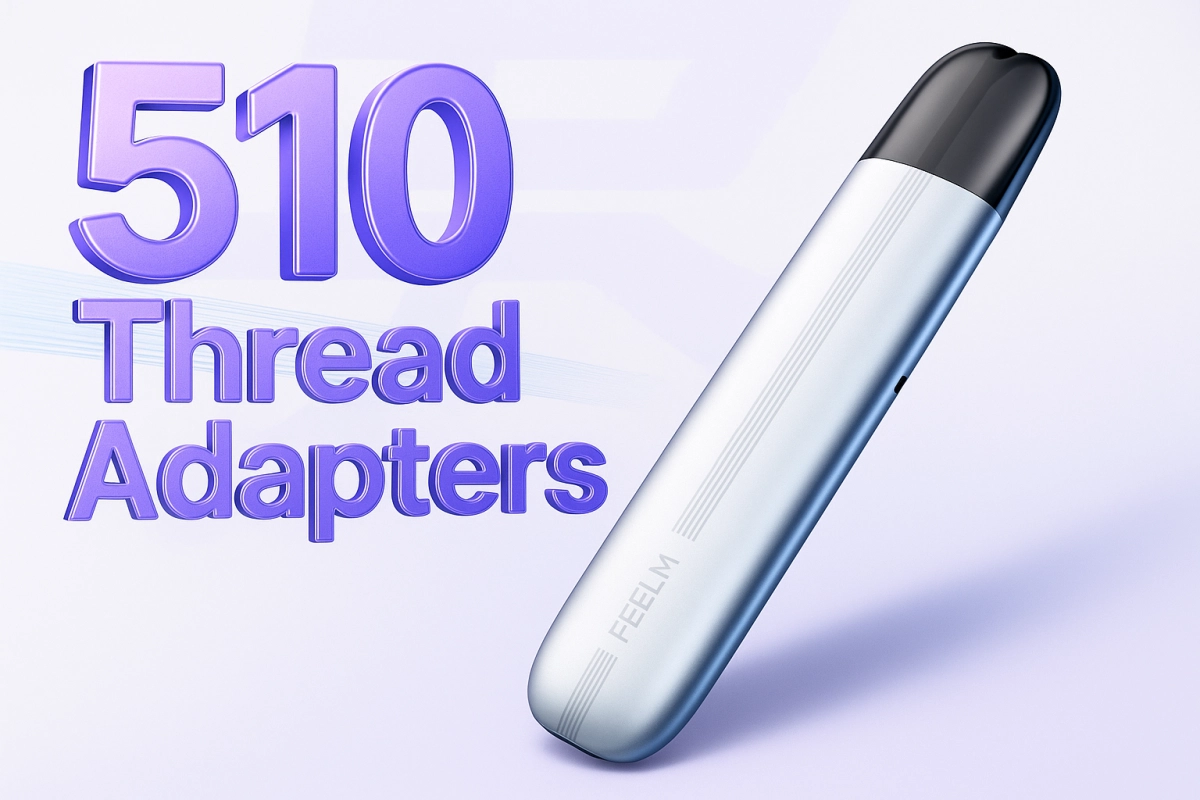
MoFu · Informational / How · Pillar: 510 vape · Keyword: 510 thread adapter
A 510 thread adapter is a small connector accessory that changes fit, height, or thread type so two vape components can mate more reliably. The trick is choosing the right adapter for the real failure mode—because many “compatibility issues” are actually contact, tolerance, or seating problems. This guide shows you how to diagnose the cause first, then pick an adapter type that solves it with the least added risk.
What a 510 thread adapter actually does
Most adapter claims sound the same (“fixes compatibility”), but adapters usually do one of three concrete things:
- Change thread type (example: bridging older thread families to 510).
- Change seating height (example: adding clearance so parts can fully seat without interference).
- Protect wear surfaces (example: using an inexpensive sacrificial interface to reduce cross-thread wear on higher-value components).
Engineering reality: a 510 connection succeeds when mechanical seating and electrical contact both stabilize. Many devices use a center pin that is spring-loaded to help maintain contact pressure, and contact materials may be copper or gold-plated copper for conductivity. If the pins don’t meet reliably, an “adapter” won’t magically fix it—unless it changes geometry enough to restore stable contact.
The 5 most common compatibility failures (and what an adapter can’t fix)
1) “It screws in, but it doesn’t work consistently”
This is usually a contact stability problem, not a thread problem. Common causes include center-pin travel limits, contamination/oxidation, or tolerance stacking (tiny variances that add up). An adapter can help only if it restores stable pin-to-pin contact by changing seating depth or contact geometry.
2) “It won’t seat all the way (gap, wobble, or interference)”
Often caused by recess depth, “skirt” geometry, or a base that bottoms out early. A short extension/clearance adapter can help by moving the mating plane outward—if the resulting leverage doesn’t create wobble.
3) “Cross-threading or gritty engagement”
This is typically a thread quality issue (damaged start, burrs, mismatched tolerances, or repeated swaps). An adapter may protect the host component by becoming the wear surface, but it will not correct poor threads upstream.
4) “Older thread families don’t match (legacy compatibility)”
Some older formats (like eGo-style setups) include different thread geometries and may require a dedicated adapter to bridge thread families. Here, the adapter is the correct tool—as long as both sides can seat without interference.
5) “Airflow feels wrong after connecting”
Airflow can change if the adapter alters the gap or blocks air paths near the base. Airflow-related adapters exist, but if airflow is a core requirement, it’s usually better to standardize compatible base geometry than to stack parts.
Adapter types explained (pick by symptom)
510-to-510 extender (clearance / seating / sacrificial interface)
- Use it when: you need extra clearance to fully seat, avoid base interference, or reduce wear on the host connector.
- Verify: stable seating (no rocking), stable contact under light side-load, and clean thread start.
- Avoid when: the setup already feels top-heavy; extra leverage can worsen wobble and intermittency.
510-to-eGo (or eGo-to-510) adapter (thread-family bridging)
- Use it when: you must connect components that belong to different thread families (common in legacy ecosystems).
- Verify: full seating and contact stability after the adapter is installed—don’t assume “thread match” means “works.”
- Avoid when: you can standardize parts upstream; adapters are best for exceptions, not for permanent SKU policy.
Heatsink / insulator-style 510 adapters (connector protection)
- Use it when: you want to reduce heat transfer into the connector area or protect cosmetic/finish surfaces.
- Verify: the adapter does not reduce contact stability or introduce a gap that causes intermittency.
Magnetic 510 ring adapters (fast swap, but higher contact risk)
- Use it when: quick swapping is a business requirement (demo, retail display, frequent SKU switching).
- Verify: consistent contact under movement and repeated attach/detach cycles.
- Avoid when: your program is sensitive to intermittent firing/returns—magnetic interfaces can increase variability.
Step-by-step troubleshooting before buying an adapter
Most teams buy adapters too early. Run this short checklist first—because if the root cause is contamination or overtightening, adding an adapter can make tolerance stacking worse.
- Power down and inspect. Check for debris, residue, deformation around the insulator, or obvious damage at the thread start.
- Clean contact surfaces. Use a non-shedding swab and appropriate cleaning method for your materials policy. Focus on threads and the contact area—don’t force tools into the center contact.
- Stop overtightening. Over-torque is a common cause of seating and contact problems. Tighten only until it seats; do not “crank” for reassurance.
- Test on a known-good reference set. If a component works on one reference host but fails on another, you likely have a tolerance/geometry mismatch—an adapter may help.
- Only then choose an adapter by symptom. If the symptom is “won’t seat,” choose clearance/extension. If it’s “thread family mismatch,” choose a bridge adapter. If it’s “intermittent contact,” prioritize restoring stable seating and contact—not stacking multiple adapters.
Safety note: Do not pry or mechanically alter center contacts unless you have a validated procedure and trained staff. Uncontrolled “pin adjustment” can damage the insulator or create unreliable contact.
Selection matrix: symptom → likely cause → best adapter
| Symptom | Likely cause | Best adapter type | Why it helps | What to verify | Common mistake |
|---|---|---|---|---|---|
| Screws in, but cuts out / inconsistent | Unstable center-pin contact; tolerance stacking; contamination | Short 510-to-510 extender (only if it restores seating) | Moves the mating plane to improve pin contact pressure/geometry | No cut-outs under light side-load; stable seating; clean contact surfaces | Stacking multiple adapters and increasing wobble |
| Won’t seat fully (gap) or feels wobbly | Recess depth / skirt interference; base geometry mismatch | 510-to-510 clearance extender | Creates clearance so the base can seat without interference | Full seating with no rocking; consistent thread engagement | Using a long extender that makes the setup top-heavy |
| Thread mismatch with legacy hardware | Different thread families (eGo vs 510 style) | 510-to-eGo (or eGo-to-510) adapter | Bridges thread geometry so parts can physically mate | Seating + contact stability after adapter installation | Assuming “thread match” guarantees electrical contact |
| Cross-threading or gritty start | Damaged thread start; burrs; poor machining/finish | Sacrificial 510-to-510 interface (quality adapter) | Protects the host connector from repeated damage | Smooth start; no metal shavings; consistent torque | Using cheap adapters that worsen thread damage |
| Airflow changes unexpectedly | Adapter blocks or alters airflow path at base | Avoid if possible; use geometry-matched parts | Most airflow issues are better solved upstream | Draw consistency across multiple lots | “Fixing” airflow with stacked adapters and creating leaks |
B2B procurement & QC checklist for adapters
Supplier spec you should request (minimum)
- Material + plating declaration for the contact surfaces (conductivity and corrosion stability depend on this).
- Thread quality controls: burr removal, thread start consistency, and acceptable torque feel.
- Dimensional controls: adapter height/clearance tolerance and concentricity.
- Compatibility scope: which component families it has been validated with (don’t accept “universal” as a test plan).
Incoming QC sampling (fast and effective)
- 3-host test: verify the adapter against at least 2–3 representative host geometries you actually deploy.
- Cycle test: repeat attach/detach cycles to surface early wear or intermittent contact behavior.
- Side-load check: after seating, apply gentle lateral movement to detect cut-outs.
- Lot traceability: adapters are small but should still be lot-labeled for rapid containment.
If you want a reusable structure for documenting acceptance criteria, sampling, and packaging checks across hardware SKUs, use your internal workflow from our QC checklist resource (linked below in the internal section).
When NOT to use an adapter
- When the problem is contamination or overtightening. Clean and correct handling first.
- When you need to stack adapters. Adapter-on-adapter setups amplify tolerance stacking and wobble risk.
- When stability is the priority. If returns/intermittency are costly, standardize geometry upstream instead of adding interfaces.
- When the adapter changes airflow in unpredictable ways. Solve airflow with matched parts, not “connector hacks.”
Where to learn more on Vapehitech
To keep your internal linking clean (and to strengthen your 510 vape pillar), these five pages map naturally to this MoFu “adapter” guide:
- 510 threaded — the core interface explained.
- 510 vape — ecosystem context and component structure.
- empty vape cartridges — a practical browsing starting point for hardware-only programs.
- 510 atomizer — attachment-side types and maintenance considerations.
- QC checklist — reusable QC and packaging workflow for scale.
Scope note: This article focuses on connector/interface compatibility and B2B verification workflows. It does not provide instructions for consumables.
FAQ
Do 510 thread adapters “fix” compatibility, or just change fit?
They mainly change geometry: thread type, seating height, or the mating plane. If the true problem is unstable contact, contamination, or damaged threads, an adapter might not help—and can sometimes make the system less stable by adding leverage.
What’s the best adapter for intermittent cut-outs?
Start by cleaning and correcting overtightening. If the issue persists and you can confirm a seating-depth mismatch, a short 510-to-510 extender can help by restoring stable contact—but avoid stacking adapters.
How do I stop cross-thread damage in high-swap environments?
Use a higher-quality sacrificial adapter so repeated swaps wear the adapter threads instead of your higher-value host connector. Validate the thread start feel, finish quality, and cycle performance in incoming QC.
References
- Innokin — 510 center pin behavior, spring-loaded contact, and conductivity notes: What Is the 510 Thread, and How Does It Work?
- Innokin — anatomy of 510 threads and typical contact materials: What Is a 510-Thread Battery?
- NIST (NBS) — thread standards background (general engineering reference): Screw-Thread Standards for Federal Services (Handbook 25)
- NASA — threaded engagement and fastening system requirements (general engineering reference): NASA-STD-5020
- TE Connectivity — connector basics and contact interface concepts: Connectors 101
- Sumitomo Electric — spring force and contact resistance fundamentals (connector contact mechanics): Prediction of Electrical Contact Resistance of Tin-Plated Terminals (paper)
- VaporPenSales — legacy eGo/510 threading overview (background reference): 510 or eGo? Understanding Vaporizer Threading
- “Golden Rules” (connector plating) — stable low contact resistance considerations (background): Golden Rules: Guidelines for the Use of Gold on Contacts (PDF)






3 Comments
Very informative post, thanks for the details.
Good content as always, keep it up!
This was clear and easy to understand. Appreciate it!