
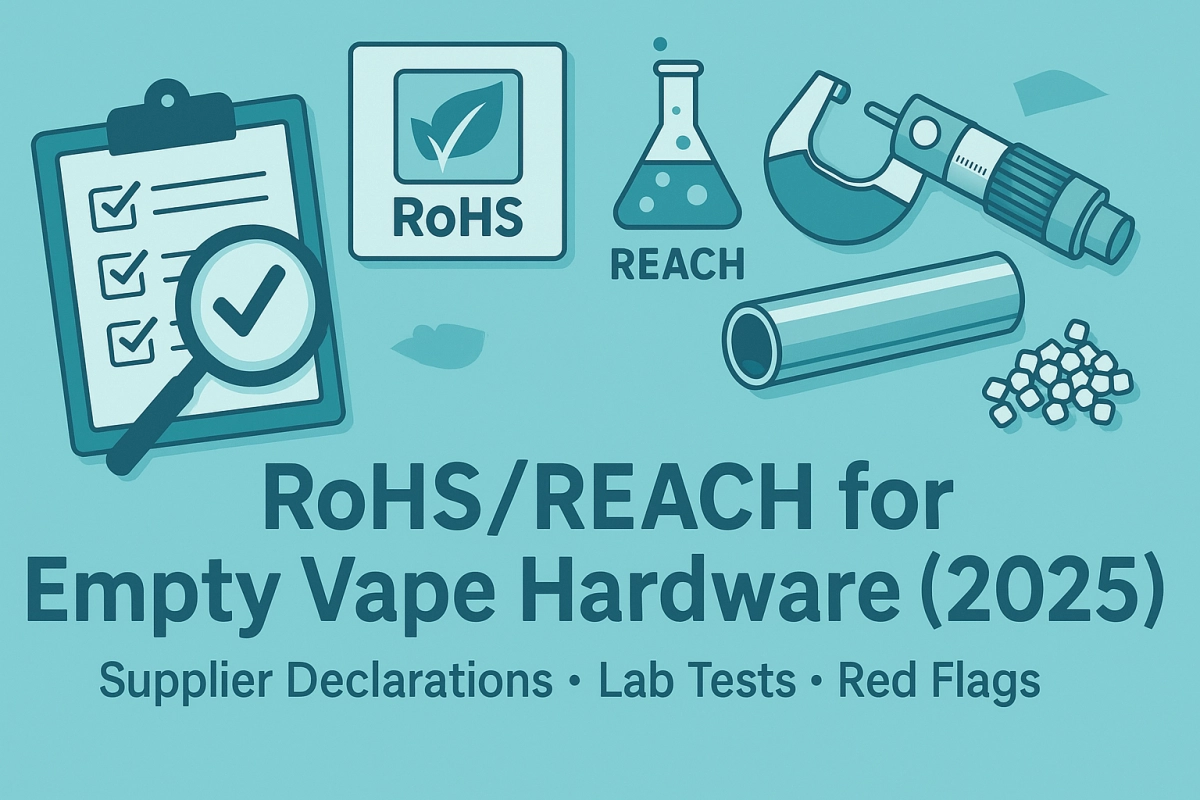
RoHS/REACH for Empty Vape Hardware (2025): Supplier Declarations, Lab Tests & Red Flags
This buyer-ready guide explains how to verify RoHS and REACH compliance for empty vape hardware in 2025 using numeric limits, accredited lab methods, and a risk-based sampling workflow you can roll into incoming QC.
1) Scope — what’s “in scope” for empty hardware
RoHS/REACH scope covers materials, components, and finishes used in empty devices: stainless tubes and mouthpieces, aluminum shells, plated brass sub-components, polymer housings (PCTG, PC/ABS, PEEK), elastomers, adhesives, inks and paints—especially coatings/platings that could introduce restricted substances.
Operationally, align this article with your receiving SOP in Incoming QC for Empty Vape Hardware (AQL & Airflow Tests).
2) RoHS restricted substances & numeric limits
Verify declarations and reports against Annex II limits under RoHS (2011/65/EU as amended by (EU) 2015/863). Thresholds per homogeneous material are:
- Cadmium (Cd): ≤ 0.01% (100 ppm)
- Lead (Pb), Mercury (Hg), Hexavalent Chromium (Cr(VI)), PBB, PBDE: ≤ 0.1% (1000 ppm)
- Phthalates: DEHP, BBP, DBP, DIBP — each ≤ 0.1% (1000 ppm)
Use part-number mapping and finish-specific declarations; for plated parts that may be in direct and prolonged skin contact, consider EN 1811 nickel-release evaluation (limit 0.5 μg/cm²/week; ≤0.88 μg/cm²/week deemed compliant per the latest interpretation).[1][2][3][4]
3) Supplier Documentation Pack (what to request)
- DoC/CoC (RoHS & REACH) referencing part numbers, revisions, finishes, and third-party report IDs.
- Material grades (e.g., 316L/304 stainless; PCTG/PC/ABS/PEEK resins) and finish declarations (Ni/Cr plating, PVD, anodizing, inks/paints).
- Third-party reports tied to lots/finishes: metals, brominated flame retardants, phthalates, nickel release, solvent/VOC screening.
- Lot/date code mapping and a BOM view of which sub-parts each declaration covers.
- Change-control (ECO triggers): resin, pigment, plating bath or supplier changes → re-qualification & evidence refresh.
For broader purchasing controls, see our Safety & Compliance Buyer’s Checklist and Gage R&R & Uncertainty.
4) Accepted lab methods & accreditation
Methods. Request testing to the IEC 62321 series for RoHS substances—for example: XRF screening per 62321-3-1; digestion + ICP-OES/AAS per 62321-5/6 for metals/bromine; and IEC 62321-8 (GC-MS or Py/TD-GC-MS) for phthalates in polymers. Cite report numbers and sample IDs that map to your part numbers and finishes.[5][6][7]
Accreditation. Use laboratories accredited to ISO/IEC 17025 by bodies that are signatories to the ILAC MRA; this supports international acceptance of results and regulator confidence. Keep the lab’s accreditation scope and validity with your files.[8][9][10]
5) AQL + chemical sampling workflow
- Routine AQL checks: appearance, dimensions, airflow (see our AQL & airflow SOP).
- Risk triage: prioritize coatings/platings, dark pigments, adhesive/ink changes, supplier switches.
- Periodic chemical tests: high-risk parts go to third-party labs on a defined cadence (or on change notices); keep raw data and chromatograms when available.
- NCR/8D: for any failure, stop-ship, quarantine, root-cause, corrective actions, and supplier re-qualification.
6) Top 10 red flags
- Generic declarations without part numbers, finishes, or report IDs.
- Report dates not aligned to current finishes or supplier lots.
- Plated parts missing nickel-release assessment where applicable.
- Inks/paints with no solvent/VOC cure evidence or pigment disclosure.
- Polymer grades listed as “equivalent” with no datasheets or CAS families.
- No change-notification process for resin, pigment, plating bath, or supplier.
- Non-searchable “photo scans” of certificates; no lab contact or accreditation scope.
- Contradictory material claims (e.g., claims 316L but density/spark/hardness disagree).
- Carton lot codes don’t match certificates/test sample IDs.
- “One-and-done” testing with no plan to refresh after process changes or SVHC updates.
7) Quick FAQ
Do I need to quote the current SVHC count?
No—ECHA updates the Candidate List periodically. Link to the live list and ask suppliers to confirm “no SVHC >0.1% w/w in articles” (or list any present) at the time of declaration.[11][12]
Should every shipment be tested?
Use risk-based periodic testing. Trigger re-tests on supplier/finish changes or adverse history, and maintain ISO/IEC 17025 + ILAC-MRA evidence for external acceptance.[8][9]
8) References
- RoHS Annex II substance list and limits (2011/65/EU as amended by (EU) 2015/863) — ECHA: https://echa.europa.eu/restricted-subs-referred-art-4-rohs
- EN 1811 nickel release — interpretation updates (2023) — Intertek bulletin: https://www.intertek.com/products-retail/insight-bulletins/2023/en-1811-2023-new-nickel-release-standard-published/
- EN 1811 amendment criteria (0.5/0.88 μg·cm²·week) — SGS/TÜV refs: https://www.sgs.com/en-mm/news/2015/09/safeguards-15515-cen-publishes-amendment-to-en-1811-nickel-release ; https://www.tuv.com/.../amendment_to_nickel_release_standard_published_en_1811_2011_a1_2015_en.pdf
- Background on 0.5 μg/cm²/week — Nickel Institute: https://nickelinstitute.org/en/science/human-health-fact-sheets/fact-sheet-1-nickel-allergic-contact-dermatitis/
- IEC 62321-8 (phthalates in polymers) — IEC Webstore: https://webstore.iec.ch/en/publication/32719
- IEC 62321 overview — (public summaries): https://getenviropass.com/iec-62321/
- BS EN 62321-8 (GC-MS / Py-GC-MS) — BSI: https://knowledge.bsigroup.com/products/determination-of-certain-substances-in-electrotechnical-products-phthalates-in-polymers-by-gc-ms-...
- ILAC — About ILAC and role of ISO/IEC 17025: https://ilac.org/about-ilac/
- ILAC MRA & signatories: https://ilac.org/ilac-mra-and-signatories/
- ILAC FAQs (scheme & standards): https://ilac.org/about-ilac/faqs/
- ECHA — Information on chemicals (live Candidate List access): https://echa.europa.eu/information-on-chemicals
- ECHA news — SVHC list updates (example, Jan 2025): https://echa.europa.eu/-/echa-adds-five-hazardous-chemicals-to-the-candidate-list-and-updates-one-entry
1 Comments
I really enjoyed reading this.