
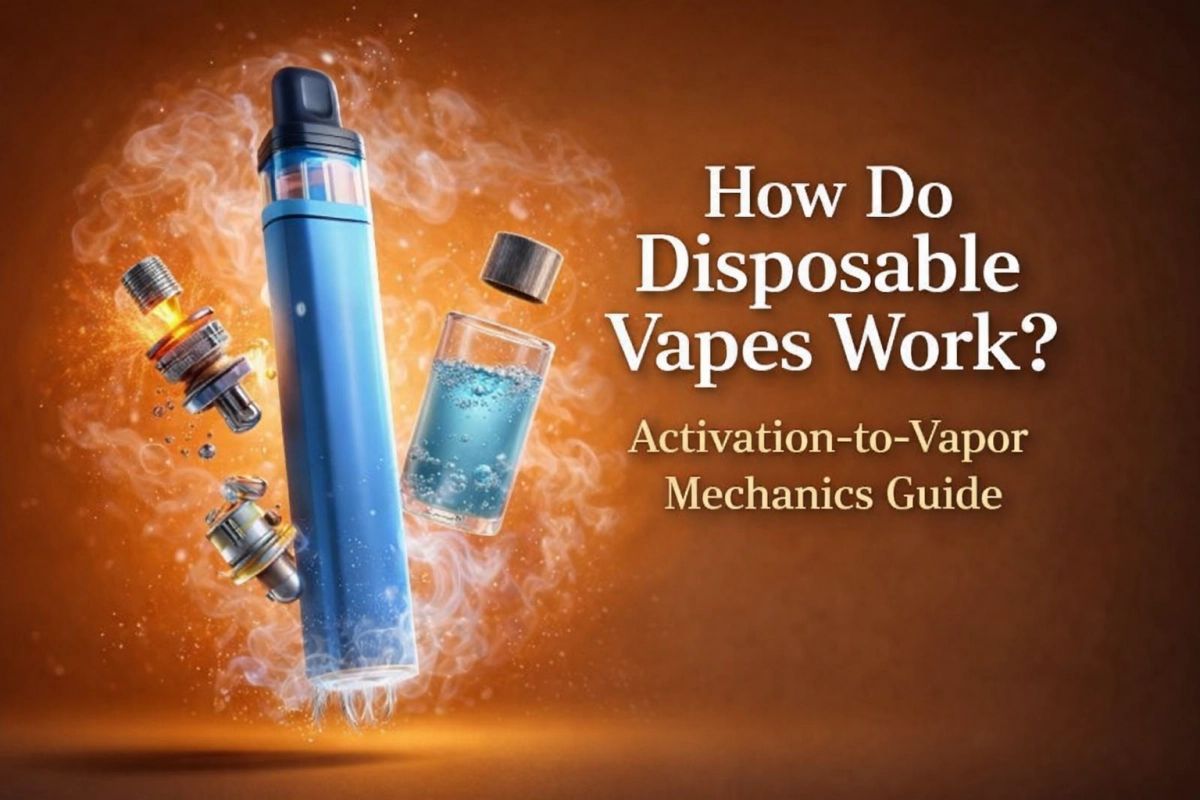
Scope: This page explains empty only mechanics. It avoids describing filled substances, dosing, or medical claims. Terms are written for clear, verifiable understanding (parts, airflow, activation, and measurable puff behavior).
Direct answer
If you’re asking how do disposable vapes work, the short version is: a draw creates airflow/negative pressure, a sensor detects it, a controller closes a circuit for a short window, the heater warms a saturated wick, and airflow carries aerosol up the chimney to the mouthpiece. Most performance differences (and “it stopped working” complaints) come from airflow restriction, contact stability, and puff timing—not mystery.
If you want the clean definition hub for the broader context, start with what is a disposable vape. For a deeper components-first overview, this internal explainer is useful: how do vapes work.
What this guide helps you do
- Visualize the “chain”: trigger → control → heating → airflow → output.
- Use consistent terms: mouthpiece, chimney, intake, wick, heater, sensor, controller.
- Diagnose calmly: tie symptoms (tight draw, weak output, intermittent hits) to specific points in the chain.
From activation to vapor: the full chain
Think of a disposable as four cooperating subsystems: activation sensing (detects a draw), control (decides “on/off” for a short window), heating + feed (wick + heater), and airflow (intake to mouthpiece). If any one subsystem is constrained, the unit can feel “finished” early even when other parts are still functional.
|
Step |
What happens |
What you can observe |
|---|---|---|
|
1) Draw starts |
Air moves through the intake path; pressure changes in the airflow channel |
Draw resistance (tight vs airy) is felt immediately |
|
2) Sensor triggers |
Airflow/pressure sensor detects the draw and signals the controller |
Some units blink a light; many are silent |
|
3) Controller closes the circuit |
Power is applied to the heater for a limited time window |
Output begins after a short ramp; some have a brief delay |
|
4) Wick supplies the heater |
Capillary action keeps the heater zone wet enough to remain consistent |
Consistency depends on puff timing (rest vs chain draws) |
|
5) Aerosol rides the airflow |
Air carries aerosol through the chimney to the mouthpiece |
Warmth, density, and smoothness vary with airflow design |
Note: The word “vapor” is used here in the everyday sense. In technical references, output is often discussed as aerosol.
What’s inside: the core parts (simple map)
While layouts vary, most disposables share a recognizable parts map. You don’t need engineering drawings to understand the mechanics—just a consistent vocabulary.
|
Part |
Role in the chain |
Typical symptom when constrained |
|---|---|---|
|
Mouthpiece |
Exit point; guides airflow from chimney to user |
Spitback/gurgle feeling when condensation accumulates |
|
Chimney |
Internal channel that carries aerosol upward |
Condensation buildup can add restriction over time |
|
Intake openings |
Air enters; sets baseline draw resistance |
Tight draw if blocked by lint/debris |
|
Sensor |
Detects airflow/pressure change to trigger activation |
No response or intermittent response on draws |
|
Controller |
Applies power to heater; includes cutoffs/limits |
Short “on” window, blinking indicators, inconsistent firing |
|
Heater |
Warms the saturated wick to generate aerosol |
Weak output if under-supplied or if contacts are unstable |
|
Wick + reservoir |
Feeds the heater; replenishes between puffs |
Harsh/dry sensation if feed lags under rapid puffs |
|
Power source |
Supplies energy for the heating window |
Output fades when voltage sags under load (often near end-of-life) |
When you read standards and public research, you’ll see these same ideas: activation sensing, heating, and standardized puff behavior. The references section links the most widely cited sources for definitions and regimes.
Activation: how draw-trigger works
What “draw-activated” means mechanically
A draw-activated disposable senses a change in airflow or pressure when you inhale. That signal tells the controller to start a short heating window. This is why a blocked intake can look like “dead”: if airflow is too restricted, the sensor may not detect a clean trigger.
Button-activated units follow the same chain (just a different trigger)
The rest of the chain—controller window, heater, wick, airflow—works similarly. The difference is the trigger: a button replaces draw sensing. If you need a neutral step-by-step overview of that trigger style, use: button-activated use.
Control logic: what happens after the trigger
The controller’s job is “bounded power,” not “unlimited on”
In most disposables, the controller applies power for a limited window, often with a cutoff to prevent very long continuous heating. This can create user-visible patterns: a brief ramp-up, a stable window, then a cutoff if you hold a draw too long.
Why this matters for ToFu troubleshooting
- Intermittent output can be a trigger/sensor issue, a contact issue, or a cutoff behavior—mechanics help separate them.
- Short “on” time is often a controller limit, not instant depletion.
- Tight draw changes the sensor signal and can prevent consistent triggering.
Heating + feed: why consistency depends on timing
Wick saturation and capillary replenishment
The heater needs a consistently saturated wick. Between puffs, the wick replenishes from the reservoir by capillary action. If puffs are too long or too close together, replenishment can lag and output quality can drop even before true end-of-life.
“Chain puffs” tend to push the system toward feed limits
Rapid back-to-back puffs increase sustained heat and reduce rest time for replenishment. Mechanically, that’s why some users report: “It works when I pause, but gets harsh or weak when I keep going.” The system isn’t “mystical”—it’s responding to timing.
Airflow path: why “tight” vs “airy” feels different
Airflow is the transport layer
Airflow does two jobs: it delivers oxygen-rich air to the heating zone, and it carries aerosol up the chimney to the mouthpiece. The intake size, internal channel geometry, and condensation behavior all shape draw resistance and perceived output.
Restriction is the most common “false end-of-life” cause
A tight draw often leads to harder pulls and longer puffs, which can make output feel inconsistent and shorten perceived lifespan. Before assuming the unit is finished, it’s rational to rule out restriction and basic contact issues.
Why your puff pattern changes output
Three terms that explain most variability
- Puff duration: how long each draw lasts (seconds)
- Puff interval: rest time between draws (seconds)
- Puff volume/intensity: how much air moves per draw (how hard you pull)
Standards-based testing uses fixed puff parameters so results can be compared. Real use varies, which is why puff claims and real experience diverge. If you want to standardize how your team talks about inhale styles (MTL/RDL/DTL) without review language, this internal guide is helpful: how to inhale a vape.
Common “not working” symptoms explained by mechanics
Symptom: nothing happens when you draw
Mechanically, this usually points to one of three areas: restriction preventing a clean trigger signal, sensor/trigger instability, or a controller condition that prevents the heating window. Start with quick checks: pen not hitting quick checks.
Symptom: weak or inconsistent output
This can be caused by a tight draw (restriction), feed lag under rapid puffs, or fading available power under load near end-of-life. Use a conservative, no-hacks approach and follow step-by-step checks here: won’t hit step-by-step fixes.
Symptom: tight draw that gets worse over time
Tight draw commonly comes from intake blockage, condensation, or debris near openings. Mechanically, tight draw also changes the trigger signal and encourages harder pulls—so solving restriction often restores consistency.
Safety note: This article avoids “mods” and “workarounds.” Do not puncture, pry, heat, or alter a disposable. If you notice abnormal heat, odor, or leakage into openings, stop using it.
A neutral checklist for describing a disposable
For ToFu readers, the goal is clarity. This checklist helps you describe a disposable without hype and without guessing.
|
Field |
Why it matters |
How to describe it neutrally |
|---|---|---|
|
Trigger type |
Explains activation behavior |
Draw-activated or button-activated |
|
Airflow feel |
Predicts draw resistance and user behavior |
Tight / medium / airy (avoid “best” language) |
|
Heater + wick class |
Shapes consistency and feed limits |
Heater type (e.g., wire/mesh) and wick material family |
|
Condensation handling |
Relates to gurgle/tight draw over time |
Notes on chimney length and mouthpiece design |
|
Cutoff behavior |
Explains “stops mid-draw” reports |
Short window / long window / indicator patterns |
A clear mechanical description beats a long feature list: trigger, airflow, heater+wick, and puff timing explain most user outcomes.
Authoritative references used
Links are provided for verifiability (standards, regimes, and public health definitions). Anchor text avoids power-source terminology by design.
- ISO 20768 routine analytical vaping machine conditions
- ISO 20768 amendment (latest update)
- CORESTA Recommended Method No. 81 (routine aerosol generation and collection)
- CORESTA Guide No. 22 vaping regimes (Aug 2024)
- FDA overview of ENDS (definitions and components)
- CDC overview page on e-cigarettes
- WHO fact sheet on e-cigarettes (regulatory context)
- PubMed: puffing topography metrics commonly used in studies
- UK notice on single-use vape policy date (market rules vary)
Editorial note: This article is informational and written for empty only understanding. It does not provide legal advice. Regulations and definitions can vary by market; verify requirements where you operate.

3 Comments
Simple and clear. Enjoyed reading this.
Useful information. Appreciate it.
Well written and straight to the point.