
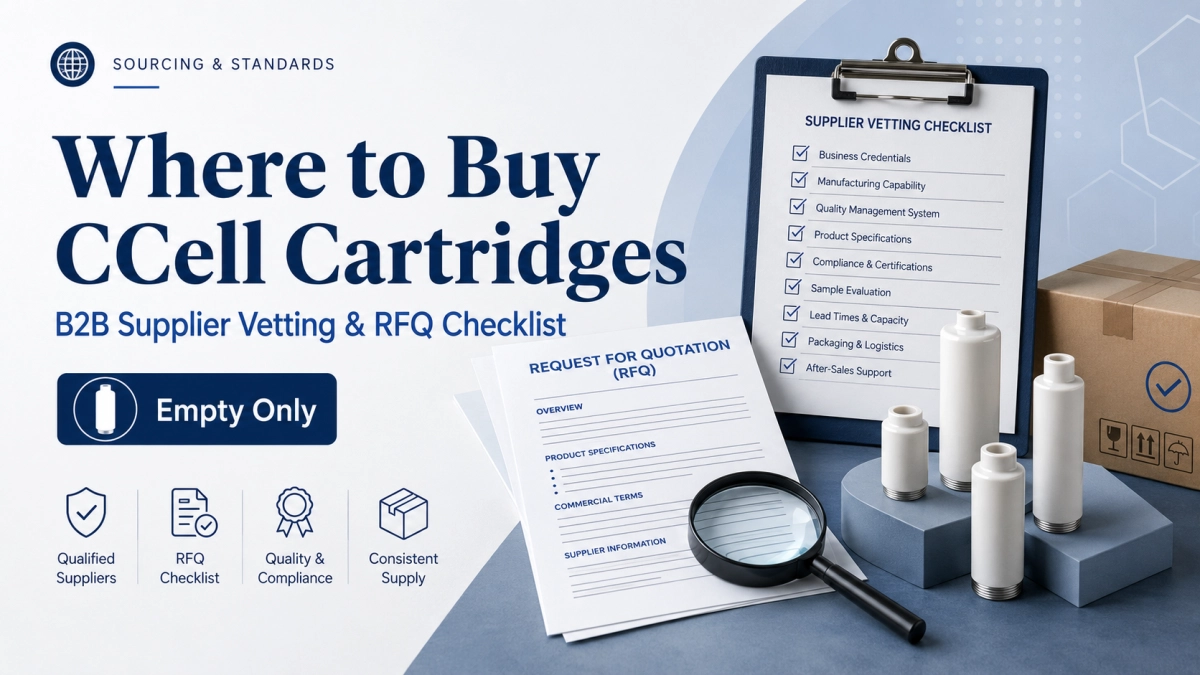
Scope: This guide is written for CCELL cartridge empty only sourcing. It covers supplier verification, authorized-route checks, cartridge-family comparison, 510 thread wording, capacity, dimensions, aperture size, mouthpiece route, material files, packaging proof, AQL planning, leak checks, receiving records, brand wording, and RFQ readiness. It does not cover filling steps, consumption guidance, potency claims, health claims, or end-user instructions. This page is not affiliated with CCELL or its trademark owner.
Why this guide matters
For B2B buyers, a CCELL cartridge order should not be approved from a product photo, short title, or unit quote alone. A strong empty only sourcing file should connect the supplier route, CCELL wording, cartridge family, 510 thread wording, capacity, dimensions, aperture size, resistance, mouthpiece route, material declaration, package proof, QC rule, carton basis, and receiving record.
The search question is simple, but the buying file is not. A buyer may ask where to buy CCELL cartridges, yet the safer answer is a supplier-vetting workflow: verify the route, request comparable documents, approve samples, define inspection rules, and keep a repeat-order control record before issuing a bulk PO.
The key idea
Treat supplier identity, cartridge family, capacity, 510 thread wording, aperture size, material declaration, package proof, AQL basis, leak-check method, and receiving records as separate fields. The RFQ, quote, approved sample, package proof, inspection report, and receiving checklist should describe the same empty only route.
Quick answer for buyers
Buyers researching where to buy ccell cartridges should start with a supplier shortlist that can document product identity, empty only scope, CCELL wording, 510 thread route, capacity, material declarations, package proof, AQL-based inspection, leak-check records, and change-control rules.
Verify the route
Ask whether the quote is for official CCELL product, stock route, authorized distribution, or a buyer-approved compatible route.
Compare the file
Request capacity, dimensions, aperture size, resistance, mouthpiece route, material notes, pack count, and carton basis.
Control QC
Use appearance checks, dimension checks, aperture checks, leak checks, AQL records, release photos, and receiving files.
Keep claims narrow
Write only claims that can be proved by sample approval, supplier documents, inspection records, and market review.
| Buyer stage | Main question | File to keep |
|---|---|---|
| TOFU education | What sourcing routes exist, and what documents separate a credible supplier from a weak listing? | Supplier checklist, official-reference links, brand-wording note, and empty only scope. |
| MOFU comparison | Which capacity, dimensions, aperture, material route, mouthpiece route, package route, and MOQ tier fit the plan? | Spec sheet, approved sample photos, material declaration, package proof, and quote table. |
| BOFU approval | Is the file complete enough for PO release, shipment review, and warehouse receiving? | RFQ answers, sample approval, AQL plan, carton file, delivery term, release photos, and change-control note. |
Where B2B buyers can source CCELL cartridges
A supplier shortlist should separate official brand channels, authorized distributors, verified wholesale suppliers, regional stock holders, and marketplace listings. Each route can be useful, but each route needs a different evidence file. The buyer should avoid approving any supplier that cannot explain product identity, empty only scope, package route, inspection rule, and claim process in writing.
| Sourcing route | Best use | What to verify | Risk signal |
|---|---|---|---|
| Official CCELL source | First-party product-family research, route definitions, and official wording. | Product family, tank volume, dimensions, resistance, aperture size, mouthpiece route, and material wording. | The page is useful for definition, but buyers still need commercial terms, shipment records, and market review. |
| Authorized distributor | Authenticity-sensitive orders and repeat sourcing with stronger traceability. | Distributor identity, authorization evidence, invoice chain, package route, and after-sale claim process. | Weak authorization proof, inconsistent naming, or refusal to provide traceability records. |
| Wholesale supplier | Price comparison, MOQ planning, regional stock planning, and package options. | Supplier history, SKU match, sample approval, QC plan, material files, carton basis, and change-control rule. | Only photos, no spec sheet, no sample record, no written inspection plan, or unclear brand wording. |
| Regional stock route | Faster replenishment, smaller lots, and reduced transfer complexity. | Stock age, carton count, package condition, lot identity, receiving photos, and claim window. | No stock photos, no carton photos, no inspection record, or mixed-route inventory. |
| Marketplace listing | Initial market scan and price visibility. | Seller identity, listing history, product identity, proof of source, documents, and sample route. | Generic title, copied photos, unusually low quote, and no documented inspection process. |
For category-level comparison, buyers can review vape cartridges wholesale before narrowing the RFQ to a CCELL-specific route.
Supplier verification checklist
Supplier vetting should happen before sample approval. A credible B2B supplier should be able to show business identity, product identity, empty only scope, route explanation, document list, package proof, inspection plan, claim process, and change-control rule. If a seller cannot provide those basics, the buyer should not rely on the quote alone.
| Verification area | Question to ask | Evidence to request |
|---|---|---|
| Business identity | Who is the seller, and who issues the invoice? | Company name, address, contact domain, invoice name, business license where relevant, and trade references. |
| Product identity | Which exact CCELL family or buyer-approved route is being quoted? | SKU, product family, capacity, dimensions, resistance, aperture size, mouthpiece route, and package route. |
| Authenticity route | Can the supplier explain the source route and product verification method? | Authorization record where relevant, invoice chain where available, package photos, engraving photos, and serial-number review where applicable. |
| Sample route | Will the sample match the bulk lot? | Sample photos, sample quantity, sample label, sample inspection checklist, and written match rule. |
| QC process | What is checked before release? | AQL basis, defect categories, sample size, leak-check method, release photos, hold rule, and rejection rule. |
| Claim process | What happens if receiving finds shortage, mixed items, leakage, breakage, or package damage? | Claim time window, photo requirements, replacement policy, credit rule, and responsible contact. |
Verification tip
Ask for proof by route, not proof by general brand name. A useful supplier file connects the quoted item, approved sample, package proof, inspection report, invoice, packing list, carton mark, and receiving photos.
Spec fields to compare before an RFQ
A CCELL cartridge RFQ should compare written fields, not broad phrases. A 0.5ml route, 1ml route, and 1.2ml route may share a 510 thread phrase but still differ in height, tank shape, aperture size, center post route, mouthpiece route, package route, and carton basis.
| Spec field | What to ask | Why it matters |
|---|---|---|
| Cartridge family | Which CCELL family, stock route, or buyer-approved SKU is being quoted? | Family wording connects the quote, sample, package proof, reorder file, and receiving checklist. |
| Capacity | Is the route 0.5ml, 0.8ml, 1ml, 1.2ml, or another buyer-approved capacity? | Capacity affects naming, packaging, carton count, sample review, and receiving checks. |
| Dimensions | Can the supplier provide length, diameter, and tolerance? | Dimensions help prevent mismatch between approved sample and bulk release. |
| Aperture size | How many apertures are present, and what size is specified? | Aperture details help compare routes without relying on broad claims. |
| Resistance | What resistance value and tolerance are written in the file? | Resistance should match the same route that is sampled and released. |
| Mouthpiece route | Is the mouthpiece screw-on, press-in, snap-fit, flat, round, ceramic, plastic, or metal? | Mouthpiece route affects sample approval, package proof, receiving photos, and change control. |
| Package route | Is it plain pack, supplier stock pack, or buyer-approved pack? | Package wording affects proof approval, label review, carton count, and claim records. |
For a broader empty route comparison, buyers can review empty vape cartridges and then build a CCELL-specific shortlist.
For capacity planning, 1ml vape cartridges can be used as a category reference when the RFQ requires a 1ml comparison field.
Materials and restricted-substance review
Material review matters because glass, ceramic, stainless steel, brass, thermoplastic, seals, ink, labels, trays, inner boxes, and cartons can affect documentation, market review, receiving checks, and repeat-order control. Buyers should collect supplier declarations where relevant and confirm whether the destination market requires restricted-substance review.
| Material field | What to ask | Document to keep |
|---|---|---|
| Glass body | Is the body borosilicate glass, another glass route, or mixed material? | Material declaration, sample approval photos, and supplier route note. |
| Ceramic part | Which ceramic part is included, and how is it described? | Spec sheet, close-up photos, supplier note, and change-control rule. |
| Metal parts | Which center post, base, and contact materials are declared? | Supplier declaration and restricted-substance checklist. |
| Plastic parts | Which plastic or thermoplastic parts are present in the mouthpiece or body route? | Material note, package proof, and sample photos. |
| Seals | Which seal material and placement route are used? | Seal note, leak-check rule, and failed-sample photo record. |
| Packaging inputs | Which tray, label, ink, inner box, and master carton route will be used? | Packaging proof, carton basis, and revision-control record. |
For internal technical context, buyers can use ceramic core QC as a supporting guide for ceramic parts, airflow paths, seals, materials, and inspection signals.
Empty only QC and AQL planning
Empty only QC should be defined before the order is released. A buyer should set lot size, sample size, defect categories, identity checks, appearance checks, fit checks, dimension checks, aperture checks, leak checks, packaging checks, carton checks, hold rules, release rules, and claim timing in writing.
| QC layer | What to check | Record to keep |
|---|---|---|
| Identity | Correct CCELL phrase, cartridge family, capacity, package route, and carton mark. | Spec sheet, package proof, carton photos, and release note. |
| Thread check | Thread finish, burrs, deformation, bottom contact, and visible damage. | Close-up photos, defect samples, and receiving checklist. |
| Dimension check | Length, diameter, mouthpiece route, and capacity-specific height. | Measurement record and approved sample comparison. |
| Aperture check | Aperture count, aperture size, visible blockage, and route consistency. | Spec sheet, close-up photos, and inspection checklist. |
| Leak check | Seal seating, mouthpiece closure, tank joint, and package condition after a defined check. | Leak-check record, hold rule, and failed-sample photos. |
| Pack count | Pieces per tray, trays per inner box, inner boxes per master carton, and total carton count. | Packing list, carton basis, and warehouse receiving count. |
AQL wording tip
Write “AQL-based inspection by attributes” only when the inspection plan includes lot size, sample size, defect categories, acceptance rule, and rejection rule. Otherwise, write “buyer-defined sample inspection” and keep the rule simple.
Packaging proof and carton records
Packaging proof should be approved before production packing starts. A CCELL cartridge file should keep artwork proof, label wording, pack count, tray layout, inner-box count, master-carton count, carton dimensions, gross weight, carton mark, and claim-photo rule in one folder.
| Packaging field | Buyer question | Approval file |
|---|---|---|
| Pack route | Is it plain pack, supplier stock pack, or buyer-approved pack? | Packaging proof, revision date, and approval record. |
| Label wording | Does CCELL wording, 510 thread wording, capacity, empty only scope, and market wording match the approved file? | Artwork proof, sample photo, and carton mark. |
| Pack count | How many pieces per tray, inner box, and master carton? | Pack-count table and packing list draft. |
| Carton basis | What are carton dimensions, gross weight, carton mark, and total carton count? | Carton photos, packing list, and warehouse receiving sheet. |
| Claim photos | What photos are required for shortage, mixed item, breakage, leakage, or package damage? | Claim instruction sheet and time window. |
Brand wording and claim control
CCELL is a brand term, so buyers should write carefully. This article is an educational supplier vetting guide and is not an affiliation, authorization, or partnership claim. Buyers should also avoid unsupported universal compatibility claims, health claims, potency claims, and guaranteed outcome claims.
| Review area | Buyer question | Why it matters |
|---|---|---|
| Brand naming | Is CCELL used only to describe the target sourcing category or product family? | Brand wording should be accurate and should not imply a relationship without proof. |
| Trademark review | Has the buyer reviewed brand wording, packaging, listing copy, and market route? | Trademark confusion risk can affect listings, packaging, and buyer claims. |
| Compatibility wording | Can the buyer prove the exact fit claim for the exact item? | Unsupported fit claims can create returns, disputes, and listing edits. |
| Quality wording | Are quality statements tied to files, photos, inspection, or supplier records? | Evidence-based language is safer than broad claims. |
| Market wording | Does the buyer need destination-market review before publishing, importing, or distributing? | Rules can vary by market, role, package, label, import route, and claim language. |
Supplier scorecard
Use a scorecard to compare suppliers without focusing only on price. Each score should be supported by written evidence.
| Score area | Suggested weight | Evidence to review |
|---|---|---|
| Supplier identity | 15 | Business record, contact domain, invoice name, trade references, and source-route explanation. |
| Route clarity | 15 | Empty only wording across RFQ, quote, sample approval, invoice, packing list, and carton mark. |
| Spec completeness | 20 | Cartridge family, capacity, dimensions, resistance, aperture size, mouthpiece route, and material note. |
| Authenticity review | 10 | Engraving photos, serial-number review where applicable, package proof, and authorization evidence where relevant. |
| QC readiness | 15 | AQL basis, defect categories, checked quantity, leak-check rule, release photos, hold rule, and claim rule. |
| Packaging control | 10 | Artwork proof, label wording, pack count, carton basis, revision control, and carton mark. |
| Brand and claim control | 10 | Trademark-safe wording, non-affiliation note, compatibility evidence, and claim review. |
| Repeat-order control | 5 | Written notice before route, package, carton, material, or process changes. |
RFQ checklist template
Use this RFQ checklist to collect comparable answers before approving samples, pilot orders, or bulk purchase orders.
Subject: RFQ for CCELL Cartridges Empty Only - Supplier Vetting, Specs, QC, and Delivery Review
Scope: Empty only
Destination market: [insert country, state, province, or licensed-market route]
Buyer role: [wholesaler / distributor / licensed operator / brand owner / importer]
Requested route: [official CCELL route / authorized distributor route / stock route / buyer-approved compatible route]
Supplier identity: [company name / invoice name / address / contact domain / trade references]
Authorization evidence: [required / not required / supplier to explain source route]
Cartridge family: [supplier route name / CCELL family name / buyer-approved SKU]
510 thread wording: [standard 510 thread / buyer-approved wording]
Capacity wording: [0.5ml / 0.8ml / 1ml / 1.2ml / buyer-approved wording]
Dimensions: [length / diameter / tolerance]
Resistance: [ohm value and tolerance]
Aperture size: [aperture count and size]
Center post route: [ceramic / stainless steel / brass / buyer-approved wording]
Mouthpiece route: [flat / round / ceramic / plastic / metal / snap-fit / screw-on / press-in]
Material declaration: [glass / ceramic / metal / plastic / seals / label / carton files where relevant]
Package route: [plain package / supplier stock package / buyer-approved package]
Quantity target: [sample / pilot / bulk / stock / reorder]
MOQ request: [sample MOQ / pilot MOQ / bulk MOQ / package MOQ / stock MOQ / reorder MOQ]
Price basis: [piece / tray / inner box / master carton / total lot]
Sample review: [sample quantity / sample photos / appearance check / fit check / dimension check / aperture check / leak check / package check]
Carton record: [pieces per pack / packs per carton / carton dimensions / gross weight / carton mark]
QC request: [AQL basis / appearance / identity check / thread check / dimension check / aperture check / leak check / pack count / carton count / photo record / release rule]
Document request: [quote sheet / spec sheet / material declaration / package proof / inspection report / packing list / lab file where relevant]
Delivery term: [EXW / FOB / FCA / DAP / DDP / buyer-specified term with named place]
Brand wording: [supplier to confirm authorization status and buyer-safe wording]
Target receiving window: [insert date range]
Claim process: [shortage, mixed item, appearance defect, leak issue, packaging issue, carton issue, or late-release process]
Official references
These references support a neutral buyer file. They do not replace legal, import, tax, trademark, packaging, restricted-substance, or licensed-market review.
| Reference area | Use in the buyer file | Source |
|---|---|---|
| CCELL product category | Supports first-party review of cartridge category wording and product-family context. | official CCELL cartridge category |
| TH2-SE spec example | Supports comparison of standard 510 thread, tank volume, dimensions, resistance, aperture size, mouthpiece route, and material wording. | CCELL TH2-SE specifications |
| Authenticity review | Supports checks for engraving, serial-number review, and counterfeit-risk screening. | CCELL authenticity checks |
| AQL sampling | Supports lot-by-lot inspection by attributes and AQL planning. | ISO 2859-1 AQL sampling |
| Package leak context | Supports packaging gross-leak discussions and seal-integrity thinking for sample plans. | ASTM F2096 gross leak test |
| EU restricted substances | Supports restricted-substance review for EU routes where relevant. | EU RoHS restricted substances |
| EU chemical registration | Supports supplier-document review for EU routes where REACH may be relevant. | EU REACH regulation |
| Glass material review | Supports buyer questions about borosilicate glass 3.3 where the supplier claims that material route. | ISO 3585 borosilicate glass 3.3 |
| Stainless material review | Supports buyer questions about stainless steel material requirements where relevant. | ASTM A240/A240M stainless steel |
| Quality management | Supports supplier process review, document control, and corrective-action discussion. | ISO 9001 quality management |
| Lab competence | Supports review of laboratory competence and test-report context. | ISO/IEC 17025 laboratories |
| Trademark review | Supports naming, package wording, and confusion-risk review. | trademark clearance check |
FAQ
Where should B2B buyers start when looking for CCELL cartridges?
Start with a supplier shortlist that can document route identity, empty only scope, cartridge family, 510 thread wording, sample approval, material declaration, package proof, inspection plan, carton basis, and claim process.
What makes a CCELL cartridge supplier credible?
A credible supplier can explain the source route, provide comparable specs, support sample approval, define inspection rules, show package proof, keep carton records, and accept a written change-control rule.
Is a low quote enough to approve a supplier?
No. A low quote should be checked against product identity, sample match, package route, AQL basis, leak-check method, material files, delivery term, and after-sale claim rules.
Which specs should appear in the RFQ?
The RFQ should include cartridge family, 510 thread wording, capacity, dimensions, resistance, aperture size, mouthpiece route, center post route, material declaration, package route, carton basis, QC rule, delivery term, and change-control rule.
How should buyers check authenticity risk?
Buyers should request source-route evidence, package photos, engraving photos, serial-number review where applicable, invoice chain where available, and a clear supplier statement about authorization status.
What does empty only mean in this guide?
Empty only means the sourcing file is limited to the empty cartridge format, packaging, QC, carton records, and business documentation. This guide does not cover filling steps, consumption guidance, potency claims, health claims, or end-user instructions.
How many internal links should this article use?
This source uses five internal links: one exact-match pillar anchor to the CCELL cartridge category, plus four short supporting anchors for category and technical context.
Is this legal advice?
No. This is an educational B2B supplier vetting guide. Buyers should use qualified legal, import, tax, trademark, packaging, restricted-substance, and licensed-market support before final approval.
0 Comments