
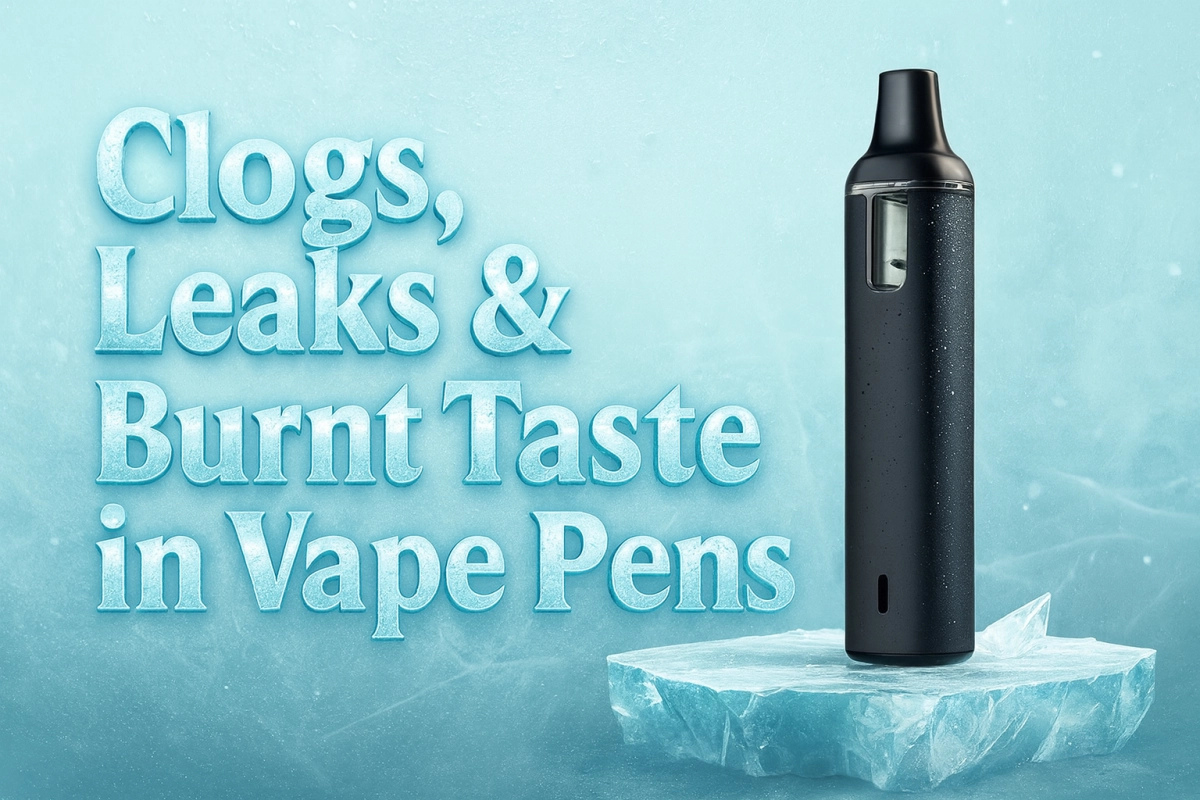
Clogs, Leaks & Burnt Taste in Vape Pens: A 2025 Root-Cause Troubleshooting Map
This revision adds a simple decision diagram, a short methods note, and links to primary standards and safety guidance to strengthen E-E-A-T.
Quick decision diagram
This diagram shows how each symptom typically maps to one of three root domains and the first corrective action to try.
Symptoms at a glance
| Symptom | Likely drivers | Quick check |
|---|---|---|
| Clog | Cold/thick extract; condensed vapor in chimney; narrow intake; long idle time | Warm to room temp; gentle preheat; check airflow holes are not blocked by pocket lint |
| Leak | Heat/altitude changes; over-thin liquid; damaged O-rings; overfilling (refillables) | Inspect mouthpiece seam; wipe and store upright; avoid hot car or strong sun |
| Burnt taste | Voltage too high; chain puffs; nearly empty reservoir; aged coil/wick | Lower voltage/shorter puffs; rest 20–30 s between pulls; replace cartridge if scorched |
| Weak vapor | Low battery; clogged intake; very viscous or very thin liquid; low voltage | Fully charge; clean contacts; verify airflow; try a modest preheat then test |
Root-cause decision map
Liquid & Temperature
- If device sat unused >48 h, assume airway condensation → warm to room temp → 2–4 s gentle preheat.
- If room < 18 °C/64 °F, viscosity rises → allow 10–15 min acclimation.
- Thin liquids can flood → if persistent gurgle, stop preheat and store upright.
Hardware & Airflow
- Check intake holes are open (no sleeve blockage); clear mouthpiece.
- Intermittent draw → inspect O-rings for nicks or flattening (replaceable types).
- Disposable with strong resistance → light reverse puff through USB cap removed? No (never blow into charging port).
Power & Pacing
- Reduce voltage/power if taste browns; many carts run well near
~6–8 Wwith 3–5 s puffs. - Rest 20–30 s between puffs to avoid heat soak.
- Reboot contact: clean battery pins with dry swab; avoid liquids on contacts.
Fix-now steps (by symptom)
Clog (no airflow or tight draw)
- Warm device in your hand 1–2 minutes; keep upright.
- Use staged preheat: 2 s → pause 5 s → 3 s; test draw gently.
- If still blocked, remove mouthpiece (if designed for service) and clean chimney with a dry lint-free swab.
Leak (gurgle or visible liquid)
- Wipe mouthpiece and base; store upright 30–60 min to re-balance.
- Avoid shaking; heat thins liquid and can worsen leaks.
- For refillables: do not exceed fill line; replace damaged O-rings.
Burnt taste (harsh/charred)
- Lower voltage one step; shorten puff to 2–3 s.
- Wait 20–30 s between puffs; if taste persists, the core is likely scorched—replace cartridge/coil.
- Do not keep heating a dry or nearly empty reservoir.
Weak vapor
- Fully charge using a reputable charger/cable; avoid high-power fast-chargers if device is not PD-capable.
- Clean contacts; verify intake holes; try a brief preheat (2–3 s) then normal draw.
- If still weak and battery is full, cartridge may be at end of life—replace.
Prevention specs (for buyers & brands)
Ranges are practical guidelines for common ceramic/cotton carts and all-in-ones. Validate with your own oil and hardware.
| Category | Suggested range / practice | Why it helps |
|---|---|---|
| Coil resistance | 1.2–1.6 Ω for thicker oils; 0.9–1.2 Ω for thinner | Keeps power density moderate; reduces burn risk on viscous oils |
| Preheat | 1–2 W staged; total 2–6 s | Clears condensation without flooding or scorching |
| Air intake | ≥ Φ1.2 mm ×2 ports (typical) | Balances draw and reduces clog sensitivity |
| Seals | Food-contact silicone or FKM; Shore A 50–60 | Better resilience across temps and solvents |
| Storage temperature | 18–24 °C (64–75 °F), away from direct sun | Limits viscosity swings and pressure-driven leaks |
| Charging | Use supplied cable; if USB-C PD not supported, avoid high-wattage PD bricks | Prevents overheating and premature aging |
| Outbound QA | 24 h low-temp stress hold; upright ship with foam support | Early detection of slow leaks/clogs in transit |
Shipping & storage
- Keep cartons upright; cushion mouthpieces with foam to avoid vibration wear.
- Avoid heat exposure (> 35 °C / 95 °F) and rapid temperature swings.
- Do not leave devices in vehicles or on hot windowsills.
When to replace vs. troubleshoot further
- Replace immediately if burnt/charred taste persists after lowering power.
- Replace if device shows swelling, cracking, or severe overheating.
- For persistent leaks after seal inspection, retire the unit and review lot QA.
FAQ
How long should preheat be?
Use short, staged pulses (2–3 s) rather than a long continuous heat. Test draw between pulses; stop if you hear gurgling.
Why is there little vapor even at high voltage?
More power is not always more vapor; too much heat can choke the wick and taste burnt. Start conservative and increase gradually.
Is it safe to blow into the mouthpiece to clear clogs?
Light reverse pressure on the mouthpiece (not the charging port) can help, but avoid forceful blows which may push liquid into the airway.
Methods & scope notes
This guide synthesizes field observations from support workflows with consensus safety concepts from recognized bodies. For battery transport and cell safety, see UN 38.3 and IEC 62133-2; for device electrical safety and charging, see UL 8139 and USB-IF USB-PD. Ranges listed are practical settings to reduce risk of dry-hits, flooding, or overheating and must be validated on your specific oil, coil, and airflow geometry.
Primary references
- PHMSA — Lithium Battery Test Summaries (UN 38.3), Revised July 2024 (landing + template PDF): link
- IEC Webstore — IEC 62133-2:2017 + Amd.1:2021 (secondary Li-ion cells/batteries): link
- UL Solutions — E-cig/Vape electrical certification (UL 8139 overview): link
- USB-IF — USB Power Delivery overview & spec package (charger interoperability): overview · specs
- EU — Directive (EU) 2022/2380 (USB-C common charger), legal text/PDF: EUR-Lex
These sources inform the safety context (battery transport, cell safety, device charging). Troubleshooting ranges and actions reflect practical engineering practice and should be validated on your product.
Important (21+): This page provides general hardware care and troubleshooting tips. Local regulations and product designs vary. Do not modify or open sealed, single-use devices. Stop use if overheating, swelling, or damage occurs.


2 Comments
great!
good