
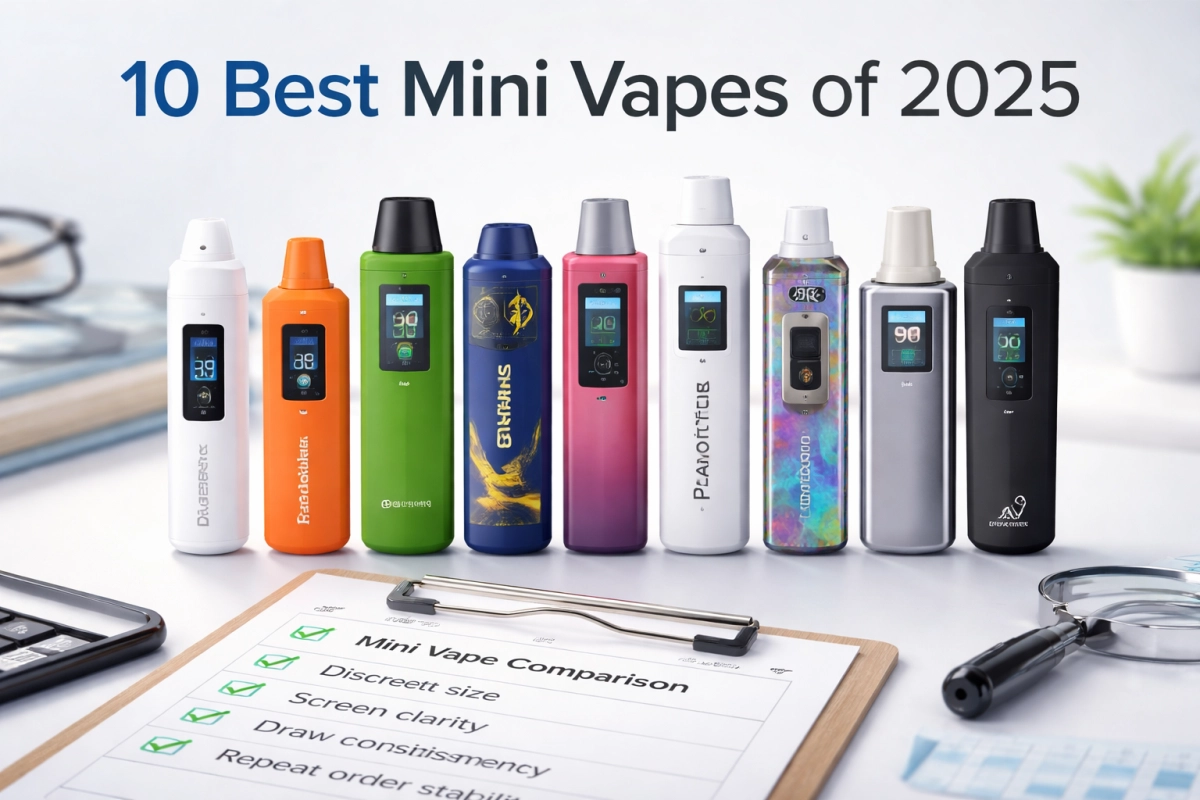
This ranking is built for buyers who want a clear, spec-first way to compare mini vapes—especially compact devices with screens, consistent draw behavior, and predictable manufacturing controls. It’s informational by design: no hype, no “puff-count chasing,” just what matters when you’re choosing a mini vape platform for a program.
TL;DR what “best” means here
Best mini vapes in 2025 aren’t the ones with the biggest marketing claims. They’re the ones that stay consistent across lots: stable airflow, readable status displays, practical ergonomics, and documentation that matches reality.
How to use this list
Use the scoring rubric below to shortlist 2–3 platforms, then validate with samples, incoming inspection, and repeat-order change control.
What counts as a mini vape in 2025
“Mini vape” used to mean “tiny and simple.” In 2025, it usually means compact + feature-dense: a shorter, pocket-friendly body with modern controls (often a status display), designed for discreet daily carry. For a deeper baseline definition (and terminology you can reuse across your site), see our mini vape guide.
Practical definition we use in this ranking
- Form factor: compact footprint that prioritizes portability and discreet handling.
- UX clarity: status information is easy to read at a glance (screen or simplified indicators).
- Repeatability: the platform can be validated with incoming inspection + change control for repeat orders.
Ranking rubric and why we don’t rank by “puffs”
“Puff count” is easy to advertise but hard to compare honestly. Delivery and aerosol output vary with device settings and puff profiles. That’s why modern analytical work uses defined machine conditions and regimes (for example ISO’s routine analytical vaping machine definitions and CORESTA guidance for selecting regimes and collecting aerosol).
Standards-based context (optional but authoritative):
Our scoring weights (built for BoFu decisions)
| Criterion | Weight | What “good” looks like in real buying |
|---|---|---|
| Discreet form factor + ergonomics | 25% | Comfortable grip, pocket-friendly shape, and a mouthpiece that supports stable draw behavior without forcing users to compensate. |
| Status visibility (screen UX) | 20% | Readable information at a glance (brightness, icons, and layout). “Looks cool” matters less than “reduces confusion.” |
| Draw consistency + airflow control | 20% | Low-lot variation, stable airflow path, fewer “tight/loose” surprises between batches. |
| Platform repeatability | 20% | Clear specs, tolerances you can verify, and change control that avoids silent component swaps. |
| Packaging + handling resilience | 15% | Less cosmetic damage in transit and fewer out-of-box defects. (A practical lens: distribution simulation testing and better pack-out discipline.) |
2025 compact tech features that actually matter
1) Screens that reduce buyer friction
The fastest-growing “must-have” in mini vapes is a clear status display. Not because it’s flashy—because it reduces uncertainty (and customer support tickets). If you want a broader browse page for screen-based minis, use mini vapes with screen as your internal hub.
2) Dual-chamber switching that stays simple
Dual-chamber designs can be great, but only if switching is intuitive and the airflow doesn’t become inconsistent. In BoFu terms: if it increases returns or “how do I use this?” messages, it’s not a win.
3) Repeatability beats novelty
A mini vape platform only wins long-term when it can be validated and repeated. For documentation credibility, prefer test work from competent labs aligned with internationally recognized principles (for example ISO/IEC 17025), and verify accreditation paths via ILAC signatory search.
Top 10 mini vapes of 2025 picks and trade-offs
Note: To keep internal linking focused (and under 5 total), we only link a few reference examples. The rest are listed by model name for comparison.
| Pick | Best for | Why it ranks | Watch-outs |
|---|---|---|---|
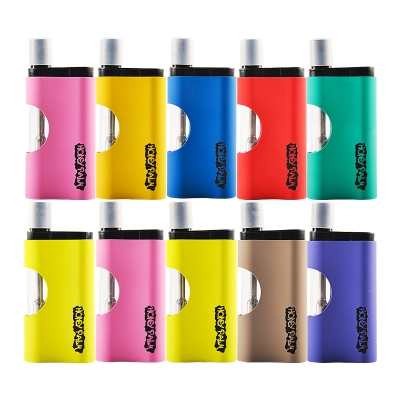
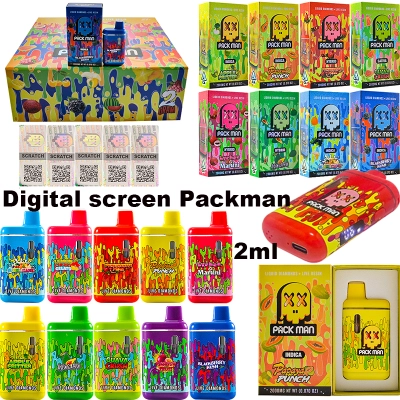
| Packman Mini 1G (screen) | Ultra-discreet carry | Compact body + clear at-a-glance status | Smaller format can be less forgiving of airflow variance |
| Packman Mini 1.5G (screen) | Balanced “small but steady” | More headroom than 1G while staying compact | Confirm screen readability under retail lighting |
| Packman Mini 2G (screen) | Max capacity in a mini family | Familiar mini ergonomics with higher capacity | Validate heat/flow stability across longer sessions |
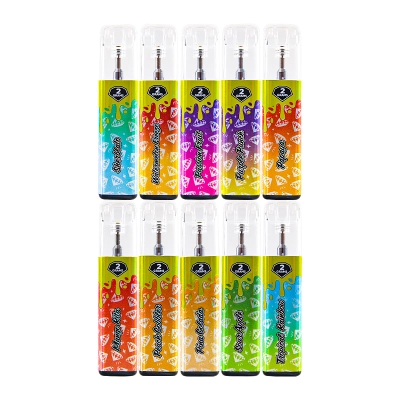
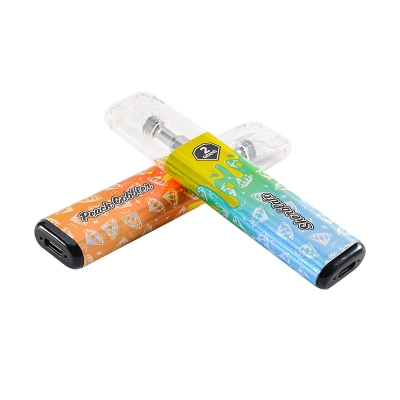
| Favorites 2G Minis (Liquid Diamonds) | Premium-positioned mini lines | Compact design cues with “premium” shelf feel | Standardize incoming inspection to reduce lot variation |
| Packwoods x Runtz V2 2G (screen) | Readable screen UX | Strong “display-first” experience | Check cosmetic consistency on faceplate/display window |
| Gas House x Packwoods V2 2G (preheat + screen) | Cold-start friendliness | Preheat workflow + modern display | Require consistent switch behavior in QC sampling |
| Cookies x The Freak Brothers V2 (dual flavor + display) | Variety without carrying two devices | Dual-chamber concept with display feedback | More parts = more places for tolerance drift |
| Pacman Gen3 2Gram (LED display) | “Feature-rich compact” | Modern display + updated platform feel | Verify draw activation consistency across cartons |
| Jeeter Juice V2 2G (digital screen) | Clean, mainstream compact builds | V2-style screen platform with familiar UX | Control supplier substitutions (coil, seals, airflow inserts) |
| Packman V6/V7 family (screen + switch variants) | Switch-based interaction | Screen + switch patterns can reduce confusion | Switch adds a failure mode—sample accordingly |
Packman Mini 1G Disposable Vape With Screen
The most “mini” pick in the list. It earns the top slot when discreet carry and simple screen feedback matter more than anything else.
Packman Mini 1.5G Disposable Vape With Screen
A practical middle ground: still compact, with extra headroom versus 1G-class minis—often an easier choice for repeat orders.
Packman Mini 2G With Screen
When customers ask for “mini” but still want a bigger capacity, the Mini 2G class is often the clean compromise—especially if your audience is already familiar with screen minis.
Favorites 2G Minis Liquid Diamonds Disposables
A strong candidate when your “mini vape” story includes premium shelf feel. It’s less about extremes and more about a polished, compact product experience.
Packwoods x Runtz V2 2G Disposable Vape Pen With Screen
A display-forward compact platform. In practice, this style ranks well when screen readability drives perceived quality and lowers “is it working?” customer questions.
Gas House x Packwoods V2 2G Preheat Platform
Preheat can be a meaningful differentiator—when it’s consistent. This pick is for buyers who want a compact device that behaves predictably in colder or variable conditions.
Cookies x The Freak Brothers V2 Dual Flavor With Display
Dual-chamber compact devices can win when done simply. The trade-off is complexity: more parts, more tolerance surfaces, and more reasons to enforce incoming inspection.
Pacman Gen3 2Gram Disposable Vape Pen With LED Display
A feature-rich compact option that’s easy to position as “modern.” In BoFu terms, it’s a good pick when your buyer wants visible feedback and a clearly updated platform.
Jeeter Juice V2 2G Disposable Vape Pen With Digital Screen
The V2-style screen platform is often a safe BoFu decision: familiar interaction, straightforward presentation, and a compact build that fits “mini vape” buyer expectations in 2025.
Packman V6/V7 Screen + Switch Variants
These variants make the list because the switch + display pattern can reduce user confusion—if it’s executed consistently. Treat the switch as an added reliability surface and sample accordingly.
Buyer checklist for BoFu decisions
Ask for specs you can verify (not marketing claims)
| What to request | Why it matters for mini vapes |
|---|---|
| Airflow path + tolerance notes | Mini platforms are sensitive to small dimensional changes. Tolerance drift shows up as “too tight / too loose.” |
| Screen module details | Brightness, icons, window finish, and assembly quality determine whether the screen reduces confusion or creates returns. |
| Incoming inspection plan (AQL) | Ranking is meaningless without verification. Use sampling to catch unit-to-unit variance before it hits your customers. |
| Change control rules | Repeat orders fail when suppliers silently swap components. Require “notify-before-change” expectations. |
| Transit resilience expectations | Compact devices often ship in dense cartons—pack-out matters. Distribution simulation guidance can be helpful for reducing damage. |
Helpful operational references: ISTA 3-series test procedures for distribution simulation context, and the EU RoHS + EU WEEE overviews if you sell into EU markets.
FAQ
What makes mini vapes “discreet” in real use?
Discreetness comes from form factor (shorter body, pocket-friendly edges), simple interaction (less fiddling), and predictable draw behavior. A readable status display can help because users don’t need to troubleshoot in public.
Should I only consider mini vapes with screens?
Not always. Screens add clarity, but they also add complexity. If your customer base values simplicity above all else, a non-screen mini platform can still win—as long as it’s consistent.
Why include standards links if this is a ranking blog?
Because BoFu decisions improve when your team can separate repeatable, verifiable criteria from marketing claims. Standards and technical guides help you explain “why we evaluate this way” to stakeholders.
How do I reduce risk when switching to a new mini vape platform?
Shortlist two or three platforms, sample across cartons (not a single unit), document your incoming checks, and lock change control expectations before the first repeat order.
Authoritative references
- ISO 20768:2018 (routine analytical vaping machine conditions)
- ISO 20768:2018/Amd 1:2025 (correction related to puff profile requirements)
- CORESTA Guide No. 22 (Aug 2024)
- CORESTA Guide No. 25 (Jul 2024)
- CORESTA Guide No. 32 (Dec 2025) overview page
- ISO/IEC 17025 (lab competence overview)
- ILAC signatory search (accreditation directory)
- UK guidance: e-cigarettes regulations for consumer products (MHRA)
- European Commission: electronic cigarettes (TPD Article 20)
- European Commission: RoHS overview
- European Commission: WEEE overview
- ISTA test procedures (distribution simulation context)
Internal hub links are intentionally limited to 5 for clean topical clustering and stronger “mini vapes → mini vape” pillar support.
Author: Casey Rowlands · Category suggestion: Buying Guides / Product Comparison · Back to top




3 Comments
Clear and easy to follow.
Good read, thanks for sharing.
Nice post, very helpful.