
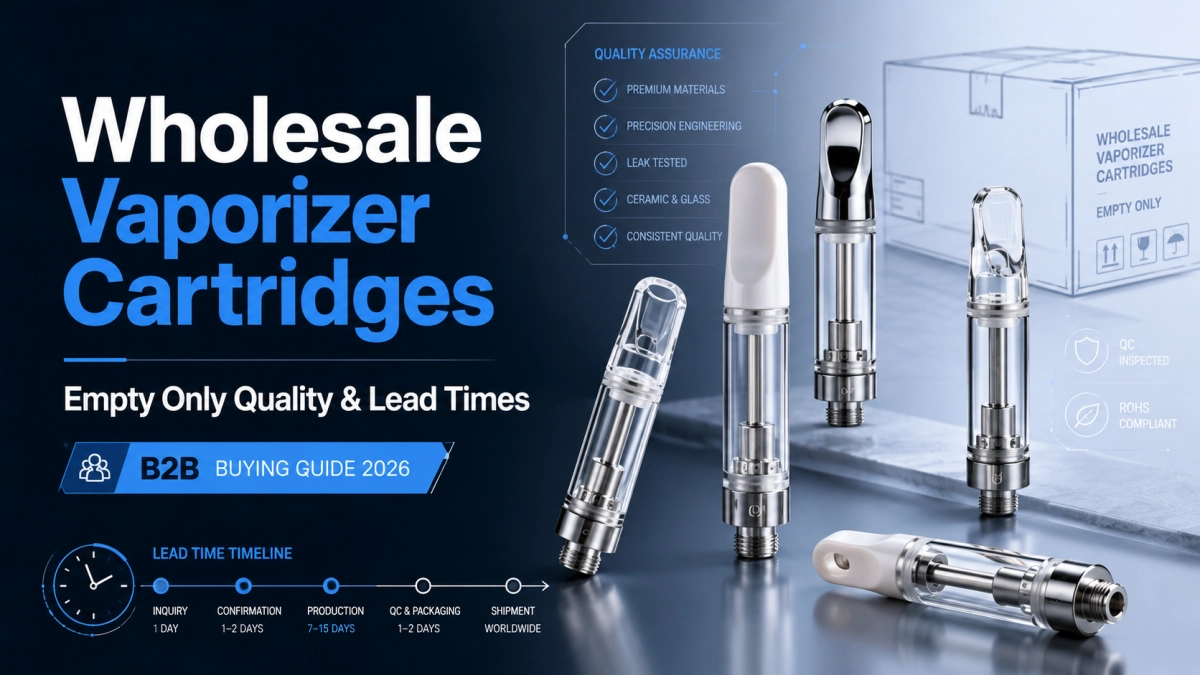
Scope: This guide is written for empty only sourcing of empty vaporizer cartridges. It focuses on quality records, material declarations, capacity wording, MOQ comparison, RFQ preparation, carton records, inspection planning, supplier files, and lead-time control. It does not cover filling steps, consumption guidance, health claims, potency claims, or end-user instructions.
Why this guide matters
Buyers searching for wholesale vaporizer cartridges are usually close to supplier comparison, sample review, or bulk order approval. At this stage, the strongest buying decision is not based on unit price alone. It should be supported by empty only wording, material records, capacity wording, MOQ tiers, inspection planning, packaging records, carton details, trade terms, and a realistic lead-time path.
This guide is built for procurement teams, brand operators, sourcing managers, and licensed-market buyers who need a neutral framework for comparing empty cartridge suppliers. The aim is to help a buyer ask clearer questions before approving samples, pilot orders, or repeat bulk orders.
The key idea
A reliable sourcing file should make every selected route reviewable by empty only scope, material declaration, capacity route, package count, carton record, QC result, supplier responsibility, trade term, and destination-market review.
Quick answer
The best way to compare wholesale vaporizer cartridge suppliers is to separate the buying file into six written layers: empty only scope, material records, capacity and MOQ, lead-time assumptions, packaging and carton records, and QC documentation. Each layer should have a supplier answer before price approval.
Best article fit
BOFU wholesale buying guide for buyers comparing empty cartridge suppliers.
Best first link route
Category page first, related cartridge category pages second, selected product page last.
Best sourcing angle
Quality records, MOQ, RFQ, QC, carton records, and lead-time control.
Best tone
Neutral, procurement-friendly, compliance-aware, and checklist-led.
Empty only sourcing scope
The first control point is scope. The quote, invoice title, sample label, packing list, carton mark, and approval record should all use the same empty only wording. This keeps the buying file focused on empty cartridges, not regulated finished goods or end-user claims.
| Scope field | Buyer question | Record to request |
|---|---|---|
| Order scope | Is the supply limited to empty only products? | Written empty only confirmation in the quote and proforma invoice. |
| Product route | Which empty cartridge route is being compared? | Product name, capacity wording, material route, package route, and sample photos. |
| Capacity route | Which capacity wording should appear on every file? | 0.5ml, 0.8ml, 1ml, 2ml, or buyer-approved capacity wording. |
| Packaging route | Is the order plain pack, tray pack, box pack, foam pack, or carton-only? | Proof photos, pack count, carton mark, and approval note. |
| Market route | Which country, state, or licensed market will review the final sales plan? | Buyer-side compliance note and destination-market checklist. |
Scope rule
Do not approve a bulk order from photos alone. The supplier file should repeat empty only wording across the quote, sample record, package record, carton basis, and final approval note.
What quality means for empty cartridges
For empty only sourcing, quality means that the approved sample can be repeated across a lot, a shipment, and a reorder. A strong quality file should define the part route, the visible appearance standard, the fit standard, the airflow route, the seal review method, the packaging basis, the carton count, and the claim process.
Buyers comparing empty vape cartridges should ask suppliers to separate design description from inspection evidence. A clear product description helps the RFQ, but a repeatable inspection record helps the buyer decide whether the lot is ready for release.
| Quality layer | What to define | Why it matters |
|---|---|---|
| Approved sample | Sample photos, capacity wording, material route, finish, packaging route, and approval date. | Creates the reference file for the first order and future reorders. |
| Lot identity | SKU, batch or lot code, production date where used, carton number, and pack count. | Helps receiving teams trace shortage, mixed item, and package-count issues. |
| Appearance | Scratch limit, dust limit, color variance, print shift, dents, mixed finishes, and rejected items. | Prevents unclear disputes after delivery. |
| Functional checks | Airflow route, fit, cap alignment, visible gap, seal seating, and thread fit where applicable. | Gives the buyer a practical release standard before shipment. |
| Packaging checks | Pieces per tray, trays per box, boxes per carton, carton marks, dimensions, and gross weight. | Reduces receiving mismatch and warehouse counting errors. |
Material records buyers should request
Material review should focus on what can be documented, inspected, and repeated. A buyer should request a written material route for each key part: tank, mouthpiece, center post, ceramic core, gasket, exterior finish, package insert, and carton protection.
Standards and official sources can support the review file. For example, supplier quality management system records can help a buyer discuss repeatable process control, while material chemical characterization can be used as a reference framework when a buyer needs a more structured material file. These references should be used carefully: they support documentation review, but they do not replace destination-market legal review.
| Material layer | What to compare | Supplier answer needed |
|---|---|---|
| Tank route | Glass, ceramic, PC, or buyer-selected material route. | Material name, sample photo, supplier declaration, and change-control note. |
| Mouthpiece route | Ceramic, plastic, metal, or buyer-selected route. | Material declaration, shape record, fit note, and approved sample photo. |
| Core route | Ceramic core route, intake-hole route, and airflow path. | Spec sheet, photo record, inspection method, and bulk approval note. |
| Center post | Material, finish, alignment, and fit consistency. | Supplier material note, appearance standard, and incoming check method. |
| Gasket and seal | Seal material, visible gap risk, plug route, and assembly consistency. | Seal photo, sample test note, and defect standard. |
| Exterior finish | Color match, print sharpness, scratches, dents, dust, and mixed items. | Approved sample photos and pass/fail limits for bulk inspection. |
| Restricted-substance file | Whether the buyer route requires RoHS, REACH, or other material declarations. | Supplier declaration, report date, report scope, and lab file where relevant. |
For CCELL-focused sourcing, buyers can review CCELL vape cartridges as a separate route in the buying file. Keep each route in its own line item so material records, capacity records, and MOQ tiers do not become mixed.
Capacity, fit, and MOQ review
Capacity and MOQ should be reviewed together. A 0.5ml route may have a different pack count, carton basis, and price tier than a 1ml route. A custom package route may also change MOQ, proof timing, and approval steps. Buyers comparing 1ml vape cartridges should request a quote sheet that separates sample, pilot, bulk, package, and reorder quantities.
| MOQ layer | What to compare | Supplier answer needed |
|---|---|---|
| Sample MOQ | Small-quantity review before bulk approval. | Sample quantity, sample cost, sample timing, and sample shipment route. |
| Pilot MOQ | First order for packaging, carton count, and receiving review. | Pilot quantity, price tier, lead time, and inspection file. |
| Bulk MOQ | Minimum order quantity for the selected capacity and material route. | Unit price, quantity tier, carton basis, and price-validity window. |
| Packaging MOQ | Whether box, foam pack, sticker, insert, or carton mark changes the order basis. | Package MOQ, proof timing, file needs, approval process, and print tolerance. |
| Stock-route MOQ | Whether available stock has a different minimum quantity. | Available quantity, pack basis, warehouse route, and receiving window. |
| Reorder MOQ | Whether repeat orders can reuse the approved file. | Reorder quantity, approved file reuse, lead time, and change notice. |
Lead times and delay control
Lead time should not be written as one vague number. A buyer-friendly lead-time file should separate sample timing, proof timing, material preparation, production queue, inspection, packing, booking, export document preparation, transit, customs review, and final receiving. Each part can change the real delivery window.
For international orders, trade terms should be written with the rule version and the named place. Incoterms 2020 delivery responsibilities and the U.S. International Trade Administration page Know Your Incoterms are useful buyer references for discussing cost, risk, and responsibility. They do not replace a contract, broker review, or import review.
| Lead-time layer | What to confirm | Delay risk to control |
|---|---|---|
| Sample timing | Available sample quantity, sample preparation days, and sample shipment route. | Unclear sample availability or sample route mismatch. |
| Proof timing | Package proof, label proof, carton mark proof, and approval deadline. | Repeated proof revisions before bulk release. |
| Material preparation | Whether the selected material route is in stock or requires preparation. | Late material confirmation after deposit. |
| Production queue | Estimated production start date, production days, and queue risk. | Factory queue changes after order approval. |
| QC and release | Inspection date, sample basis, photo report, defect review, and release rule. | Shipment hold because QC requirements were not agreed early. |
| Packing and carton record | Pieces per pack, packs per carton, carton dimensions, gross weight, and carton count. | Warehouse intake delays caused by carton mismatch. |
| Export documents | Commercial invoice, packing list, trade term, commodity description, and buyer-side broker needs. | Document revision after the goods are ready. |
| Transit and receiving | Shipment route, carrier handoff, tracking record, customs review, and receiving appointment. | Unplanned handoff delays or missing receiving records. |
Lead-time rule
Ask the supplier to quote lead time by milestone, not only by total days. Milestone wording makes it easier to find the real cause of a delay.
Packaging, carton, and label records
Packaging review should be separate from material review. Buyers should ask for pack format, proof photos, sample pack photos, carton marks, carton dimensions, gross weight, pieces per box, boxes per carton, and total carton count. If the destination market requires special packaging, the buyer should request a related report file and review it before approval.
For carton protection, shipping container performance testing is a useful external reference for discussing distribution simulation. For special packaging discussions, buyers can review CPSC PPPA business guidance, 16 CFR 1700.20 special packaging test procedure, and child-resistant package classification where the buyer route requires that review.
| Packaging field | What to ask | Record to keep |
|---|---|---|
| Pack format | Is the route plain pack, foam pack, tray pack, box pack, or carton-only? | Pack photos, proof file, sample approval, and approval date. |
| Special packaging | Does the market route require child-resistant or special packaging? | Test report, lab name, report date, test procedure, and buyer-side review note. |
| Label area | Where will barcode, warning, lot, capacity, and identity fields appear? | Proof file, label map, barcode area, and final print confirmation. |
| Carton mark | What appears on the outer carton? | SKU, empty only wording, count, carton number, dimensions, and gross weight. |
| Transit protection | How are trays, inserts, dividers, and outer cartons protected? | Pre-shipment carton photos and receiving inspection note. |
QC and incoming inspection
QC should be planned before payment approval. The buyer and supplier should define sample basis, defect list, photo record, carton count method, and hold or release rule. For lot-by-lot inspection, ISO 2859-1:2026 AQL sampling can help teams discuss sampling when the buyer and supplier agree on the inspection plan.
| QC layer | Inspection point | Record to keep |
|---|---|---|
| Appearance | Scratches, dents, dust, scuffs, print shift, mixed colors, and color mismatch. | Photo set, checked quantity, defect count, and release decision. |
| Fit | Mouthpiece fit, shell alignment, center-post alignment, and thread fit where applicable. | Sample comparison, pass/fail note, and rejected quantity. |
| Airflow route | Blocked path, uneven pull, and route inconsistency. | Inspection method, result range, and hold rule. |
| Seal review | Visible gap, loose cap, plug shift, tray shift, and pack orientation. | Photo record and corrective-action note. |
| Pack count | Pieces per tray, trays per box, boxes per carton, and total cartons. | Packing list, carton mark, and warehouse intake confirmation. |
| Repeat order | Whether the new lot matches the approved sample record. | Approved sample file, lot photos, and change-control note. |
Supplier documentation file
A complete buying file should be clear enough for procurement, compliance, and warehouse teams to review. It should not depend on chat screenshots alone. Every important supplier claim should connect to a quote sheet, specification sheet, material declaration, packaging proof, inspection report, packing list, lab file, trade-term record, or change-control note.
Where lab reports are used, buyers can request the report scope, lab name, report date, and accreditation information. ISO/IEC 17025 laboratory competence and the ILAC signatory search can help buyers verify whether a lab-related file is suitable for the requested review.
| File type | What it should include | How buyers use it |
|---|---|---|
| Quote sheet | Empty only scope, product route, capacity wording, MOQ, price tier, lead time, and validity date. | Compares supplier offers without mixing sample, pilot, and bulk terms. |
| Specification sheet | Capacity, tank route, mouthpiece route, core route, airflow path, finish, package route, and carton basis. | Creates a stable record for sample approval and reorder control. |
| Material declaration | Tank, mouthpiece, center post, core, gasket, finish, restricted-substance records, and report scope where relevant. | Supports buyer-side material review and market-route documentation. |
| Packaging proof | Proof file, sample photos, label area, barcode area, carton mark, and approval date. | Reduces print, count, and receiving disputes. |
| Inspection report | Sampling basis, checked quantity, defect list, carton count, photo record, and release decision. | Supports shipment approval and receiving review. |
| Lab file | Lab name, report scope, test date, standard used, and accreditation link where relevant. | Helps buyers verify whether a report fits the requested review. |
| Trade-term record | EXW, FOB, FCA, DAP, DDP, or buyer-specified term with the rule version written clearly. | Clarifies tasks, costs, risk transfer, and document responsibility. |
RFQ template
This RFQ template helps buyers turn a broad supplier search into comparable answers.
Subject: RFQ for Wholesale Vaporizer Cartridges - Empty Only
Scope: Empty only
Buyer market: [insert country, state, region, or licensed-market route]
Product route: [empty cartridge / CCELL route / 1ml route / selected route]
Capacity route: [0.5ml / 0.8ml / 1ml / 2ml / selected wording]
Material route: [tank / mouthpiece / core / center post / gasket / finish]
Quantity target: [sample / pilot / bulk / reorder]
MOQ request: [sample MOQ / pilot MOQ / bulk MOQ / package MOQ / reorder MOQ]
Package route: [plain pack / foam pack / tray pack / box pack / carton-only]
Carton record: [pieces per pack / packs per carton / carton dimensions / gross weight / carton mark]
QC request: [appearance / fit / airflow route / seal review / pack count / carton count / photo record]
Documentation request: [quote sheet / specification sheet / material declaration / packaging proof / inspection report / packing list / lab file where relevant]
Trade term: [EXW / FOB / FCA / DAP / DDP / buyer-specified term]
Target receiving window: [insert date range]
Claim process: [shortage, mixed item, appearance defect, pack issue, or carton issue process]
Supplier scorecard
A scorecard helps teams compare suppliers without over-focusing on the lowest quote. Use the table below to create a 100-point comparison file for sample approval, pilot approval, or reorder review.
| Score area | Suggested weight | Evidence to review |
|---|---|---|
| Empty only scope | 10 | Quote wording, invoice wording, sample label, carton mark, and supplier confirmation. |
| Material records | 15 | Material declarations, report scope, change-control note, and approved sample file. |
| Quality consistency | 20 | Inspection report, defect list, sample photos, lot photos, and corrective-action process. |
| Capacity and MOQ clarity | 10 | Capacity route, sample MOQ, pilot MOQ, bulk MOQ, package MOQ, and reorder MOQ. |
| Packaging and carton records | 15 | Package proof, pack count, carton dimensions, carton mark, gross weight, and receiving plan. |
| Lead-time reliability | 15 | Milestone schedule, proof deadline, production queue, QC date, packing date, and shipment route. |
| Documentation quality | 10 | Spec sheet, lab file, packing list, trade-term record, and supplier change notice. |
| Claim process | 5 | Written shortage, mixed item, appearance defect, packaging issue, and carton issue process. |
Supplier questions
BOFU supplier questions should create comparable answers. Use the list below in a supplier scorecard or RFQ file.
- Can you confirm in writing that this order is empty only?
- What exact product name and capacity wording should appear on the quote, packing list, and carton mark?
- What materials are used for the tank, mouthpiece, core, center post, gasket, and exterior finish?
- Can you provide supplier declarations for the selected material route?
- What are the sample MOQ, pilot MOQ, bulk MOQ, package MOQ, and reorder MOQ?
- Is the price based on pieces, boxes, lots, or cartons?
- Which package routes are available, and which route changes MOQ?
- Can you provide proof photos before mass approval?
- Can you provide carton dimensions, gross weight, and carton count before shipment?
- Which QC checks are completed before release?
- Which sampling basis can be used for lot-by-lot inspection?
- Can you provide a lab file where packaging or material review requires it?
- What is the claim process for shortage, mixed items, appearance defects, pack damage, or carton damage?
- Will the approved sample record be reused for repeat orders?
- How will you notify the buyer if material, finish, package, or carton basis changes?
Market-route references
Market-route review should be completed by the buyer and qualified advisors for the destination market. The references below are official or standards-body sources that can help organize the buying file. They do not replace legal, import, tax, or licensed-market review.
| Record layer | What buyers should check | Official source |
|---|---|---|
| Supplier process | Whether the supplier has repeatable quality processes, corrective actions, and document control. | ISO 9001 |
| Material characterization | Whether a structured material file is needed for the selected route. | ISO 10993-18 |
| Lab competence | Whether a laboratory can show competence for the relevant report scope. | ISO/IEC 17025 |
| Accreditation check | How to locate accreditation bodies and check directories. | ILAC signatory search |
| Lot inspection | How to discuss AQL sampling for lot-by-lot inspection. | ISO 2859-1:2026 |
| Transit packaging | How shipping-unit testing can be discussed for carton protection. | ASTM D4169 |
| Special packaging | Whether the route requires child-resistant or special packaging records. | CPSC PPPA business guidance |
| Special packaging test | How child-resistant and adult-use panels are structured under the cited procedure. | 16 CFR 1700.20 |
| Package classification | How package types can be classified when special packaging records are requested. | ASTM D3475 |
| Trade terms | How to write the correct trade term and rule version in contracts. | ICC Incoterms 2020 |
| Trade-term explanation | How U.S. export guidance explains common trade terms. | Know Your Incoterms |
| Product identifiers | Whether barcode, GTIN, or product data fields are needed for inventory and sales routes. | GS1 product data |
| Carton and lot data | How standardized data fields can support carton, lot, and inventory records. | GS1 Application Identifiers |
FAQ
What are wholesale vaporizer cartridges in this guide?
They are empty only cartridge products reviewed for B2B sourcing, material records, packaging, QC, documentation, and supplier comparison. This guide does not cover filling, consumption, health claims, potency claims, or end-user instructions.
What should buyers confirm before asking for a bulk quote?
Buyers should confirm empty only wording, material route, capacity route, MOQ tier, package route, carton basis, supplier responsibility, QC process, lead-time milestones, and documentation availability.
Which materials should be reviewed in an empty cartridge file?
Buyers should review the tank, mouthpiece, core, center post, gasket, exterior finish, package insert, and carton protection records.
Should MOQ be written as one number?
No. MOQ should be separated into sample MOQ, pilot MOQ, bulk MOQ, package MOQ, stock-route MOQ, and reorder MOQ where relevant.
How should lead time be quoted?
Lead time should be quoted by milestone: sample, proof, material preparation, production queue, QC, packing, export document preparation, transit, customs review, and receiving.
What is the most important supplier question?
The most important question is whether the supplier can confirm empty only scope in writing and match that wording across the quote, packing list, carton mark, and approval file.
How should buyers compare suppliers without over-focusing on price?
Use a scorecard that includes material route, capacity wording, MOQ, packaging proof, carton records, inspection plan, lab file, trade term, lead time, and claim process.
Is this legal advice?
No. This is a neutral B2B buying guide. Buyers should use qualified legal, import, tax, and licensed-market support before final approval.
References
- ISO 9001
- ISO 10993-18
- ISO/IEC 17025
- ILAC signatory search
- ISO 2859-1:2026
- ASTM D4169
- CPSC PPPA business guidance
- 16 CFR 1700.20
- ASTM D3475
- ICC Incoterms 2020
- Know Your Incoterms
- GS1 product data
- GS1 Application Identifiers
These references support a neutral wholesale buying process: supplier process review, material records, lab-file verification, lot inspection, package-count checks, carton protection, special packaging, trade terms, product identifiers, and lot records.
0 Comments