
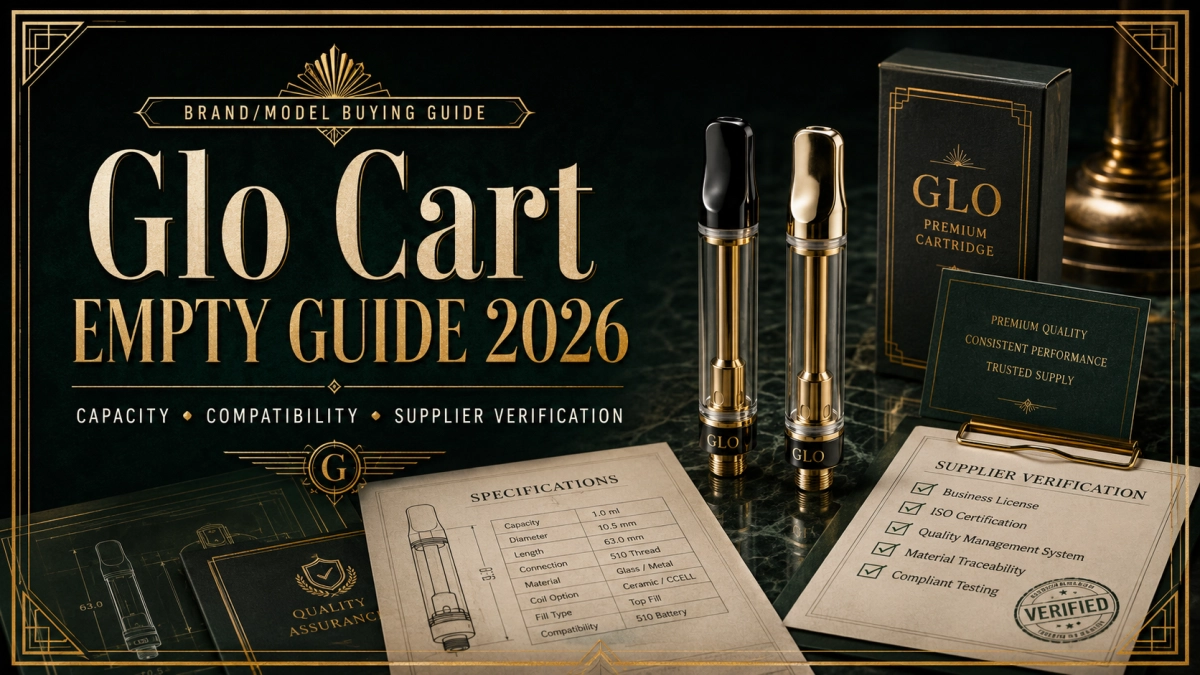
Scope: This guide is for Glo-related empty only cart sourcing, capacity records, compatibility review, packaging proof, sample approval, supplier identity checks, invoice consistency, inspection planning, receiving review, and claim files. It does not cover filling steps, end-user operation, potency claims, dosage claims, health claims, or medical claims. This page is not affiliated with BAT, Glo, Glo Extracts, or any trademark owner.
Why this guide matters
Glo-related empty cart sourcing can look simple when a buyer sees a familiar name, a capacity note, a photo set, and a quote. In wholesale review, the stronger file is built from records: the approved SKU name, empty only scope, capacity wording, compatibility basis, packaging proof, sample photos, carton basis, supplier identity, inspection rule, receiving evidence, and claim terms.
For buyers comparing glo cart options, the goal is not to approve the lowest quote. The goal is to approve the supplier that can document what is being supplied, how it is packed, how it will be checked, and how the receiving team should handle differences between the approved sample and the bulk lot.
The key idea
A stronger wholesale decision should be document-backed. Keep one buyer-approved SKU name, one empty only scope statement, one capacity record, one compatibility record, one package record, one sample approval file, one carton basis, and one QC rule for the order under review.
Quick answer for buyers
Before placing a bulk order, buyers should verify the model family, confirm empty only scope, record capacity and cart fields, review packaging proof, approve a sample, define carton records, set an inspection plan where appropriate, screen the supplier, confirm invoice consistency, and keep a receiving checklist.
Confirm the model family
Record Glo-related naming, capacity wording, cart format, package route, and the buyer-approved SKU name.
Define empty only scope
Use consistent empty only wording across the RFQ, quote, invoice, sample approval, packing list, carton mark, and receiving file.
Match sample to bulk
Compare capacity wording, thread route, mouthpiece route, material declaration, dimensions, package panels, seal area, pack count, carton marks, and release photos.
Use records, not claims
Treat screenshots, social proof, and seller promises as weak evidence unless they match public records and supplier documents.
| Funnel stage | Buyer question | Record to keep |
|---|---|---|
| TOFU education | What should Glo-related cart buyers compare before shortlisting suppliers? | Model overview, capacity field list, empty only note, compatibility checklist, package-photo checklist, and supplier-screening rule. |
| MOFU comparison | Which supplier can support sample matching, carton records, packaging proof, and QC? | RFQ answers, quote sheet, sample photos, packaging proof, carton basis, and inspection plan. |
| BOFU approval | Is the file complete enough for purchase order release and warehouse receiving? | Approved sample, inspection basis, release photos, packing list, carton marks, receiving checklist, and claim terms. |
Brand and model context
A brand/model buying guide should separate brand wording from buyer records. Use official glo overview only to confirm brand background. Use the supplier file to confirm the empty only cart route, capacity wording, packaging proof, invoice name, and receiving rules.
Glo-related listings can use similar words in different ways. A buyer should therefore record the exact SKU name, capacity route, thread route, material declaration, visible marks, package route, and carton basis before sample approval.
| Record field | What to record | Why it matters |
|---|---|---|
| Brand reference | Glo-related wording, model name, authorization status where claimed, and non-affiliation wording where needed. | Clear wording lowers the risk of implying official status without proof. |
| Capacity route | 0.8ml, 1ml, or buyer-approved capacity wording across the quote, sample, package, and packing list. | Capacity wording should match the approved sample and receiving file. |
| Cart route | Thread route, mouthpiece route, tank route, oil-hole note, outer shell route, and buyer-approved material declaration. | Route details support sample matching, package proof, and reorder control. |
| Visible marks | Logo placement, color route, package panel, barcode, label text, and carton marks. | Visible marks make QC and receiving review more precise. |
| Pack basis | Pieces per tray, trays per inner box, inner boxes per master carton, and total carton count. | Pack basis connects the quote, packing list, release photos, and receiving count. |
Capacity records: 0.8ml vs 1ml
Capacity should be recorded as a buyer-controlled field, not as loose listing language. The same capacity wording should appear in the RFQ, quote, product title, sample approval, package proof, packing list, and receiving checklist. If the online listing, invoice, and package panel use different capacity wording, the buyer should pause release until the supplier corrects the file.
For category-level comparison, 1ml vape cartridges can help buyers map capacity wording across empty cart listings before narrowing the file to a single approved Glo-related SKU.
| Capacity field | Buyer question | Record to keep |
|---|---|---|
| Listed capacity | Is the listing recorded as 0.8ml, 1ml, or another buyer-approved route? | Listing screenshot, quote line, package proof, and sample approval date. |
| Sample capacity | Does the sample label, package panel, and supplier spec sheet use the same capacity wording? | Sample photos, measurement note, and supplier written confirmation. |
| Bulk capacity | Does the packing list match the sample approval and purchase order wording? | Packing list draft, carton mark, release photos, and receiving count sheet. |
| Change control | Will the supplier notify the buyer before changing capacity wording, package count, or SKU title? | Revision note, updated proof, and buyer approval. |
Compatibility record checklist
Compatibility should be documented with physical and packaging records. Do not rely on a product title alone. Buyers should define the thread route, contact area, tank material, mouthpiece route, cap route, oil-hole note, dimensions, package panels, and carton marks before a bulk order is released.
For material-route mapping, metal and glass vape cartridges can support a wider comparison of tank and shell records before the buyer approves one Glo-related empty cart route. For broader category context, vape cartridges can help connect Glo-related content to the larger empty cart category.
| Compatibility field | Buyer question | Record to keep |
|---|---|---|
| Thread route | Does the thread route match the buyer-approved route? | Close-up photo, supplier spec sheet, and sample approval note. |
| Mouthpiece route | Does the mouthpiece match the approved sample and package photo? | Front photo, side photo, top photo, and measurement record. |
| Tank route | Is the tank material, color route, and visible fill window recorded consistently? | Material declaration, sample photo set, and bulk release photos. |
| Oil-hole note | Is the oil-hole record written the same way in the quote, spec sheet, and QC checklist? | Spec line, photo evidence, and QC acceptance note. |
| Package route | Can warehouse staff identify the correct SKU without relying on memory? | Front panel, back panel, barcode, seal area, inner box, and carton mark photos. |
Empty only scope and document control
Empty only wording should be consistent from the first RFQ through receiving review. If one document uses broad product wording and another uses a narrower empty only scope, warehouse, finance, and compliance teams may not be reviewing the same order.
| Document | What it should say | Review point |
|---|---|---|
| RFQ | Empty only scope, model name, capacity wording, compatibility basis, package route, carton basis, and QC request. | Confirm that the supplier understands the exact scope before quoting. |
| Quote | Buyer-approved SKU name, quantity basis, pack count, carton count, delivery term, and payment name. | Reject vague names that do not match the approved sample. |
| Sample approval | Sample photos, package panels, dimensions, seal area, thread route, tank route, and approved date. | Use the sample file as the baseline for bulk release. |
| Packing list | Pieces per tray, trays per inner box, inner boxes per master carton, total cartons, and gross weight. | Make receiving count and claim evidence easier to manage. |
| Receiving file | Arrival photos, carton count, package condition, visible defects, shortage record, and hold rule. | Connect warehouse evidence to the approved buyer file. |
Document control rule
Keep one buyer-approved SKU name and one empty only scope statement across every file. If the supplier changes the name, package, carton mark, count basis, capacity wording, or route wording, require a new written approval before release.
Sample approval and SKU record
A sample approval file should define the exact SKU that the supplier must match in bulk. It should include front, back, top, bottom, side, package, and carton photos, plus a written rule that any change requires buyer approval before release.
For a focused sample record, Glo NFC Verified cart can be used as a reference point for Glo-related naming, 0.8ml and 1ml capacity wording, 510 thread wording, photo review, and SKU record control.
| Sample field | What to capture | Approval rule |
|---|---|---|
| SKU name | Buyer-approved SKU title, cart route, capacity wording, and empty only scope. | No bulk release unless the quote, invoice, packing list, and carton mark use matching wording. |
| Visual file | Full photos from each side, package photos, and seal-area photos. | No substitutions without new sample approval. |
| Measurement file | Height, width, diameter where relevant, and tolerance fields. | Bulk lot should match the approved measurement range. |
| Package file | Front panel, back panel, pack count, carton mark, and revision date. | Package route changes require written buyer approval. |
| Claim basis | Required photos for shortage, mixed items, package damage, breakage, leakage, or visible defect. | Claim terms should be agreed before the order ships. |
Supplier verification
Supplier review should happen before payment approval. A supplier website can look polished and still lack business identity, payment consistency, carton records, or clear claim terms. The buyer should connect website details to company documents, finance records, sample evidence, and receiving requirements.
| Review area | Warning sign | Buyer action |
|---|---|---|
| Domain record | The domain is new, unclear, or similar to a known brand domain. | Use ICANN Lookup and save the review date. |
| Website safety | The site triggers unsafe-page, phishing, or redirect concerns. | Check Google Safe Browsing site status before staff open checkout, login, document, or payment links. |
| Invoice name | The website name, quote name, invoice name, and payment receiver do not match. | Use FTC small-business scam guidance to build finance-team review steps. |
| Trademark wording | The supplier implies official status without proof, or the wording creates confusion. | Use USPTO trademark search for brand-term review and keep a non-affiliation note where needed. |
| Audit readiness | The supplier cannot explain process records, corrective action records, or external audit support. | Use ISO 19011 audit guidance as a reference for audit-program questions. |
| Quality-system evidence | The supplier claims strong QC but cannot provide lot records, inspection files, or complaint handling records. | Use ISO 9001 quality management as a reference for process and quality-system questions. |
QC checklist and AQL planning
QC should turn buyer expectations into measurable acceptance points. Use AQL language only when the file defines lot size, inspection level, sample size, defect categories, acceptance rule, rejection rule, and hold process. If those fields are missing, call it buyer-defined sample inspection until the rule is complete.
| QC layer | What to check | Record to keep |
|---|---|---|
| Identity | Correct model route, capacity wording, empty only scope, package route, and carton mark. | Spec sheet, package proof, carton photos, and release note. |
| Appearance | Scratches, cracks, dents, seal damage, color mismatch, print defects, and visible contamination. | Inspection checklist, defect photos, hold records, and decision note. |
| Dimensions | Height, diameter, mouthpiece route, tank route, and tolerance fields. | Measurement record and approved sample comparison. |
| Package integrity | Seal condition, package closure, carton damage, and leakage review where applicable. | Inspection record, package photos, and failed-sample photos. |
| Pack count | Pieces per tray, trays per inner box, inner boxes per master carton, and total carton count. | Packing list, pack-count table, and warehouse receiving count. |
| Receiving review | Carton count, package condition, visible defects, shortage, mixed-item risk, and claim photos. | Receiving checklist, arrival photos, and claim-file evidence. |
Wholesale buyer scorecard
A scorecard prevents the buying decision from becoming a lowest-quote decision. Every score should be backed by documents and photos.
| Score area | Suggested weight | Evidence to review |
|---|---|---|
| Model match | 15 | Glo-related naming, capacity wording, cart route, and buyer-approved SKU name. |
| Empty only scope | 10 | Consistent wording across RFQ, quote, sample approval, invoice, packing list, carton mark, and receiving file. |
| Sample proof | 15 | Full photos, measurement record, package panels, seal area, and sample approval date. |
| Compatibility file | 15 | Thread route, tank route, mouthpiece route, oil-hole note, dimensions, and package route. |
| QC readiness | 15 | AQL basis, lot size, sample size, defect categories, release photos, hold rule, and rejection rule. |
| Supplier identity | 10 | Company name, invoice name, payment receiver, address, contact domain, and responsible contact. |
| Regulatory file support | 10 | Market route, package proof, material declaration, label note, and restricted-substance review where relevant. |
| Claim control | 10 | Claim window, required photos, replacement terms, credit terms, and dispute contact. |
RFQ template
Use this RFQ template to collect comparable answers before approving samples, pilot quantities, or bulk purchase orders.
Subject: RFQ for Glo Cart Empty Only - Capacity, Compatibility, Packaging, QC, and Supplier Review
Scope: Empty only
Destination market: [insert country, state, province, or regulated-market route]
Buyer role: [wholesaler / distributor / licensed operator / importer / brand owner]
Requested route: [authorized route / stock route / buyer-approved empty only route]
Supplier identity: [company name / invoice name / address / contact domain / trade references]
Website review: [domain / registrar record / unsafe-site screen / contact page / payment receiver]
Brand wording: [supplier to confirm authorization status and buyer-safe wording]
Model naming: [Glo / Glo NFC Verified / buyer-approved SKU name / package route]
Capacity wording: [0.8ml / 1ml / buyer-approved wording]
Cart fields: [thread route / tank route / mouthpiece route / oil-hole note / visible marks / seal area / sample reference]
Dimensions: [height / width / diameter where relevant / tolerance]
Material declaration: [tank / mouthpiece / seals / tray / label / inner box / master carton]
Package route: [plain package / stock package / buyer-approved package]
Packaging proof: [front panel / back panel / seal area / pack count / carton mark / revision date]
Quantity target: [sample / pilot / bulk / stock / reorder]
MOQ request: [sample MOQ / pilot MOQ / bulk MOQ / package MOQ / stock MOQ / reorder MOQ]
Price basis: [piece / tray / inner box / master carton / total lot]
Sample review: [sample quantity / sample photos / appearance check / dimension check / package check / leakage review where applicable]
Carton record: [pieces per tray / trays per carton / carton dimensions / gross weight / carton mark]
QC request: [AQL basis / identity check / appearance check / dimension check / package check / pack count / carton count / photo record / release rule]
Document request: [quote sheet / spec sheet / material declaration / package proof / inspection report / packing list]
Delivery term: [EXW / FOB / FCA / DAP / DDP / buyer-specified term with named place]
Target receiving window: [insert date range]
Claim process: [shortage, mix-up, leakage, breakage, packaging issue, carton issue, or late-release process]
Official references
These references support a neutral buyer file. They do not replace legal, import, tax, trademark, packaging, restricted-substance, or regulated-market review.
| Reference area | Use in the buyer file | Source |
|---|---|---|
| Glo brand background | Use only to confirm official brand background before writing non-affiliation notes. | official glo overview |
| U.S. PMTA overview | Use for regulatory-file awareness in U.S. tobacco-product routes. | FDA PMTA requirements |
| ENDS PMTA guidance | Use to understand FDA guidance for PMTA submissions involving ENDS routes. | FDA ENDS PMTA guidance |
| Regulatory text | Use for PMTA rule checks when a U.S. market route is part of the buyer file. | eCFR 21 CFR Part 1114 |
| Quality management | Use for supplier process review, corrective action records, and quality-system questions. | ISO 9001 quality management |
| Audit program | Use for internal audit, external audit, and supplier-audit planning questions. | ISO 19011 audit guidance |
| AQL sampling | Use for lot-by-lot inspection by attributes and AQL-based planning. | ISO 2859-1 AQL sampling |
| Restricted substances | Use for material declarations and restricted-substance review where relevant. | EU RoHS restricted substances |
| General product safety | Use for EU product-safety route awareness and responsible-operator questions. | EU GPSR product safety rules |
| Package classification | Use for package-classification language where child-resistant packaging review is relevant. | ASTM D3475 package classification |
| Product identification | Use for SKU, GTIN, barcode, carton label, and master data review. | GS1 GTIN identifiers |
| Domain review | Use for domain creation date, registrar data, update date, and name-server review. | ICANN Lookup |
| Website safety | Use before staff open checkout, login, document, or payment links from a new seller. | Google Safe Browsing site status |
| Small-business scam checks | Use for fake invoice, impersonation, urgency, and unusual payment warning signs. | FTC small-business scam guidance |
| Trademark review | Use for brand-term review, confusion-risk notes, and non-affiliation wording. | USPTO trademark search |
FAQ
What does Glo cart mean for B2B buyers?
It means the buyer should record a Glo-related empty cart route with capacity wording, compatibility basis, empty only scope, package proof, sample photos, carton records, and QC rules before approving a bulk order.
What should buyers check before ordering?
Start with model naming, empty only scope, supplier identity, sample photos, capacity records, compatibility fields, packaging proof, and carton basis. Then review QC, regulatory-route records where relevant, invoice consistency, and claim terms.
Is a product photo enough for wholesale approval?
No. A photo should be supported by sample approval, package panels, measurement records, carton marks, packing list basis, inspection rules, and receiving evidence.
How should AQL be used?
AQL should be used only when lot size, sample size, defect categories, acceptance rule, rejection rule, and hold process are defined. Otherwise, use a buyer-defined sample inspection until the plan is complete.
What does empty only mean in this guide?
Empty only means the sourcing file is limited to empty cart formats, packaging, QC, carton records, receiving files, and commercial documents. This guide does not cover filling steps, end-user operation, potency claims, health claims, or dosage claims.
Is this legal advice?
No. This is an educational B2B buying guide. Buyers should use qualified legal, import, tax, trademark, packaging, restricted-substance, and regulated-market support before final approval.
0 Comments