
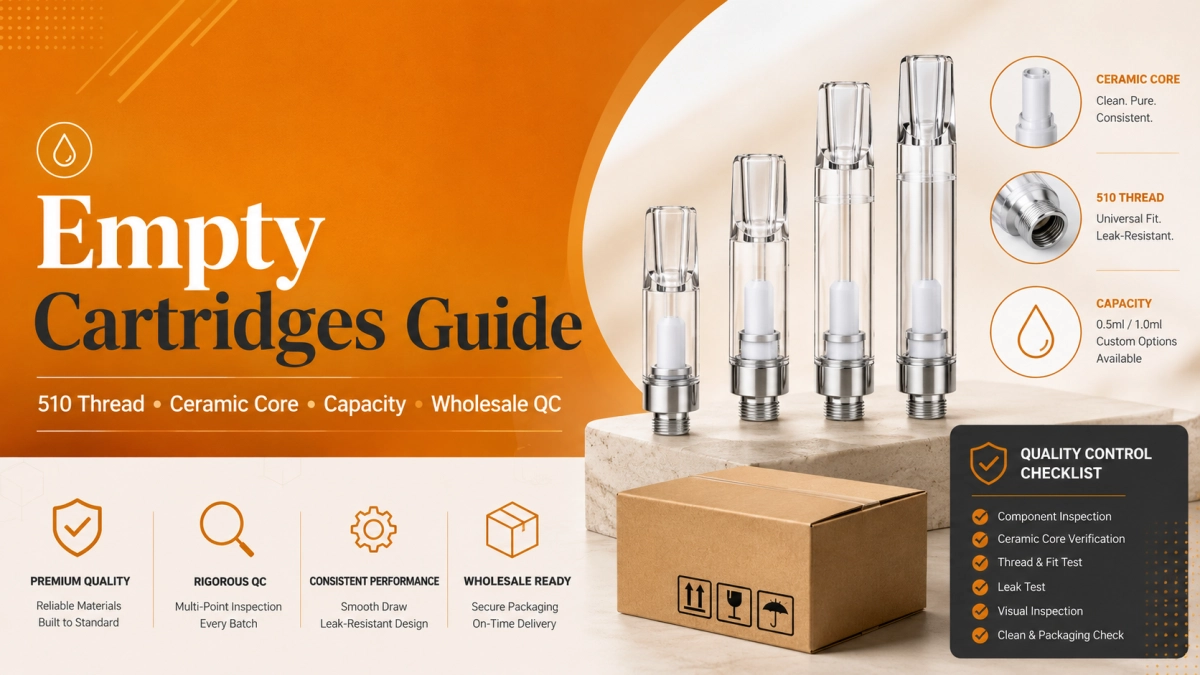
Scope: This guide is written for empty only cartridge sourcing. It covers 510 thread review, ceramic core records, capacity comparison, wholesale QC planning, supplier documentation, packaging records, and receiving checks. It does not cover filling steps, consumption guidance, health claims, potency claims, or end-user instructions.
Why empty cartridge sourcing needs a quality file
Buyers comparing empty cartridges should look beyond product photos and unit price. A stronger buying file should confirm empty only wording, 510 thread route, ceramic core details, capacity wording, material records, sample approval, packaging proof, carton count, and inspection rules before wholesale approval.
This article is designed for sourcing managers, brand operators, packaging teams, compliance coordinators, and licensed-market business buyers who need a neutral framework for comparing empty only cartridge options. The goal is not to make a hard sales claim. The goal is to help teams build a reviewable file before sample approval, pilot purchase, or repeat wholesale order.
The key idea
A reliable empty only buying file turns supplier promises into records: product route, thread route, core route, capacity wording, material declaration, sample approval, AQL plan, carton basis, and claim process.
Quick answer
The best way to source empty cartridges is to compare four areas before price: 510 thread fit, ceramic core consistency, capacity records, and wholesale QC. A buyer should request a written specification sheet, approved sample photos, material declarations, packaging proof, carton count, and inspection report before releasing a bulk order.
Best article fit
Educational buying guide for early research and supplier comparison.
Best first check
Confirm empty only wording in the quote, sample file, invoice title, packing list, and carton mark.
Best quality angle
Use written records for thread route, core route, capacity, material, packaging, and inspection.
Best BOFU action
Ask suppliers for an RFQ answer, sample approval record, AQL plan, and pre-shipment photo report.
Empty only scope
Before comparing specifications, the order scope should be written as empty only. This wording should appear consistently in the quote, proforma invoice, sample label, packing list, carton mark, and receiving file. Consistent wording reduces confusion between sample review, warehouse receiving, and reorder control.
| Scope field | Buyer question | Record to request |
|---|---|---|
| Order scope | Is the supply limited to empty only cartridge products? | Written empty only confirmation in the quote and invoice title. |
| Product identity | What exact product name, SKU, and capacity wording will be used? | Specification sheet, sample label, and approved product photo. |
| Sample route | Does the sample match the intended wholesale route? | Sample quantity, sample photos, approval date, and supplier contact. |
| Packaging route | Will the package route match the quote and carton record? | Packaging proof, pack count, carton dimensions, and gross weight. |
| Market review | Which destination market will review labeling, import, and sale limits? | Buyer-side legal, import, tax, and licensed-market notes. |
510 thread review
The 510 thread section of a buying file should focus on the threaded base and fit tolerance of the cartridge route. Buyers comparing 510 thread vape cartridges should request a written thread route, appearance limit, center-post alignment check, and sample comparison photo before placing a wholesale order.
| 510 thread point | What to review | Why it matters |
|---|---|---|
| Thread finish | Check burrs, deformation, rough edges, color variance, and residue. | Visible issues can signal poor process control before fit testing. |
| Thread route | Confirm the same route across sample, bulk order, and reorder. | Prevents a sample-approved route from changing without notice. |
| Center-post alignment | Review alignment, height consistency, and visible gap limits. | Supports repeatable fit checks and incoming inspection. |
| Fit check | Ask the supplier how fit is checked and recorded before release. | Creates a measurable point for QC rather than a general promise. |
| Lot comparison | Compare a new lot against the approved sample photo set. | Helps detect process drift in repeat wholesale orders. |
Buyer note
Do not turn the 510 thread section into an end-use guide. Keep the article focused on empty only purchasing, fit records, sample approval, and inspection.
Ceramic core review
Ceramic core comparison should be evidence-based. Buyers reviewing ceramic core cartridges should request the core route, intake-hole route, airflow path, visible defect limits, and change-control statement. A ceramic description alone is not enough for wholesale approval.
| Core record | Buyer check | File to keep |
|---|---|---|
| Core route | What ceramic route is used, and will it remain the same for repeat orders? | Specification sheet, supplier declaration, and sample photo. |
| Intake-hole route | What intake-hole size, count, and placement are approved? | Close-up photo record and approved sample date. |
| Airflow path | How is airflow path consistency checked across a lot? | Inspection method, result range, and release decision. |
| Visible defects | What limits apply to cracks, chips, dust, staining, and loose particles? | Defect list, photo examples, and pass/fail rule. |
| Change notice | How will the buyer be notified before a core route change? | Written change-control note and reapproval process. |
Capacity comparison: 0.5ml, 0.8ml, 1ml, and 2ml
Capacity affects SKU records, packaging count, carton count, warehouse receiving, and wholesale price tiers. Buyers comparing 1ml vape cartridges should keep a separate quote line, sample file, and carton basis for that route. Buyers comparing 0.5ml vape cartridges should do the same so mixed capacity records do not create receiving disputes.
| Capacity point | Buyer check | Why it matters |
|---|---|---|
| Capacity wording | Does the same wording appear on the quote, sample file, proof, and packing list? | Prevents mixed SKU records and warehouse count errors. |
| Sample separation | Is each capacity route reviewed as its own sample line? | Prevents one sample approval from being applied to a different route. |
| Pack count | How many pieces per tray, inner box, master carton, and shipment? | Supports receiving checks and shortage review. |
| Net quantity wording | Does the buyer need a destination-market review for stated quantity? | Helps align packaging records with market requirements. |
| MOQ tiers | Are sample MOQ, pilot MOQ, bulk MOQ, and reorder MOQ listed separately? | Prevents price and lead-time confusion during approval. |
For package quantity review, buyers can reference NIST Handbook 133 as a procedural resource for net content testing concepts. It should be used as a reference for organizing questions, not as a substitute for destination-market review.
Material and document records
Material review should be based on written records rather than broad claims. The buyer file should list the tank material, mouthpiece material, core route, center post, gasket route, exterior finish, packaging materials, and any restricted-substance declarations required by the buyer route.
| Record area | What to request | How to use it |
|---|---|---|
| Material declaration | Part-by-part material list for tank, mouthpiece, core, center post, gasket, and package insert. | Confirms what was reviewed and what must stay unchanged for reorders. |
| Restricted-substance file | Supplier declarations and lab reports where the buyer route requires them. | Supports buyer-side review of heavy metals, plasticisers, and other restricted substances. |
| Plastic packaging review | Material records for plastic packaging or contact-related components where relevant. | Helps structure questions on material identity and documentation scope. |
| Lab report review | Report date, lab name, test scope, sample identity, method, and accreditation route. | Helps buyers verify that a report applies to the ordered route. |
| Change control | Written notice before material, finish, core route, package route, or carton basis changes. | Protects repeat-order consistency. |
Useful reference points include USP plastic packaging materials for organizing plastic material questions and RoHS restricted substances for restricted-substance documentation where the route falls within the relevant scope.
Wholesale QC plan
Wholesale QC should be written before order approval. The plan should define lot size, sampling basis, defect categories, carton count, photo requirements, hold rules, release rules, and claim process. A clear QC plan helps both buyer and supplier avoid vague arguments after shipment.
| QC layer | Inspection point | Record to keep |
|---|---|---|
| Sampling basis | How many cartons and pieces will be checked from the lot? | Lot size, checked quantity, sampling rule, and inspector name. |
| Critical defects | Wrong product route, wrong capacity, broken pieces, mixed SKU, or unsafe sharp edge. | Defect photos, rejected count, hold decision, and corrective action. |
| Major defects | Thread deformation, loose cap, visible gap, blocked airflow path, or wrong carton count. | Inspection report, photo record, and release decision. |
| Minor defects | Small scratch, light scuff, dust mark, slight print shift, or small color variance. | Defect limit, counted quantity, and approval note. |
| Packaging check | Tray count, inner box count, carton mark, gross weight, and dimensions. | Packing list, carton photos, and receiving confirmation. |
| Release rule | Will the lot be released, held, reworked, replaced, or partly accepted? | Written release decision and supplier acknowledgement. |
For lot-by-lot inspection planning, ISO 2859-1:2026 AQL sampling is the most relevant standards-body reference. For supplier process review, ISO 9001 quality management system provides a useful framework for repeatable processes, corrective action, and document control.
Packaging and carton records
Packaging records are part of quality control, not an afterthought. The buyer should request pack format, proof file, label area, carton mark, gross weight, dimensions, pieces per carton, carton count, and shipment photo set before release. These records help warehouse teams check identity and quantity when the order arrives.
| Packaging field | Buyer question | Record to keep |
|---|---|---|
| Pack format | Is the order packed by tray, inner box, master carton, or buyer-approved route? | Pack photos, proof file, and approval date. |
| Count basis | How many pieces per tray, trays per inner box, and boxes per carton? | Count sheet, packing list, and carton photos. |
| Carton mark | What appears on the master carton? | SKU, empty only wording, quantity, carton number, dimensions, and gross weight. |
| Lot traceability | Will the lot or batch field be recorded on internal documents or labels? | Lot code rule, barcode plan where used, and receiving file. |
| Transit protection | How are cartons protected against compression, vibration, and handling damage? | Pre-shipment photos and receiving inspection notes. |
For carton protection discussions, ASTM D4169 shipping-unit testing is a useful reference. For lot and batch data fields, GS1 Application Identifiers can help teams structure traceability records where barcodes are used.
Buyer scorecard
A scorecard keeps supplier comparison neutral. It helps buyers avoid choosing only by lowest unit price and gives internal teams a repeatable review method.
| Score area | Suggested weight | Evidence to review |
|---|---|---|
| Empty only scope | 10 | Quote wording, invoice title, sample label, carton mark, and supplier confirmation. |
| 510 thread route | 10 | Thread finish, fit check, center-post alignment, and approved sample photo. |
| Ceramic core route | 15 | Core route, intake-hole route, airflow path, defect limits, and change notice. |
| Capacity records | 10 | Capacity wording, sample file, pack count, MOQ tier, and carton basis. |
| Material documents | 15 | Material declaration, restricted-substance file, report scope, and lab review. |
| Wholesale QC | 15 | AQL plan, defect categories, photo report, release rule, and claim process. |
| Packaging records | 15 | Proof file, count sheet, carton mark, dimensions, gross weight, and shipment photos. |
| Lead-time control | 10 | Sample timing, proof deadline, production queue, inspection date, packing date, and trade term. |
RFQ template
Use this RFQ template when asking suppliers for empty only cartridge quotes. It keeps the discussion educational, evidence-based, and comparable across suppliers.
Subject: RFQ for Empty Cartridges - 510 Thread, Ceramic Core, Capacity, and Wholesale QC Review
Scope: Empty only
Destination market: [insert country, state, region, or licensed-market route]
Product route: [empty cartridge / 510 thread route / ceramic core route / selected route]
Capacity route: [0.5ml / 0.8ml / 1ml / 2ml / selected wording]
Material route: [tank / mouthpiece / ceramic core / center post / gasket / exterior finish]
Quantity target: [sample / pilot / bulk / reorder]
MOQ request: [sample MOQ / pilot MOQ / bulk MOQ / packaging MOQ / reorder MOQ]
Sample review: [sample quantity / sample photos / thread check / core route / seal review / appearance check]
Packaging route: [tray / inner box / master carton / buyer-approved route]
Carton record: [pieces per pack / packs per carton / carton dimensions / gross weight / carton mark]
QC request: [appearance / thread fit / airflow path / seal review / pack count / carton count / photo record]
Document request: [quote sheet / specification sheet / material declaration / proof file / inspection report / packing list / lab file where relevant]
Trade term: [EXW / FOB / FCA / DAP / DDP / buyer-specified term]
Target receiving window: [insert date range]
Claim process: [shortage, mixed item, appearance defect, packaging issue, or carton issue process]
For cross-border orders, ICC Incoterms 2020 and the U.S. International Trade Administration guide to Know Your Incoterms can help teams write trade terms and named places more clearly.
Supplier questions
- Can you confirm in writing that the order is empty only?
- What exact product name, SKU, and capacity wording will appear on the quote and packing list?
- Which 510 thread route is used, and how is fit checked before release?
- Which ceramic core route, intake-hole route, and airflow path are selected?
- What materials are used for the tank, mouthpiece, core, center post, gasket, and exterior finish?
- Can you provide supplier declarations and lab files where the buyer route requires them?
- What sample quantity can be checked before bulk approval?
- What are the sample MOQ, pilot MOQ, bulk MOQ, packaging MOQ, and reorder MOQ?
- Is the price based on pieces, inner boxes, master cartons, or total lot quantity?
- Can you provide proof photos before mass approval?
- Can you provide carton dimensions, gross weight, carton count, and carton mark before shipment?
- Which QC checks are completed before release?
- Which sampling basis can be used for lot-by-lot inspection?
- How will you handle shortage, mixed items, appearance defects, packaging issues, or carton damage?
- Will the approved sample file be reused for repeat orders?
- How will you notify the buyer if the material route, finish, core route, packaging route, or carton basis changes?
FAQ
What are empty cartridges in this guide?
They are empty only cartridge products reviewed for B2B sourcing, 510 thread route, ceramic core records, capacity comparison, packaging records, QC planning, and supplier documentation. This guide does not cover filling steps, consumption guidance, health claims, potency claims, or end-user instructions.
What should buyers check first?
Buyers should first confirm empty only wording across the quote, invoice title, sample label, packing list, carton mark, and receiving file.
How should buyers compare 510 thread options?
Buyers should compare thread finish, thread route, center-post alignment, visible gap limits, fit check method, approved sample photos, and change-control notes.
Why does ceramic core documentation matter?
Documentation helps confirm the selected core route, intake-hole route, airflow path, visual defect limits, and repeat-order consistency. A broad ceramic claim is not enough for wholesale approval.
How should 0.5ml, 0.8ml, 1ml, and 2ml routes be managed?
Each capacity route should have its own quote line, sample file, pack count, carton basis, MOQ tier, and receiving record. This reduces mixed records and shortage disputes.
What belongs in a wholesale QC plan?
A wholesale QC plan should include lot size, sampling basis, defect categories, photo requirements, carton count, hold rule, release rule, and claim process.
Is a product photo enough for approval?
No. A product photo is useful, but buyers should also request a specification sheet, material declaration, sample file, packaging proof, inspection report, carton record, and change-control note.
Is this legal advice?
No. This is an educational B2B sourcing guide. Buyers should use qualified legal, import, tax, and licensed-market support before final approval.
References
These references support a neutral buying file. They do not replace legal, import, tax, or licensed-market review.
| Reference area | Use in the buying file | Official source |
|---|---|---|
| Lot inspection | Sampling plan, AQL discussion, and lot-by-lot inspection structure. | ISO 2859-1:2026 |
| Supplier process | Quality management system, document control, and corrective action review. | ISO 9001 explained |
| Quantity records | Net content testing concepts and package quantity review. | NIST Handbook 133 |
| Transit packaging | Shipping-unit performance testing and carton protection discussion. | ASTM D4169 |
| Plastic material questions | Plastic packaging material records and supplier documentation scope. | USP plastic packaging materials |
| Restricted substances | Buyer-side review of heavy metals, flame retardants, plasticisers, and related declarations. | RoHS restricted substances |
| Lot and barcode fields | Batch, lot, and traceability data where barcodes are used. | GS1 Application Identifiers |
| Lab competence | Review of lab competence and report credibility. | ISO/IEC 17025 |
| Accreditation check | Directory review for accreditation bodies and related lab records. | ILAC signatory search |
| Trade terms | Named place, rule version, and responsibility split. | ICC Incoterms 2020 |
| Trade-term explanation | Plain-language trade term review for international orders. | Know Your Incoterms |
0 Comments