
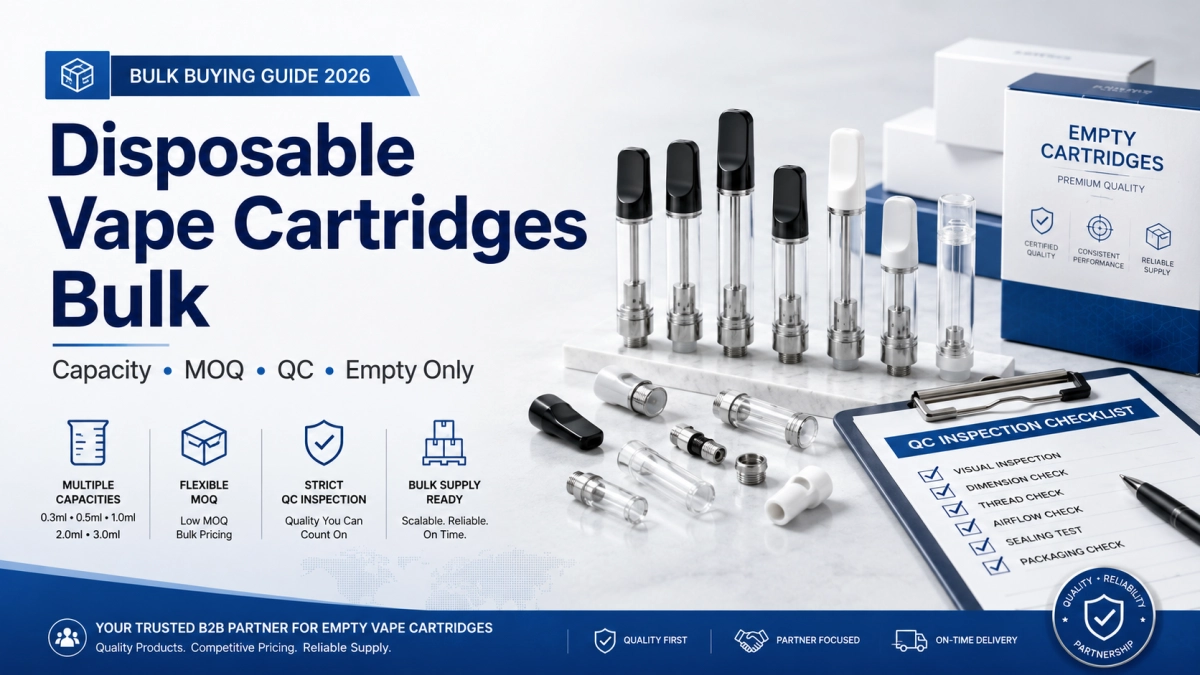
Scope: This guide is written for empty only bulk sourcing of disposable vape cartridges and related empty cartridge formats. It covers capacity selection, MOQ review, carton records, supplier questions, incoming QC, documentation files, and RFQ preparation. It does not provide filling steps, consumption guidance, medical claims, or end-consumer instructions.
Why this topic is BOFU
Buyers searching for disposable vape cartridges bulk are usually close to supplier review, sample comparison, or RFQ preparation. They are not only looking for a definition. They need to compare capacity, MOQ, empty only scope, cartridge structure, pack count, carton basis, documentation files, and quality records before confirming a bulk order.
This guide is designed for procurement teams, wholesalers, brand operators, and purchasing managers who need a neutral checklist for empty cartridge sourcing. The focus is not a hard-selling product pitch. The goal is to help buyers prepare a cleaner quote request, compare supplier answers, and reduce avoidable approval problems before a purchase order is placed.
The key idea
Bulk buying should start with empty only scope, exact capacity wording, MOQ tier, packaging route, carton record, supplier documentation, and incoming QC plan. A clear RFQ makes every supplier answer easier to compare.
Quick answer
The best way to source disposable vape cartridges in bulk is to build a buying file around capacity, MOQ, material record, airflow path, mouthpiece fit, leak-control structure, packaging basis, carton count, inspection sampling, and destination-market review. Buyers should avoid using one long product title as the whole buying file.
Best article type
Bulk buying guide for empty only cartridge sourcing and RFQ preparation.
Best funnel fit
BOFU, because the reader is preparing supplier questions, sample review, MOQ comparison, and QC acceptance rules.
Best internal route
Category page first, capacity page second, material or cartridge family page third, selected item page last.
Best content tone
Neutral, procurement-led, documentation-aware, and useful for business review.
Buyer intent behind bulk cartridge sourcing
A bulk cartridge buyer usually has a shortlist in mind. The real question is whether the supplier can support repeatable empty only orders with clear capacity records, stable MOQ tiers, reasonable packaging options, and quality documentation that can be reviewed before shipment approval.
| Buyer intent | What the buyer needs | Best record to request |
|---|---|---|
| Capacity comparison | Confirm whether 0.5ml, 0.8ml, 1ml, or another selected capacity is the right route. | Exact capacity wording, size route, product photos, and sample record. |
| MOQ review | Know whether the order basis changes by sample, standard bulk, packaging, or repeat order. | Separate MOQ table with pieces, boxes, lots, or cartons clearly shown. |
| QC approval | Understand how the supplier checks appearance, fit, airflow, leakage risk, pack count, and carton count. | Incoming inspection plan, pre-shipment record, photo record, and acceptance rule. |
| Documentation review | Prepare product identifiers, invoice wording, material declarations, and market-route records. | Documentation file with product record, pack list, carton details, and declaration files. |
| Repeat order planning | Keep the approved specification stable across reorder cycles. | Approved sample record, version control, pack basis, and reorder MOQ. |
Capacity planning: 0.5ml, 0.8ml, 1ml and beyond
Capacity should be treated as a confirmed specification field, not a loose marketing phrase. For cartridge sourcing, common comparison points include 0.5ml, 0.8ml, and 1ml. Buyers reviewing 1ml vape cartridges should still confirm the quote wording, carton basis, mouthpiece route, core route, and packaging route before approval.
| Capacity route | Typical buying question | What to confirm before bulk order |
|---|---|---|
| 0.5ml | Does the buyer need a smaller cartridge format for a compact empty only program? | Exact capacity wording, pack basis, sample quantity, and acceptance check. |
| 0.8ml | Is the order built around a mid-capacity cartridge route? | Core route, mouthpiece fit, carton count, and MOQ tier. |
| 1ml | Is the buyer standardizing around a common cartridge capacity? | Material record, oil-hole record, pack count, and supplier QC file. |
| Selected custom route | Does the buyer need a capacity or body route that is not shown in the standard table? | Sample approval, drawing or specification file, packaging basis, and lead time. |
Capacity rule
Do not approve a bulk cartridge quote by capacity alone. Pair capacity with empty only scope, fit record, core route, packaging basis, carton basis, and QC acceptance criteria.
MOQ tiers and cost structure
MOQ is often where bulk orders become unclear. A supplier may have one MOQ for samples, another for standard bulk orders, another for packaging work, and another for repeat orders. Buyers should request each MOQ as a separate line so the buying file remains easy to audit.
| MOQ field | What to ask | Supplier answer needed |
|---|---|---|
| Sample MOQ | How many empty cartridges can be ordered for sample review? | Sample quantity, sample cost, sample timing, and shipping route. |
| Standard bulk MOQ | What is the minimum order quantity for the selected cartridge record? | Unit price, quantity tier, price-validity window, and pack basis. |
| Packaging MOQ | Does plain pack, sticker route, or custom box work change the MOQ? | Packaging MOQ, artwork proof timing, carton count, and lead time. |
| Color or logo MOQ | Does body color or logo placement change the quote basis? | MOQ, proof record, file requirement, and approval process. |
| Stock-route MOQ | Is the MOQ different for available stock? | Available quantity, warehouse route, receiving window, and pack count. |
| Reorder MOQ | Can the approved record be used for repeat orders? | Reorder quantity, file reuse, price tier, and production window. |
MOQ rule
Ask for MOQ by sample, standard bulk, packaging, color or logo work, stock route, and reorder. One MOQ number is rarely enough for a reliable procurement file.
QC checklist for empty cartridges
A bulk order should include a written QC plan. For empty only cartridge sourcing, buyers should check visual finish, mouthpiece fit, threading, core position, airflow path, leakage-risk indicators, pack count, carton count, and photo records. AQL sampling can help structure lot-by-lot inspection when the buyer and supplier agree on inspection level and acceptance criteria.
Buyers comparing empty vape cartridges should use a short checklist that can be repeated for samples, pilot orders, and final bulk approval.
| QC layer | Inspection point | Record to keep |
|---|---|---|
| Appearance | Surface finish, printed marks, color match, visible damage, dust, and mixed items. | Photo record, sample comparison, and pass or hold decision. |
| Fit and assembly | Mouthpiece fit, thread fit, cap fit, body alignment, and part consistency. | Sample reference, inspection note, and quantity checked. |
| Capacity record | Capacity label, product record, packaging wording, and invoice wording. | Approved capacity field and quote confirmation. |
| Core route | Core material, center post alignment, oil-hole record, and airflow path. | Specification file, supplier confirmation, and sample photo. |
| Leakage-risk review | Seal fit, visible gap, cap pressure, thread condition, and packaging orientation. | Inspection report, rejected quantity, and corrective action note. |
| Pack count | Pieces per pack, packs per carton, carton label, and mixed-carton risk. | Packing list, carton photos, and receiving check record. |
| Transit packaging | Inner tray, carton strength, carton marking, and shipment protection. | Carton dimension, gross weight, and pre-shipment photo record. |
For material-led comparison, a buyer can review a full ceramic cartridge record and then request the same fields in the RFQ: capacity, material route, oil-hole record, color route, pack basis, and quantity tier.
Documentation and supplier records
Documentation should support the buyer’s internal approval process. A complete sourcing file is not only a price quote. It should connect product identity, capacity wording, packaging basis, carton details, inspection records, route terms, and destination-market review.
| Document type | What it should show | Why it matters |
|---|---|---|
| Quote sheet | Selected cartridge record, capacity, quantity tier, MOQ, price basis, and validity date. | Prevents later confusion between sample pricing and bulk pricing. |
| Specification file | Capacity, material route, mouthpiece route, thread route, packaging route, and color route. | Creates a repeatable approval file for reorder planning. |
| Sample approval record | Sample photos, sample date, selected route, and buyer approval note. | Connects the final bulk order to the approved reference. |
| Inspection report | Inspection quantity, sampling basis, defect list, carton count, and pass or hold result. | Gives the buyer a practical acceptance file before shipment release. |
| Packing list | Pieces per pack, packs per carton, carton quantity, gross weight, and carton dimensions. | Supports warehouse receiving and logistics planning. |
| Material declaration | Supplier declarations for restricted-substance review where required by the route. | Helps the buyer organize destination-market documentation. |
| Route-term record | EXW, FOB, FCA, DAP, DDP, or buyer-specified term with the version clearly written. | Clarifies task, cost, and risk allocation between buyer and seller. |
RFQ template for bulk buyers
A strong RFQ should make supplier answers comparable. The template below keeps empty only scope, capacity, MOQ, packaging, carton records, and QC expectations in separate fields.
Subject: RFQ for Disposable Vape Cartridges Bulk Order Review
Scope: Empty only
Cartridge route: [510 thread / ceramic route / glass tank route / selected product record]
Capacity route: [0.5ml / 0.8ml / 1ml / exact selected wording]
Quantity target: [sample quantity / pilot quantity / bulk quantity / reorder quantity]
MOQ request: [sample MOQ / standard bulk MOQ / packaging MOQ / color or logo MOQ / reorder MOQ]
Packaging route: [plain pack / sticker route / custom box review / carton-only route]
Carton record: [pieces per pack / packs per carton / carton dimensions / gross weight / carton mark]
QC request: [appearance / fit / airflow path / leakage-risk review / pack count / carton count / photo record]
Documentation request: [quote sheet / specification file / sample photos / inspection report / packing list / material declarations]
Route term: [EXW / FOB / FCA / DAP / DDP / buyer-specified term]
Destination market: [insert country or region for buyer review]
Target receiving window: [insert date range]
Supplier questions
Use questions that produce clear and comparable answers. The list below is written for procurement review rather than promotion.
- Is this quotation limited to empty only cartridges?
- What exact capacity wording should be used on the quote, invoice, product record, and packing list?
- What are the sample MOQ, standard bulk MOQ, packaging MOQ, color or logo MOQ, stock-route MOQ, and reorder MOQ?
- Is the price based on pieces, boxes, lots, or cartons?
- Which cartridge routes are available for comparison?
- Which capacity routes are available for the selected cartridge family?
- Which material route, core route, mouthpiece route, and thread route are included in the quote?
- Does packaging work change the MOQ, lead time, or carton basis?
- Can the supplier provide sample photos, carton photos, and an inspection report before shipment release?
- Which AQL or sampling basis can be used for lot-by-lot inspection?
- What is the claim process if pack count, carton count, appearance, or fit records do not match the approved file?
- Can the approved sample record be reused for repeat orders?
Market-route notes
Bulk-order planning should include destination-market review. Official references can help buyers organize the file, but they do not replace professional compliance review.
| Record layer | What buyers should check | Official source |
|---|---|---|
| U.S. ENDS background | Review how FDA describes ENDS products, components, and parts before building a U.S. market file. | FDA ENDS overview |
| U.S. import file | Review product description, market authorization, entry information, and import records before U.S. route planning. | FDA importing tobacco products |
| U.S. authorization claims | Use current FDA records when checking any authorization statement for the U.S. market. | FDA authorized ENDS list |
| EU notification route | Check EU rules for electronic cigarettes and related product notification where the route requires it. | European Commission electronic cigarettes |
| EU Common Entry Gate | Use EU-CEG information when the buyer needs to understand notification workflow for EU Member States. | EU-CEG step-by-step guide |
| AQL sampling | Use a recognized sampling framework when agreeing on lot-by-lot inspection by attributes. | ISO 2859-1:2026 |
| Supplier quality system | Review whether the supplier’s quality system is documented and repeatable. | ISO 9001 quality management systems |
| Capacity verification | Use recognized net-content checking references when capacity records need formal review. | NIST Handbook 133 current edition |
| Transit packaging | Use a recognized shipping-unit test reference when carton protection needs structured evaluation. | ASTM D4169 |
| Restricted-substance review | Request material declarations where EU restricted-substance review may apply. | EU RoHS restrictions |
| Chemical record | Review supplier declarations and restricted-substance records where the route requires them. | EU REACH regulation |
| Route term | Use a recognized delivery term so both parties understand task, cost, and risk allocation. | Incoterms 2020 rules |
| Trade-term wording | Write the Incoterms version clearly in the purchase order or sales contract. | Know your Incoterms |
| Product identifiers | Prepare barcode and product identification records where the selling route requires them. | GS1 product identifiers |
| Carton and batch records | Use standardized data fields where carton, lot, or batch records are required. | GS1 Application Identifiers |
Market-route rule
Keep product record, origin wording, route term, material declarations, and destination-market review in separate fields. This makes the buying file easier to check before final approval.
Internal category route for buyers
A category-first path helps buyers compare multiple empty cartridge options before narrowing the RFQ. For example, 510 thread ceramic cartridges can be reviewed when the buyer wants a cartridge-family route before selecting a specific capacity or pack basis.
| Buyer need | Best starting point | RFQ field to confirm |
|---|---|---|
| Broad cartridge comparison | Vape cartridges category | Capacity, MOQ, pack count, and route term. |
| Capacity-led comparison | 1ml cartridge route | Exact capacity wording, carton basis, and price tier. |
| Empty only sourcing | Empty cartridge category | Scope, supplier record, packaging route, and sample approval. |
| Material-led comparison | Ceramic or selected cartridge family | Material route, oil-hole record, fit record, and QC file. |
FAQ
What does disposable vape cartridges bulk mean in this guide?
It means a B2B sourcing request for empty only disposable vape cartridges in bulk, usually involving capacity choice, MOQ tiers, pack basis, carton records, supplier documentation, and QC acceptance checks.
Which capacity should bulk buyers compare first?
Buyers commonly compare 0.5ml, 0.8ml, and 1ml routes first, then confirm the exact capacity wording shown in the selected product record, quote sheet, invoice, and packing list.
Should MOQ be written as one number?
No. MOQ should be separated into sample MOQ, standard bulk MOQ, packaging MOQ, color or logo MOQ, stock-route MOQ, and reorder MOQ where relevant.
What should be included in a cartridge QC checklist?
A practical checklist includes appearance, fit, thread route, mouthpiece fit, core position, airflow path, leakage-risk review, pack count, carton count, carton photos, and inspection result.
Why start with category pages?
Category pages help buyers compare capacity and cartridge-family routes before narrowing the request to one selected record. This supports better internal linking and a cleaner buyer journey.
Is this legal guidance?
No. This is a neutral B2B sourcing guide. Buyers should review official rules, destination-market requirements, and professional support before final approval.
References
- FDA ENDS overview
- FDA importing tobacco products
- FDA authorized ENDS list
- European Commission electronic cigarettes
- EU-CEG step-by-step guide
- ISO 2859-1:2026
- ISO 9001 quality management systems
- NIST Handbook 133 current edition
- ASTM D4169
- EU RoHS restrictions
- EU REACH regulation
- Incoterms 2020 rules
- Know your Incoterms
- GS1 product identifiers
- GS1 Application Identifiers
These references support a neutral sourcing approach: official market-route review, import-file preparation, AQL sampling, supplier quality review, capacity verification, transit packaging review, material declarations, route-term clarity, and product identification records.
0 Comments