
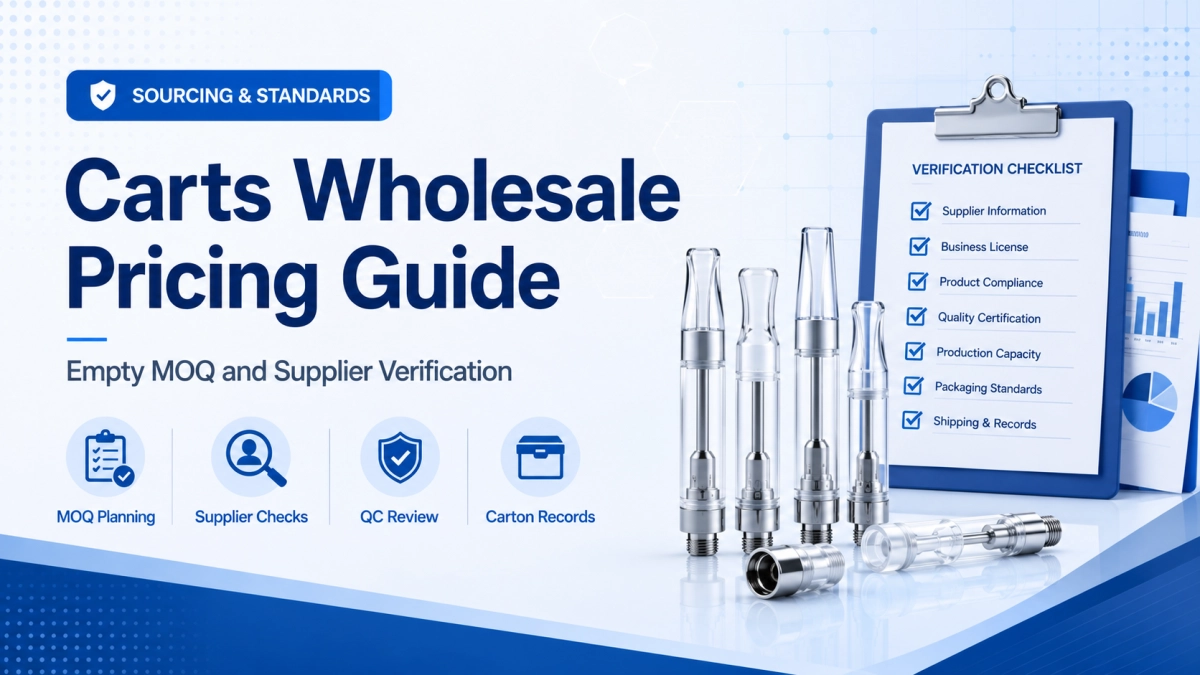
Scope: This guide is written for empty only cartridge sourcing. It covers pricing basis, MOQ tiers, sample files, capacity records, supplier verification, carton records, inspection planning, import review, and purchase-order readiness. It does not cover filling steps, consumption guidance, potency claims, health claims, or end-user instructions.
Why this guide matters
A carts wholesale decision should not be based on a low unit quote alone. BOFU buyers need a complete empty only file: cartridge route, capacity, pack count, MOQ tier, warehouse route, package proof, carton basis, inspection plan, supplier records, and purchase-order terms.
The real question is not simply “What is the price?” The stronger question is “What exactly is included in this price, and can the supplier prove it in a repeatable way?” A clear answer helps wholesalers compare quotes, reduce mixed-order risk, and prepare a receiving file that warehouse teams can actually use.
The key idea
Treat pricing, MOQ, and supplier verification as one decision. A lower quote can become expensive if capacity wording, pack count, delivery term, carton basis, or inspection release rules are unclear.
Quick answer for BOFU buyers
A strong wholesale cartridge purchase file should confirm six items before PO approval: route identity, capacity, MOQ tier, pack count, supplier proof, and release criteria.
Price basis
Confirm whether the quote is based on pieces, trays, inner boxes, master cartons, local stock, or scheduled production.
MOQ basis
Separate sample MOQ, pilot MOQ, bulk MOQ, packaging MOQ, stock MOQ, and reorder MOQ.
Supplier proof
Request spec sheets, sample photos, package proofs, carton data, inspection records, and change-control notes.
Final approval
Approve only when the quote, sample, package proof, packing list, carton mark, and receiving plan match.
Empty cartridge pricing factors
Empty cartridge pricing is shaped by more than the quoted unit number. Buyers comparing empty vape cartridges should build a pricing table that separates capacity, route, packaging, stock location, carton count, inspection needs, and delivery terms.
| Pricing factor | Buyer question | Why it affects cost |
|---|---|---|
| Capacity | Is the quote for 0.5ml, 0.8ml, 1ml, or a mixed capacity order? | Different capacities can have different carton counts, packaging needs, and reorder rules. |
| Pack count | Is the price based on pieces, trays, inner boxes, or master cartons? | Two quotes can look similar until the buyer checks the unit basis and pack count. |
| Warehouse route | Is the quote based on local stock, regional stock, or overseas production? | Stock route changes lead time, inspection timing, release photos, and landed-cost planning. |
| Packaging route | Is the order using plain packaging, buyer-approved packaging, or supplier stock packaging? | Packaging can add proof fees, printing minimums, extra lead time, and carton changes. |
| Inspection basis | Is lot-by-lot inspection included, optional, or buyer-arranged? | Inspection planning affects release timing, claim handling, and receiving confidence. |
| Delivery term | Does the quote clearly state EXW, FOB, FCA, DAP, DDP, or another agreed term? | Delivery terms decide which party handles transport, risk points, fees, and named-place responsibility. |
MOQ tiers and capacity planning
MOQ should be written as a tiered table. A single MOQ number is not enough for wholesale decisions because samples, stock orders, custom packaging, and repeat orders may not share the same minimum.
| MOQ tier | What to confirm | Buyer record |
|---|---|---|
| Sample MOQ | How many samples can be reviewed before pilot or bulk approval? | Sample invoice, sample date, photos, capacity wording, and supplier confirmation. |
| Pilot MOQ | Is there a smaller first-lot route for carton and receiving checks? | Pilot quote, package proof, inspection rule, and release photos. |
| Bulk MOQ | Which quantity unlocks the bulk unit basis? | Bulk quote, unit basis, carton plan, and delivery term. |
| Packaging MOQ | Does buyer-approved packaging require a separate minimum? | Artwork proof, print quantity, barcode fields where used, and carton mark. |
| Stock MOQ | Is ready stock sold by piece, tray, inner box, or master carton? | Stock list, available count, warehouse route, release date, and lot photos. |
| Reorder MOQ | Can the same approved route be repeated at the same minimum? | Reorder quote, approved sample file, and change-control note. |
Capacity should be reviewed separately. For larger standard orders, 1ml vape cartridges can be used as a capacity planning reference. For smaller capacity planning, 0.5ml cartridge options help buyers compare packaging count, unit basis, and sample needs.
Supplier verification before PO
Supplier verification should happen before the purchase order, not after the shipment is ready. A wholesale buyer should verify business identity, route records, quality process, package proof, sample control, warehouse route, and change-control rules.
| Verification area | What to ask | Proof to request |
|---|---|---|
| Business identity | Who is issuing the quote, invoice, and shipment file? | Company name, contact record, invoice details, and signed quotation. |
| Route identity | Which empty only cartridge route is being quoted? | Spec sheet, SKU list, sample photos, and route name used on all files. |
| Capacity record | Does capacity wording match across quote, package proof, packing list, and carton mark? | Capacity table, package proof, and packing list sample. |
| Quality process | How are visible defects, mixed items, pack count errors, and carton issues controlled? | Inspection checklist, defect categories, photo proof, and claim rule. |
| Stock proof | Is the stock actually available under the quoted route? | Warehouse photos, lot count, carton count, release date, and stock validity note. |
| Change control | How will the supplier notify the buyer before route, packaging, pack count, or carton changes? | Written change-control rule and buyer approval requirement. |
A CCELL cartridge spec example can be used as a product-page reference for capacity wording, pack presentation, route naming, and spec-sheet review. Treat the page as a reference point, not as a replacement for quote, inspection, and receiving files.
Documents to request
A BOFU buyer should collect comparable files from each supplier. The goal is to make the purchase decision reviewable by procurement, compliance, warehouse, and finance teams.
| Document | Minimum content | How buyers use it |
|---|---|---|
| Quote sheet | Empty only scope, route name, capacity, MOQ, unit basis, stock route, lead time, and validity date. | Compares suppliers without mixing sample, pilot, bulk, stock, and reorder terms. |
| Spec sheet | Route identity, capacity wording, materials declaration, pack count, carton basis, and inspection basis. | Creates the approval file for samples and repeat orders. |
| Sample approval | Sample quantity, sample date, photos, appearance check, package check, and approval decision. | Defines the reference point for the bulk lot. |
| Package proof | Artwork file, barcode fields where used, warning-space review, pack count, and buyer approval date. | Prevents packaging errors before production or stock release. |
| Inspection report | Sampling basis, checked quantity, defect categories, carton count, photos, and release decision. | Supports shipment approval and receiving review. |
| Change-control note | Written notice rule before changes to route, package, pack count, carton basis, or production process. | Protects repeat-order consistency. |
QC, AQL, and receiving checks
Quality control should be written into the purchase file before payment or release. Buyers should define sample size, lot size, defect categories, checked quantity, photo proof, hold rule, release rule, and claim process.
| QC layer | What to check | Record to keep |
|---|---|---|
| Appearance | Finish, mouthpiece fit, visible particles, crack risk, print alignment, and visible damage. | Photo set, defect examples, inspection checklist, and approved sample comparison. |
| Route identity | Correct empty only route, correct capacity wording, correct package proof, and correct carton mark. | Spec sheet, packing list, carton photos, and release note. |
| Pack count | Pieces per tray, trays per inner box, inner boxes per master carton, and total carton count. | Carton file, packing list, and warehouse receiving count. |
| Defect categories | Critical, major, and minor defects agreed before release. | AQL table, inspection report, and hold rule. |
| Receiving review | Compare received cartons against the supplier release file, carton marks, and packing list. | Receiving file, discrepancy report, and claim photos where needed. |
For inspection planning, ISO 2859-1 sampling plan supports lot-by-lot inspection by attributes and AQL-based sampling. For supplier process review, ISO 9001 quality management helps buyers discuss document control, consistency, corrective action, and repeatable process records.
If a supplier provides lab records, ISO/IEC 17025 lab competence can help buyers review whether the laboratory context is credible. For pack-count and quantity concepts, NIST Handbook 133 package quantity checks is a useful official reference.
Landed-cost and delivery-term review
A quote is not the same as landed cost. Before PO approval, buyers should separate product cost, packaging cost, inspection cost, inland transport, export handling, freight, duties, tax, brokerage, storage, and claim handling.
| Cost field | Buyer question | File to keep |
|---|---|---|
| Unit price | What unit basis is used: piece, tray, box, carton, or lot? | Quote sheet and MOQ table. |
| Packaging cost | Is packaging included, separate, or subject to its own minimum? | Package proof, packaging quote, and approval date. |
| Inspection cost | Who arranges inspection, and when does release happen? | Inspection plan, report, and release note. |
| Delivery term | Which party handles transport, risk points, and named-place responsibility? | Purchase order, invoice, and delivery-term note. |
| Import review | Does the buyer need a license, permit, certification, or agency review? | Importer file, broker notes, and buyer-side compliance checklist. |
| Origin claim | Are warehouse, origin, or local-stock claims supported by records? | Warehouse proof, supplier statement, and origin-support records. |
For import planning, use US import license or permit check. For delivery responsibility wording, use Incoterms 2020 delivery responsibilities. If a supplier makes origin or local-stock claims, FTC origin claim substantiation can help buyers understand why claims should be supported by evidence.
Supplier red flags
A BOFU buyer should slow down when a supplier cannot provide clear documents. Red flags do not always mean the supplier is unusable, but they do mean the buyer should ask more questions before payment.
| Red flag | Why it matters | Better buyer response |
|---|---|---|
| One vague MOQ | The quote may hide differences between samples, stock, packaging, and bulk orders. | Ask for sample MOQ, pilot MOQ, bulk MOQ, packaging MOQ, stock MOQ, and reorder MOQ separately. |
| No pack-count basis | The buyer cannot compare unit price or receiving quantity accurately. | Request pieces per tray, trays per box, boxes per carton, and master-carton count. |
| No release photos | The buyer has little proof of stock condition before shipment. | Request lot photos, carton photos, package photos, and dated release proof. |
| No inspection rule | Claims become difficult if defects or shortages appear after receiving. | Define AQL basis, defect categories, checked quantity, release rule, and claim window. |
| Changing names across files | Mixed wording can create receiving and audit confusion. | Require one route name across quote, invoice, package proof, packing list, and carton mark. |
| Unsupported local-stock claim | Lead time and cost can change if the stock route is not real or not allocated. | Ask for warehouse route, available count, carton photos, and validity date. |
Wholesale scorecard
Use a scorecard to compare suppliers without focusing only on price. Each score should be based on written evidence.
| Score area | Suggested weight | Evidence to review |
|---|---|---|
| Price clarity | 15 | Unit basis, MOQ table, packaging cost, stock route, delivery term, and quote validity. |
| MOQ transparency | 15 | Sample MOQ, pilot MOQ, bulk MOQ, packaging MOQ, stock MOQ, and reorder MOQ. |
| Route consistency | 15 | Same route name, capacity, and empty only wording across all order records. |
| Supplier proof | 15 | Spec sheet, sample photos, package proof, stock proof, and change-control note. |
| QC readiness | 15 | AQL plan, defect categories, checked quantity, release photos, and claim rule. |
| Carton and receiving records | 10 | Pack count, carton count, dimensions, gross weight, carton mark, and receiving checklist. |
| Import and delivery review | 10 | Delivery term, named place, importer file, broker notes, and permit review where relevant. |
| Repeat-order control | 5 | Written notice before route, packaging, pack count, carton, or process changes. |
RFQ template
Use this RFQ template to collect comparable answers before approving samples, pilot orders, or bulk purchase orders.
Subject: RFQ for Carts Wholesale - Empty Cartridge Pricing, MOQ, and Supplier Verification
Scope: Empty only
Destination market: [insert country, state, province, or licensed-market route]
Route requested: [cartridge route / capacity / package route / warehouse route]
Quantity target: [sample / pilot / bulk / stock / reorder]
MOQ request: [sample MOQ / pilot MOQ / bulk MOQ / packaging MOQ / stock MOQ / reorder MOQ]
Price basis: [piece / tray / inner box / master carton / total lot]
Sample review: [sample quantity / sample photos / appearance check / package check / carton basis]
Packaging route: [plain package / buyer-approved package / tray / inner box / master carton]
Carton record: [pieces per pack / packs per carton / carton dimensions / gross weight / carton mark]
QC request: [appearance / capacity wording / route identity / pack count / carton count / photo record]
Document request: [quote sheet / spec sheet / material declaration / proof file / inspection report / packing list / lab file where relevant]
Delivery term: [EXW / FOB / FCA / DAP / DDP / buyer-specified term]
Target receiving window: [insert date range]
Claim process: [shortage, mixed item, appearance defect, packaging issue, carton issue, or late-release process]
Official references
These references support a neutral buyer file. They do not replace legal, import, tax, packaging, or licensed-market review.
| Reference area | Use in the buyer file | Source |
|---|---|---|
| Inspection sampling | Supports lot-by-lot inspection, AQL planning, and release rules. | ISO 2859-1 sampling plan |
| Quality management | Supports supplier process review, document control, and corrective-action discussion. | ISO 9001 quality management |
| Lab-file review | Supports review of laboratory competence and report context. | ISO/IEC 17025 lab competence |
| Package quantity | Supports pack-count and quantity-record review. | NIST Handbook 133 package quantity checks |
| US import check | Helps teams ask whether a license, permit, or certification is needed. | US import license or permit check |
| Origin claims | Supports review of warehouse, origin, and local-stock claims. | FTC origin claim substantiation |
| Delivery terms | Supports named-place wording, cost responsibility, and risk-point review. | Incoterms 2020 delivery responsibilities |
| US cannabis context | Supports buyer-side review of FDA cannabis and cannabis-derived product resources. | FDA cannabis product regulation |
| Cannabis standards | Supports standards-based sourcing, quality, compliance, and business-record review. | ASTM cannabis standards |
| Regulator resources | Provides a government-focused entry point for cannabis regulatory topics. | cannabis regulator resources |
FAQ
What does carts wholesale mean in this guide?
It means a wholesale buying process for empty only cartridges, including pricing comparison, MOQ planning, supplier verification, package records, inspection files, carton checks, and PO approval.
What should buyers compare before choosing a supplier?
Buyers should compare route identity, capacity, unit basis, MOQ tiers, packaging route, warehouse route, inspection plan, release photos, carton count, delivery term, and change-control rules.
Why is one MOQ number not enough?
One MOQ number can hide important differences. Samples, pilot orders, bulk orders, packaging, stock orders, and repeat orders may each have different minimums and different costs.
How should buyers review cartridge pricing?
Buyers should ask whether pricing is based on pieces, trays, inner boxes, master cartons, or total lot quantity. They should also check whether packaging, inspection, transport, import costs, and claims handling are included.
What supplier documents are most important?
The most important documents are the quote sheet, spec sheet, sample approval file, package proof, inspection report, packing list, carton file, and change-control note.
Is a product photo enough for approval?
No. A product photo is useful, but it should be supported by capacity wording, pack count, carton records, inspection rules, package proof, and receiving checks.
Is this legal advice?
No. This is an educational B2B sourcing guide. Buyers should use qualified legal, import, tax, packaging, and licensed-market support before final approval.
0 Comments