
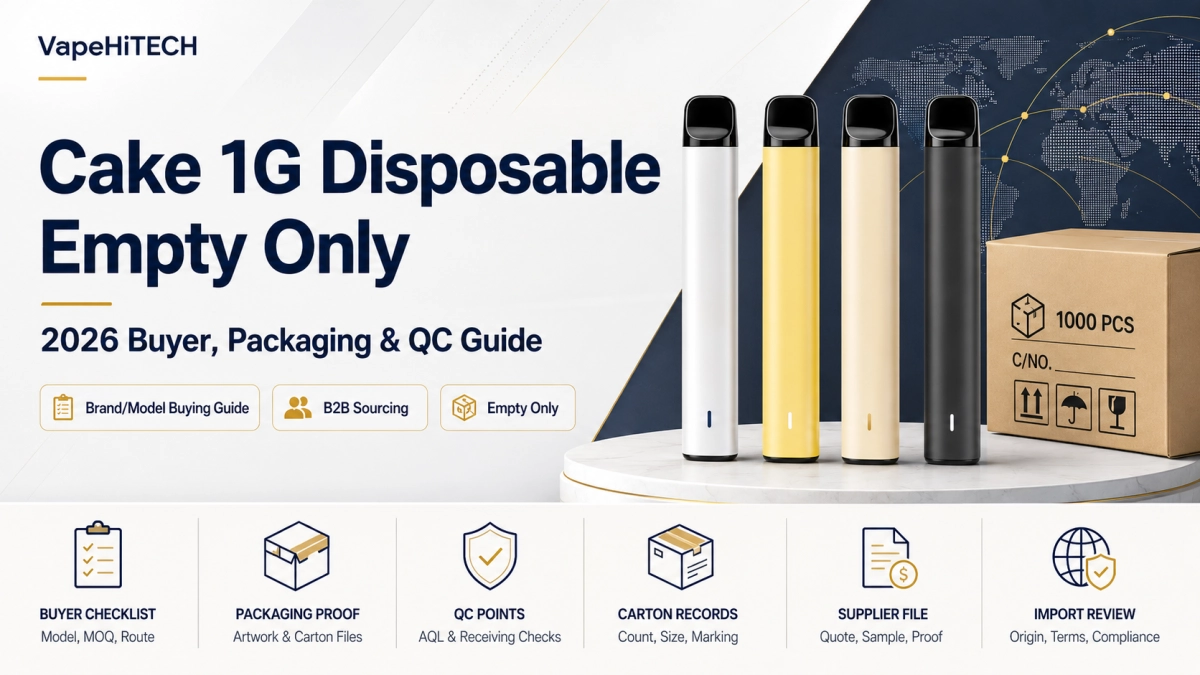
Scope: This guide is written for Cake 1G disposable empty only sourcing. It covers buyer checklist items, model naming, packaging review, QC records, carton records, supplier proof, delivery terms, and purchase-order readiness. It does not cover filling steps, consumption guidance, potency claims, health claims, or end-user instructions.
Why this guide matters
A cake 1g disposable purchase file should not be approved from a product photo or unit quote alone. Bulk buyers need a complete empty only file that connects brand phrase, run label, capacity wording, sample photos, package proof, carton count, inspection plan, and delivery term.
Cake-related searches often mix brand language, run names, 1G wording, 1ml wording, and warehouse notes. If each field is not documented, a sourcing team can end up with mixed listings, mismatched package proof, unclear carton counts, or receiving disputes.
The key idea
Treat Cake, 1G, 1ml, version label, package route, and carton basis as separate buyer-file fields. A clean file should prove that the quoted route, approved sample, package proof, and receiving record all describe the same empty only item.
Quick answer for buyers
Before approving a Cake 1G disposable empty only order, buyers should confirm seven areas: scope, brand phrase, run label, capacity wording, package route, QC rule, and destination-market review.
Scope
Use empty only wording across the RFQ, quote, sample approval, invoice, packing list, and carton mark.
Run label
Separate gen, version, warehouse route, and capacity wording so look-alike listings do not get mixed.
Packaging
Approve package proof, carton mark, pack count, warning-space review, and revision date before release.
QC file
Define inspection basis, defect categories, photo proof, hold rule, and receiving claim process.
| Buyer stage | Main question | File to keep |
|---|---|---|
| TOFU education | What does a Cake 1G empty only sourcing route include? | Brand notes, run-label map, capacity definitions, and destination-market questions. |
| MOFU comparison | Which run, MOQ tier, package route, and carton basis fit the purchase plan? | Spec sheet, sample photos, MOQ table, package proof, and carton basis. |
| BOFU approval | Is the supplier file complete enough for PO release and receiving review? | Quote, sample approval, inspection plan, carton file, delivery term, and claim rule. |
What Cake 1G disposable empty only means
In this guide, Cake 1G disposable empty only means a Cake-family one-gram or 1ml disposable vape format reviewed for business sourcing, catalog naming, package proof, QC planning, carton records, and purchase-order approval. The phrase should be handled carefully because supplier pages may use 1G, 1gram, 1ml, gen, version, or warehouse wording in different ways.
The safest buyer approach is to define the route in separate fields: Cake family phrase, run label, capacity wording, empty only scope, packaging route, carton basis, inspection rule, and market review.
Recommended buyer wording
Use “Cake 1G disposable empty only” in the RFQ, then add version label, capacity wording, package basis, carton count, inspection rule, and delivery term as separate fields.
Buyer checklist before sample approval
A buyer checklist should make each supplier answer the same questions before samples, package proof, or bulk release. This keeps the article educational while still supporting BOFU decision-making.
| Checklist field | What to confirm | Why it matters |
|---|---|---|
| Brand phrase | Confirm whether the supplier uses Cake, CAKE, She Hits Different, or a run-specific phrase. | Brand wording affects catalog grouping, search intent, package proof, and receiving records. |
| Empty only scope | RFQ, quote, sample approval, invoice, packing list, and carton mark should all use empty only wording. | Clear scope reduces mixed-file risk and keeps the purchase file consistent. |
| Capacity wording | Confirm whether the supplier uses 1G, 1gram, 1ml, or buyer-approved wording. | Capacity wording should match the quote, package proof, invoice, packing list, and receiving checklist. |
| Run label | Confirm gen, version, warehouse route, or internal SKU label. | Run separation helps prevent look-alike products from being mixed in the same listing or carton file. |
| Package route | Plain package, supplier stock package, or buyer-approved package. | Package route affects MOQ, artwork proof, carton basis, and approval timing. |
| Release rule | Define what must be checked before shipment release. | Buyers should keep photo proof, inspection notes, carton photos, and a release record. |
For capacity normalization beyond one brand family, buyers can use the 1G capacity hub as a neutral internal reference when comparing 1G, 1ml, and full-gram wording across related routes.
Model naming and run separation
Cake-family pages may use different run labels, and buyers should not assume that similar names describe the same route. Keep a naming map that separates family phrase, version label, capacity class, package route, warehouse route, and carton basis.
| Field | Buyer-safe wording | Example use |
|---|---|---|
| Family phrase | CAKE or Cake She Hits Different | Use for catalog grouping and buyer navigation. |
| Run label | Gen, version, 5th, 6th, or supplier route name. | Use for SKU separation and sample approval. |
| Capacity class | 1G, 1gram, 1ml, or buyer-approved capacity wording. | Use for quote comparison, package proof, and carton records. |
| Warehouse route | USA route, UK route, EU route, or buyer-specified route. | Use for lead-time planning and receiving records. |
| Package route | Plain package, supplier stock package, or buyer-approved package. | Use for package proof and MOQ planning. |
For run-level examples, buyers can review Cake gen6 empty 1ml and Cake 5th 1ml empty route. These links should support naming and sample-check education, not replace a current quote or live stock confirmation.
Packaging proof and carton records
Packaging review is central to a Cake 1G disposable empty only order because package wording often repeats the brand phrase, run label, capacity wording, and carton count. Buyers should approve package proof before bulk release, then compare the received cartons against the same file.
| Packaging field | Buyer question | Approval file |
|---|---|---|
| Front wording | Does the package wording match the approved family phrase and run label? | Artwork proof, sample photos, and revision date. |
| Capacity wording | Does the package match the quote, spec sheet, invoice, packing list, and carton mark? | Capacity table, package proof, and packing list sample. |
| Empty only note | Is empty only wording used consistently in buyer-facing records? | RFQ, quote, invoice, packing list, and release note. |
| Country-of-origin mark | Does the import route require country-of-origin marking review? | country-of-origin marking rules. |
| Special packaging | Does the destination market require special packaging review? | special packaging guide. |
| Carton mark | Does the carton mark match the PO, invoice, quantity, and receiving plan? | Carton photo, carton mark file, and receiving checklist. |
| Shipping unit | Can the carton plan handle expected distribution conditions? | ASTM D4169 distribution testing. |
QC, AQL, and receiving checks
Quality control should be written into the purchase file before the order is released. The buyer should define lot size, sample size, defect categories, package checks, carton checks, hold rules, release rules, and claim timing.
| QC layer | What to check | Record to keep |
|---|---|---|
| Appearance | Visible damage, loose parts, dust, print alignment, color mismatch, and package condition. | Photo set, defect examples, inspection checklist, and approved sample comparison. |
| Route identity | Correct Cake family phrase, correct run label, correct 1G or 1ml wording, and correct package route. | Spec sheet, package proof, carton photos, and release note. |
| Pack count | Pieces per tray, trays per inner box, inner boxes per master carton, and total carton count. | Packing list, carton file, and warehouse receiving count. |
| Defect categories | Critical, major, and minor defects agreed before release. | AQL table, inspection report, and hold rule. |
| Receiving review | Compare received cartons against supplier release file, carton marks, and packing list. | Receiving file, discrepancy report, and claim photos where needed. |
| Change control | Supplier must notify the buyer before changes to route, package, carton, or process records. | Written change-control rule and buyer approval record. |
For lot-by-lot sampling by attributes, ISO 2859-1:2026 AQL is a useful official reference when the buyer wants a documented sampling basis.
Supplier verification file
Supplier verification should happen before PO approval. A wholesale buyer should collect comparable files from each supplier so procurement, compliance, warehouse, and finance teams can review the same evidence.
| Verification area | What to ask | Proof to request |
|---|---|---|
| Business identity | Who issues the quote, invoice, and shipment file? | Company name, contact record, invoice details, and signed quotation. |
| Route identity | Which Cake 1G disposable empty only route is being quoted? | Spec sheet, route name, sample photos, package proof, and SKU list. |
| Run proof | Does the run label match across quote, sample, package proof, and release photos? | Close-up photos, run note, artwork proof, and release record. |
| Quality process | How does the supplier control documents, nonconformities, corrective action, and repeat orders? | ISO 9001 QMS can help frame supplier-process questions. |
| Lab-file context | If the supplier provides test files, is the laboratory context credible? | ISO/IEC 17025 laboratories can support lab-competence review. |
| Brand/model context | Does the buyer need a broader CAKE family reference for internal catalog teams? | Use the CAKE sourcing guide as a final support link, not as the main keyword target. |
Market and import checks
Market review should happen before sample approval and again before PO release. Empty only scope does not remove buyer-side obligations. Requirements can vary by destination market, business role, package wording, import route, and claim language.
| Check area | Buyer question | Useful reference |
|---|---|---|
| Official brand context | Does the buyer need first-party context for CAKE family positioning? | CAKE official overview. |
| Authenticity questions | Does the buyer need a first-party reference for authenticity wording and channel review? | CAKE official FAQ. |
| US ENDS scope | Could the product, component, package, label, or claim fall within FDA ENDS review? | FDA ENDS overview. |
| US authorization context | Does the buyer need to check whether a planned market route has relevant FDA authorization context? | FDA authorized ENDS list. |
| US application context | Does the buyer need to review PMTA-related expectations for a planned market route? | FDA PMTA guidance. |
| US enforcement context | Does the buyer need to review FDA enforcement priority context before market planning? | FDA enforcement priorities. |
| EU route | Does the EU route require notification, packaging, labeling, or ingredient-file review? | EU electronic cigarette rules. |
| UK route | Does a GB or Northern Ireland route require MHRA-related product-file review? | MHRA vape guidance. |
| US import review | Could an agency require a license, permit, certification, or import specialist review? | US import permit check and CBP importing basics. |
These references support buyer questions. They do not replace legal, import, tax, labeling, or licensed-market advice.
Landed cost and delivery terms
A quote is not the same as landed cost. Before PO approval, buyers should separate unit cost, package cost, inspection cost, inland transport, export handling, freight, duties, taxes, brokerage, storage, and claim handling.
| Cost field | Buyer question | File to keep |
|---|---|---|
| Unit price | What unit basis is used: piece, tray, box, carton, or lot? | Quote sheet and MOQ table. |
| Package cost | Is packaging included, separate, or subject to its own minimum? | Package proof, package quote, and approval date. |
| Inspection cost | Who arranges inspection, and when does release happen? | Inspection plan, report, and release note. |
| Carton cost | Is the quote calculated by piece count, master carton, or full lot? | Carton basis, carton photos, and packing list sample. |
| Delivery term | Which party handles transport, named place, cost responsibility, and risk point? | Purchase order, invoice, and Incoterms 2020 rules. |
| Import review | Does the buyer need a license, permit, certification, or agency review? | Importer file, broker notes, and buyer-side compliance checklist. |
Bulk buyer scorecard
Use a scorecard to compare suppliers without focusing only on price. Each score should be supported by written evidence.
| Score area | Suggested weight | Evidence to review |
|---|---|---|
| Scope clarity | 15 | Empty only wording across RFQ, quote, sample approval, invoice, packing list, and carton mark. |
| Model clarity | 15 | Family phrase, run label, capacity wording, package route, warehouse route, and SKU map. |
| MOQ clarity | 15 | Sample MOQ, pilot MOQ, stock-lot MOQ, package MOQ, carton basis, and reorder MOQ. |
| Supplier proof | 15 | Spec sheet, sample photos, stock proof, package proof, carton photos, and change-control note. |
| QC readiness | 15 | AQL basis, defect categories, checked quantity, release photos, hold rule, and claim rule. |
| Market readiness | 10 | Destination-market checklist, package review, restricted-substance declaration where relevant, and import notes. |
| Carton and receiving records | 10 | Pieces per carton, carton dimensions, gross weight, carton mark, packing list, and receiving checklist. |
| Repeat-order control | 5 | Written notice before route, package, carton, or process changes. |
RFQ template
Use this RFQ template to collect comparable answers before approving samples, pilot orders, or bulk purchase orders.
Subject: RFQ for Cake 1G Disposable Empty Only - Buyer Checklist, Packaging, QC, and Delivery Review
Scope: Empty only
Destination market: [insert country, state, province, or licensed-market route]
Buyer role: [wholesaler / distributor / licensed operator / brand owner / importer]
Requested route: [Cake / CAKE / She Hits Different / gen or version / 1G / 1ml / buyer-approved wording]
Package route: [plain package / supplier stock package / buyer-approved package]
Quantity target: [sample / pilot / bulk / stock / reorder]
MOQ request: [sample MOQ / pilot MOQ / bulk MOQ / package MOQ / stock MOQ / reorder MOQ]
Price basis: [piece / tray / inner box / master carton / total lot]
Specification request: [capacity wording / run label / material declaration where relevant / pack count / carton basis]
Sample review: [sample quantity / sample photos / appearance check / package check / carton basis]
Carton record: [pieces per pack / packs per carton / carton dimensions / gross weight / carton mark]
QC request: [AQL basis / appearance / route identity / pack count / carton count / photo record / release rule]
Document request: [quote sheet / spec sheet / material declaration / package proof / inspection report / packing list / lab file where relevant]
Delivery term: [EXW / FOB / FCA / DAP / DDP / buyer-specified term with named place]
Target receiving window: [insert date range]
Claim process: [shortage, mixed item, appearance defect, packaging issue, carton issue, or late-release process]
Official references
These references support a neutral buyer file. They do not replace legal, import, tax, packaging, or licensed-market review.
| Reference area | Use in the buyer file | Source |
|---|---|---|
| Brand context | Supports first-party review of the CAKE family phrase and brand positioning. | CAKE official overview |
| Authenticity questions | Supports buyer-side channel and authenticity questions. | CAKE official FAQ |
| US ENDS scope | Supports buyer-side review of category, components, claims, packaging, and market scope. | FDA ENDS overview |
| US authorization context | Supports current-market cross-checks for relevant FDA authorization context. | FDA authorized ENDS list |
| US application context | Supports PMTA-related review questions for planned market routes. | FDA PMTA guidance |
| US enforcement context | Supports review of FDA enforcement priority context before market planning. | FDA enforcement priorities |
| Country-of-origin marking | Supports import marking review for articles and containers. | country-of-origin marking rules |
| Special packaging | Supports child-resistant and senior-friendly packaging questions where applicable. | special packaging guide |
| Quality management | Supports supplier process review, document control, and corrective-action discussion. | ISO 9001 QMS |
| Lab competence | Supports review of laboratory competence and test-report context. | ISO/IEC 17025 laboratories |
| Sampling inspection | Supports AQL planning and lot-by-lot inspection by attributes. | ISO 2859-1:2026 AQL |
| Distribution testing | Supports carton and distribution-risk discussion. | ASTM D4169 distribution testing |
| US import | Supports license, permit, certification, agency, and port-of-entry review. | US import permit check |
| CBP importing basics | Supports importer responsibility and broker-file questions. | CBP importing basics |
| Delivery terms | Supports named-place wording, cost responsibility, and risk-point review. | Incoterms 2020 rules |
FAQ
What does Cake 1G disposable mean in this guide?
It means a Cake-family 1G or 1ml disposable vape empty only format reviewed for B2B sourcing, model naming, package proof, QC planning, carton records, and purchase-order approval.
Is 1G the same as 1ml?
Not always. Some supplier pages use 1G, 1gram, and 1ml wording in different ways. Buyers should define the exact wording in the RFQ and keep it consistent across quote, sample approval, package proof, invoice, packing list, and carton mark.
What should buyers confirm before ordering?
Buyers should confirm empty only scope, Cake family phrase, run label, capacity wording, MOQ tier, package proof, supplier documentation, inspection rules, delivery terms, and receiving records.
Why does run separation matter?
Run separation helps prevent similar Cake-family listings from being mixed. The buyer file should separate family phrase, version label, capacity wording, package route, warehouse route, and carton basis.
Is a product photo enough for approval?
No. A product photo should be supported by a spec sheet, sample approval, package proof, inspection checklist, carton record, and release photos.
Which documents are most important for bulk buyers?
The most important documents are the quote sheet, spec sheet, material declaration where relevant, sample photo record, package proof, stock proof, carton file, inspection report, packing list, and change-control note.
Is this legal advice?
No. This is an educational B2B sourcing guide. Buyers should use qualified legal, import, tax, packaging, and licensed-market support before final approval.
0 Comments