
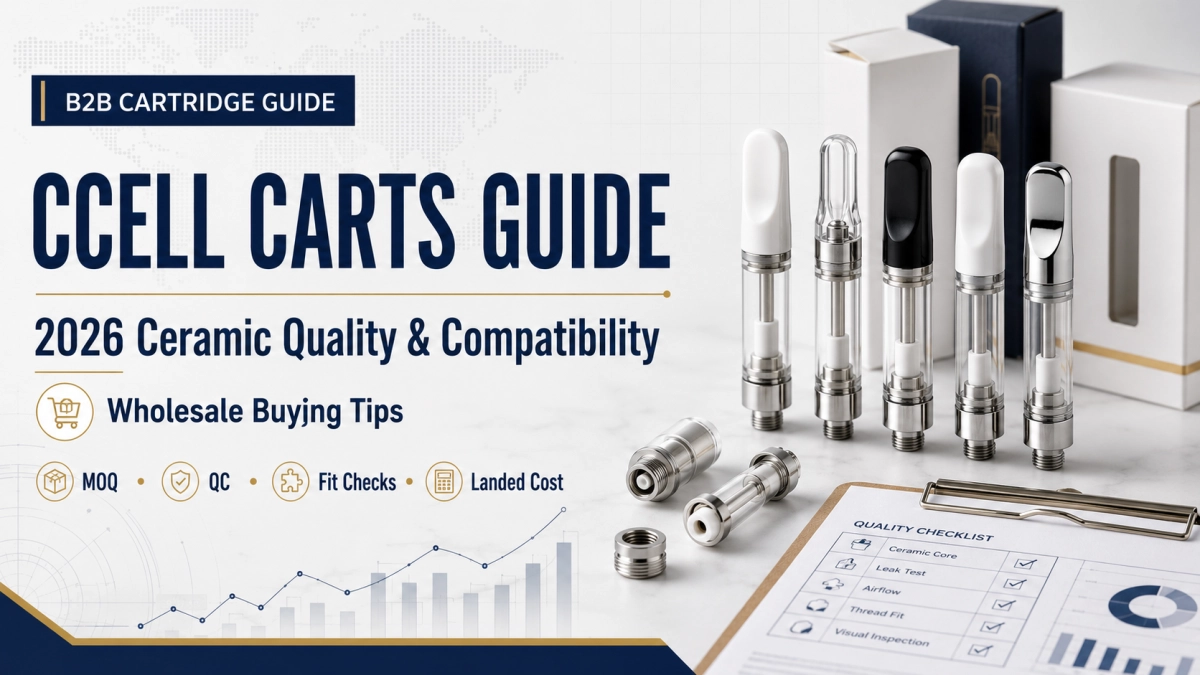
Scope: This guide is written for CCELL carts empty only sourcing. It covers ceramic cartridge quality, capacity wording, fit checks, material files, packaging proof, QC records, supplier review, landed-cost planning, and RFQ readiness. It does not cover filling steps, consumption guidance, potency claims, health claims, or end-user instructions.
Why this guide matters
A CCELL cart buying file should not be approved from a product photo or unit quote alone. Bulk buyers need a complete empty only file that connects the brand phrase, capacity wording, ceramic core note, mouthpiece route, material declaration, package proof, carton basis, inspection rule, and delivery term.
CCELL-related searches often mix brand naming, 510 cartridge wording, ceramic cartridge language, glass tank notes, 0.5ml and 1ml capacity wording, and wholesale MOQ claims. If each field is not documented, a sourcing team may compare unlike quotes or approve an item that does not match the receiving plan.
The key idea
Treat CCELL, cartridge type, ceramic core note, capacity wording, mouthpiece route, package route, carton basis, and market review as separate buyer-file fields. A clean file should prove that the quote, approved sample, package proof, inspection record, and receiving checklist describe the same empty only item.
Quick answer for buyers
ccell carts are best reviewed as a ceramic cartridge sourcing category, not as a single generic SKU. For wholesale buying, the buyer should confirm the cartridge family, capacity wording, ceramic core note, glass or metal parts, mouthpiece route, package basis, MOQ tier, QC rule, and delivery term before sample approval.
Quality
Review ceramic core description, glass or metal parts, seal consistency, and repeat-order records.
Fit
Confirm 510-thread wording, cartridge dimensions, mouthpiece route, and capacity wording in writing.
Wholesale
Compare MOQ tiers, package route, carton basis, inspection rule, and quote validity period.
Risk control
Keep market review, trademark review, material declarations, and landed-cost assumptions in the buyer file.
| Buyer stage | Main question | File to keep |
|---|---|---|
| TOFU education | What makes a CCELL cart different from a generic empty cartridge? | Brand note, cartridge-family note, ceramic-core note, and capacity glossary. |
| MOFU comparison | Which capacity, mouthpiece route, material file, and MOQ tier fit the purchase plan? | Spec sheet, sample photos, MOQ table, material declaration, and package proof. |
| BOFU approval | Is the supplier file complete enough for PO release and receiving review? | Quote, sample approval, inspection plan, carton file, delivery term, and claim rule. |
What CCELL carts means in a buyer file
In this guide, CCELL carts means CCELL-family empty ceramic cartridges reviewed for B2B sourcing, cartridge quality, fit checks, package review, QC planning, carton records, and purchase-order approval. The phrase should be handled carefully because supplier pages may use CCELL, CCell, ceramic cart, 510 cartridge, 0.5ml, 0.8ml, 1ml, glass, metal, or warehouse wording in different ways.
The safest buyer approach is to define the route in separate fields: brand phrase, cartridge family, capacity wording, empty only scope, mouthpiece route, material note, packaging route, carton basis, inspection rule, and market review.
Recommended buyer wording
Use “CCELL carts empty only” in the RFQ, then add cartridge family, capacity wording, mouthpiece route, material declaration, package basis, carton count, inspection rule, and delivery term as separate fields.
Ceramic cartridge quality checks
Ceramic cartridge quality should be reviewed through repeatable records, not through broad performance claims. CCELL’s official technology pages describe ceramic heating-core development and cartridge families, while buyer files should translate those claims into practical sourcing checks: core description, housing material, seal layout, mouthpiece route, batch photos, and release evidence.
| Quality area | What to confirm | Buyer file |
|---|---|---|
| Ceramic core | Ask for the cartridge family, core description, and approved sample photos. | Spec sheet, close-up photos, and sample approval record. |
| Housing | Confirm glass, metal, ceramic, or mixed-material wording. | Material declaration and supplier quote note. |
| Mouthpiece route | Confirm snap-fit, screw-on, press-on, flat, round, ceramic, plastic, or metal wording. | Mouthpiece photo record and sample approval. |
| Seal consistency | Ask how seals are checked before release and how changes are reported. | Inspection checklist, release photos, and change-control rule. |
| Repeat order | Confirm whether reorders use the same route, pack count, and carton basis. | Reorder note, lot note, carton photos, and receiving checklist. |
For broader category context, buyers can compare related vape cartridges before narrowing the RFQ to a CCELL-specific route.
Compatibility and fit checklist
Compatibility should be written as a buyer checklist rather than a general promise. The buyer should confirm thread wording, tank capacity, outer dimensions, mouthpiece route, cap method, package route, and sample approval before bulk release. Avoid unsupported universal-fit language unless the supplier provides written evidence for the exact item and market route.
| Fit field | Buyer question | Why it matters |
|---|---|---|
| Thread wording | Is the quote using standard 510 cartridge wording? | Thread wording affects catalog naming, sample approval, and receiving checks. |
| Capacity | Does the supplier use 0.5ml, 0.8ml, 1ml, or buyer-approved wording? | Capacity must match the quote, package proof, invoice, packing list, and carton mark. |
| Mouthpiece | Is the mouthpiece flat, round, ceramic, plastic, metal, screw-on, or press-on? | Mouthpiece route affects pack proof, sample approval, and receiving photos. |
| Dimensions | Can the supplier provide length, diameter, tolerance, and carton basis? | Dimensions help prevent mismatch between sample and bulk release. |
| Oil-viscosity context | Can the supplier provide a written suitability note without end-user instructions? | Business buyers need fit context, not filling or usage guidance. |
When capacity is the central filter, the 0.5ml vape cartridges category is a useful internal reference because it helps separate small-capacity routes from 0.8ml and 1ml quote files.
Material, glass, and ceramic review
Material review is important because ceramic, glass, metal, and mouthpiece choices can affect cost, package wording, documentation, and receiving checks. Buyers should collect a material declaration where relevant and confirm whether any destination-market restricted-substance review is needed.
| Material field | What to ask | Document to keep |
|---|---|---|
| Ceramic parts | Which ceramic parts are included, and how are they described in the supplier file? | Spec sheet, material note, and close-up photos. |
| Glass parts | Is the housing glass, and does the supplier specify a glass type? | Material declaration and sample approval photos. |
| Metal parts | Which metal parts are used, and are restricted-substance files available where relevant? | Supplier declaration and destination-market checklist. |
| Plastic parts | Which plastic parts are present in the mouthpiece, seal, or package route? | Material note and package proof. |
| Change control | Will the supplier notify the buyer before material, route, or packaging changes? | Written change-control rule and buyer approval record. |
For material browsing and buyer-file planning, metal and glass vape cartridges can support the quality section without turning the article into a sales page.
Wholesale buying tips: MOQ, packaging, and supplier proof
Wholesale buying should compare complete files, not only unit prices. Each supplier should quote the same capacity, same cartridge family, same mouthpiece route, same package route, same carton basis, and same delivery term. If one supplier includes package proof and inspection while another excludes them, the lower unit quote may not be the lower total cost.
| Wholesale field | Buyer question | Approval file |
|---|---|---|
| MOQ tier | Is the quote for sample, pilot, carton, stock lot, or larger bulk quantity? | MOQ table, price basis, and quote validity date. |
| Package route | Is the route plain pack, supplier stock pack, or buyer-approved pack? | Artwork proof, revision date, pack count, and carton mark. |
| Supplier proof | Can the supplier prove the same route across quote, sample, package, and release photos? | Spec sheet, sample photos, package proof, and carton photos. |
| Capacity option | Does the supplier offer 0.5ml, 0.8ml, 1ml, or other buyer-approved wording? | Capacity map, SKU list, and receiving checklist. |
| Example file | Is there a single product page that can act as a sample buyer-file reference? | CCELL White vape cartridges. |
QC, AQL, and receiving checks
Quality control should be defined before the order is released. A buyer should set lot size, sample size, defect categories, package checks, carton checks, hold rules, release rules, and claim timing in writing. A documented AQL method can help teams review lots consistently.
| QC layer | What to check | Record to keep |
|---|---|---|
| Identity | Correct CCELL phrase, correct cartridge family, correct capacity wording, and correct package route. | Spec sheet, package proof, carton photos, and release note. |
| Appearance | Visible damage, loose parts, dust, print alignment, color mismatch, and package condition. | Photo set, defect examples, inspection checklist, and approved sample comparison. |
| Pack count | Pieces per tray, trays per inner box, inner boxes per master carton, and total carton count. | Packing list, carton file, and warehouse receiving count. |
| Defect categories | Critical, major, and minor defects agreed before release. | AQL table, inspection report, and hold rule. |
| Receiving review | Compare received cartons against supplier release file, carton marks, and packing list. | Receiving file, discrepancy report, and claim photos where needed. |
| Change control | Supplier must notify the buyer before changes to route, package, carton, material, or process records. | Written change-control rule and buyer approval record. |
Import, landed cost, and trade terms
A unit quote is not the same as landed cost. Before PO approval, buyers should separate unit cost, package cost, inspection cost, inland transport, export handling, freight, duties, taxes, brokerage, storage, and claim handling. Trade-term wording should include the named place and should be aligned with the purchase order.
| Cost field | Buyer question | File to keep |
|---|---|---|
| Unit price | What unit basis is used: piece, tray, box, carton, or lot? | Quote sheet and MOQ table. |
| Package cost | Is packaging included, separate, or subject to its own minimum? | Package proof, package quote, and approval date. |
| Inspection cost | Who arranges inspection, and when does release happen? | Inspection plan, report, and release note. |
| Carton cost | Is the quote calculated by piece count, master carton, or full lot? | Carton basis, carton photos, and packing list sample. |
| Trade term | Which party handles transport, named place, cost responsibility, and risk point? | Purchase order, invoice, and delivery-term note. |
| Import review | Does the buyer need tariff, permit, certificate, or broker review? | Importer file, broker notes, and buyer-side checklist. |
Brand and claim review
CCELL is a brand term, so buyers should write carefully. This article is an educational sourcing guide and is not an affiliation, authorization, or partnership claim. Buyers should also avoid unsupported universal compatibility claims, health claims, potency claims, and guaranteed outcome claims.
| Review area | Buyer question | Why it matters |
|---|---|---|
| Brand naming | Is the page using CCELL only to describe the target sourcing category? | Brand wording should be accurate and not imply a relationship without proof. |
| Compatibility wording | Can the buyer prove the exact fit claim for the exact item? | Unsupported fit claims can create returns, disputes, and listing edits. |
| Quality wording | Are quality statements tied to files, photos, inspection, or supplier records? | Evidence-based language is safer than broad claims. |
| Market wording | Does the buyer need destination-market review before publishing or importing? | Rules can vary by market, role, package, label, import route, and claim language. |
Bulk buyer scorecard
Use a scorecard to compare suppliers without focusing only on price. Each score should be supported by written evidence.
| Score area | Suggested weight | Evidence to review |
|---|---|---|
| Scope clarity | 15 | Empty only wording across RFQ, quote, sample approval, invoice, packing list, and carton mark. |
| Cartridge identity | 15 | CCELL phrase, cartridge family, capacity wording, mouthpiece route, material note, and SKU map. |
| MOQ clarity | 15 | Sample MOQ, pilot MOQ, stock-lot MOQ, package MOQ, carton basis, and reorder MOQ. |
| Supplier proof | 15 | Spec sheet, sample photos, stock proof, package proof, carton photos, and change-control note. |
| QC readiness | 15 | AQL basis, defect categories, checked quantity, release photos, hold rule, and claim rule. |
| Market readiness | 10 | Destination-market checklist, package review, material declaration where relevant, and import notes. |
| Carton and receiving records | 10 | Pieces per carton, carton dimensions, gross weight, carton mark, packing list, and receiving checklist. |
| Repeat-order control | 5 | Written notice before route, package, carton, material, or process changes. |
RFQ template
Use this RFQ template to collect comparable answers before approving samples, pilot orders, or bulk purchase orders.
Subject: RFQ for CCELL Carts Empty Only - Ceramic Cartridge Quality, Fit, MOQ, QC, and Delivery Review
Scope: Empty only
Destination market: [insert country, state, province, or licensed-market route]
Buyer role: [wholesaler / distributor / licensed operator / brand owner / importer]
Requested route: [CCELL / ceramic cartridge / 510 cartridge / buyer-approved wording]
Capacity wording: [0.5ml / 0.8ml / 1ml / buyer-approved wording]
Cartridge family: [supplier route name / CCELL family name / buyer-approved SKU]
Mouthpiece route: [flat / round / ceramic / plastic / metal / snap-fit / screw-on / press-on]
Package route: [plain package / supplier stock package / buyer-approved package]
Quantity target: [sample / pilot / bulk / stock / reorder]
MOQ request: [sample MOQ / pilot MOQ / bulk MOQ / package MOQ / stock MOQ / reorder MOQ]
Price basis: [piece / tray / inner box / master carton / total lot]
Specification request: [capacity wording / ceramic-core note / material declaration where relevant / pack count / carton basis]
Sample review: [sample quantity / sample photos / appearance check / package check / carton basis]
Carton record: [pieces per pack / packs per carton / carton dimensions / gross weight / carton mark]
QC request: [AQL basis / appearance / identity check / pack count / carton count / photo record / release rule]
Document request: [quote sheet / spec sheet / material declaration / package proof / inspection report / packing list / lab file where relevant]
Delivery term: [EXW / FOB / FCA / DAP / DDP / buyer-specified term with named place]
Target receiving window: [insert date range]
Claim process: [shortage, mixed item, appearance defect, packaging issue, carton issue, or late-release process]
Official references
These references support a neutral buyer file. They do not replace legal, import, tax, trademark, packaging, or licensed-market review.
| Reference area | Use in the buyer file | Source |
|---|---|---|
| CCELL cartridge context | Supports first-party review of cartridge family naming and 510 cartridge wording. | CCELL cartridge family |
| Ceramic technology | Supports ceramic-core language and buyer questions about quality checks. | CCELL ceramic technology |
| Manufacturing context | Supports supplier-process questions and mass-production quality review. | CCELL manufacturing capability |
| US component scope | Supports buyer-side review of category, components, claims, packaging, and market scope. | FDA ENDS component scope |
| Tariff schedule | Supports broker review of current US tariff classification before PO approval. | current HTS schedule |
| Landed cost | Supports estimation of freight, insurance, duties, taxes, and other fees. | landed cost estimate |
| Delivery terms | Supports named-place wording, cost responsibility, and risk-point review. | Incoterms cost responsibilities |
| EU material restrictions | Supports restricted-substance review for EU routes where relevant. | EU RoHS material restrictions |
| EU chemical review | Supports SVHC and restricted-substance file review where relevant. | REACH SVHC review |
| Trademark review | Supports naming, package wording, and confusion-risk review. | trademark clearance check |
| Quality management | Supports supplier process review, document control, and corrective-action discussion. | ISO 9001 QMS |
| Lab competence | Supports review of laboratory competence and test-report context. | ISO/IEC 17025 laboratories |
| Sampling inspection | Supports AQL planning and lot-by-lot inspection by attributes. | ISO 2859-1 AQL sampling |
FAQ
What are CCELL carts?
CCELL carts are CCELL-family empty ceramic cartridges reviewed in this guide for B2B sourcing, cartridge quality, fit checks, package proof, QC planning, carton records, and purchase-order approval.
Why do buyers focus on ceramic cartridge quality?
Ceramic cartridge quality affects the buyer file because it connects the ceramic core note, material selection, seal checks, sample approval, supplier proof, and receiving inspection.
What should buyers confirm before ordering?
Buyers should confirm empty only scope, CCELL phrase, cartridge family, capacity wording, mouthpiece route, material declaration, MOQ tier, package proof, supplier documentation, inspection rules, delivery terms, and receiving records.
How should buyers review compatibility?
Buyers should review compatibility through written fit fields: thread wording, capacity, dimensions, mouthpiece route, package route, approved sample photos, and supplier fit notes for the exact item.
Is a product photo enough for approval?
No. A product photo should be supported by a spec sheet, sample approval, package proof, inspection checklist, carton record, and release photos.
Which documents are most important for bulk buyers?
The most important documents are the quote sheet, spec sheet, material declaration where relevant, sample photo record, package proof, stock proof, carton file, inspection report, packing list, and change-control note.
Is this legal advice?
No. This is an educational B2B sourcing guide. Buyers should use qualified legal, import, tax, trademark, packaging, and licensed-market support before final approval.
0 Comments