
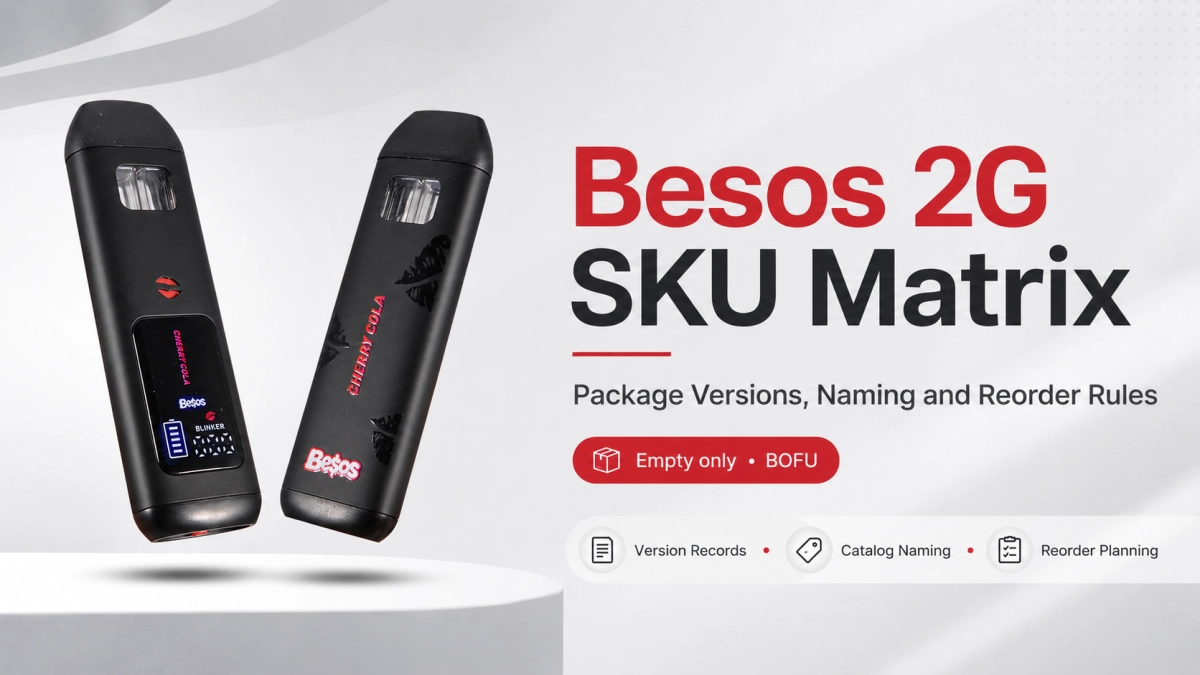
Scope: This brief is written for qualified wholesale buyers, catalog teams, receiving teams, and inventory planners reviewing empty only Besos 2G rows in markets where allowed. It focuses on SKU selection, package-version separation, catalog naming, reorder records, and internal data quality. It does not cover filled material, formulas, filling steps, dosage claims, potency claims, medical claims, therapeutic claims, consumer use directions, youth-facing messaging, or legal advice.
Why a Besos 2G SKU matrix matters
A clean besos 2g SKU matrix helps wholesale teams separate category routing, package version, catalog naming, and reorder logic before they repeat a purchase. The goal is not to push one row over another. The goal is to prevent mixed naming, unclear package notes, and reorder confusion when similar Besos 2G rows appear in the same catalog file.
For BOFU buyers, the useful question is practical: which Besos 2G row should be selected, how should it be named, what package version should be recorded, and what must be checked before reordering? A matrix turns that decision into a repeatable internal process.
The core idea
Let the category page hold the main Besos 2G route. Let each SKU row carry a clear package version, catalog name, reorder rule, and receiving record.
Quick answer
A Besos 2G SKU Selection Matrix should separate the parent family from specific rows such as Blue, Gold Edition, mixed-flavor assortments, and other package versions. Each row should have a controlled name, a package-version note, a reorder threshold, a photo record, and a receiving rule. The matrix should be simple enough for purchasing, catalog, and warehouse teams to use without rewriting titles every time a new order is placed.
Main buyer need
Choose the right Besos 2G row without mixing package versions or order notes.
Best page role
This article should support the Besos category route and clarify SKU-level selection.
Matrix outcome
A repeatable naming, package, and reorder record for each empty only row.
Content boundary
Keep the brief proof-led, operational, and non-promotional.
SKU selection matrix
The matrix should show how each Besos 2G row is selected and maintained. Use the category route for discovery, then assign row-level ownership to the actual package version or assortment being reviewed.
| SKU decision field | What to record | Recommended owner | Why it matters |
|---|---|---|---|
| Parent family | Besos 2G as the category-level route. | Category manager. | Prevents every row from competing for the same broad phrase. |
| Package version | Visible package wording, edition wording, color cue, and carton note. | Receiving team. | Keeps similar rows from being merged by mistake. |
| Catalog name | Controlled title used in product cards, spreadsheets, invoices, and reorder files. | Catalog team. | Improves search clarity and internal reporting. |
| Assortment rule | Single-version row, color-led row, edition-led row, or mixed-flavor row. | Buyer. | Clarifies whether the row is a stable repeat item or a changing assortment. |
| Reorder trigger | Minimum stock level, lead time, package version check, and approval note. | Inventory planner. | Reduces wrong-version replenishment. |
Package-version separation
Package versions should be separated when visible wording, color cue, edition label, carton setup, or assortment logic changes. For example, Besos Blue 2G is useful as a color-led SKU example because the buyer can place the color cue directly into the selection matrix. A row such as Besos Gold Edition 2G should carry its edition wording in the matrix instead of being shortened into a generic 2G line.
| Version signal | Matrix field | Acceptable record | Risk if ignored |
|---|---|---|---|
| Color cue | Color or visible version note. | Blue, black, gold, or other visible cue where applicable. | Color-specific rows may be mixed in one reorder file. |
| Edition wording | Edition field. | Gold Edition or other exact wording from the listing and package. | Edition pages may compete with standard rows. |
| Package setup | Outer box, inner box, label, and carton note. | Dated photo set and receiving checklist. | The next order may not match the approved version. |
| Assortment format | Single row or mixed row. | Clear note for mixed flavor, single color, or fixed package version. | Inventory counts become hard to compare across orders. |
| Supplier note | Source and confirmation note. | Written confirmation attached to the SKU file. | Teams rely on memory instead of repeatable records. |
Matrix rule
If the package version changes the way buyers identify, receive, or reorder the row, it should have its own matrix line.
Catalog naming rules
Catalog naming should be clear, stable, and short enough for product cards, spreadsheets, and reorder files. A good name should answer four questions: brand family, capacity class, version cue, and package or assortment role.
| Naming layer | Recommended field | Example format | Do not |
|---|---|---|---|
| Family | Besos. | Besos. | Use only the brand family when version matters. |
| Capacity class | 2G. | Besos 2G. | Switch between 2G, 2g, 2 gram, and 2ml randomly. |
| Version cue | Blue, Gold Edition, V4, or other visible cue. | Besos Blue 2G or Besos Gold Edition 2G. | Remove version wording from rows that need separation. |
| Assortment cue | Mixed flavors or fixed version note. | Besos 2G mixed flavors. | Make a mixed row look like a single fixed version. |
| Reorder note | Internal-only reorder tag. | Approved package version, date, and receiving photo set. | Publish internal reorder notes as public marketing copy. |
For external search clarity, Google recommends clear page titles that help users understand what the page is about. In a Besos 2G matrix, that means a category route can use the broad phrase, while row-level pages should keep visible version cues in the title and body copy.
Reorder planning
Reorder planning should not depend only on how quickly a row sells through. The buyer should also confirm that the requested replacement row has the same package version, same catalog name, same assortment rule, and same receiving expectations as the previous approved order. A page such as Besos 2G mixed flavors is a useful example because assortment rows require clearer reorder notes than single-version rows.
| Reorder checkpoint | Question to answer | Record to keep | Decision rule |
|---|---|---|---|
| Same row? | Is the requested row the same as the approved matrix line? | Previous title, current quote title, and link record. | Approve only when the version and assortment role match. |
| Same package version? | Do the package photos match the previous approved version? | Dated photo set and receiving comparison. | Pause if package wording or visual cues differ. |
| Same carton logic? | Is the carton, inner pack, or mixed-case logic the same? | Carton note, case count, and receiving count. | Review before reordering if packing levels changed. |
| Same catalog name? | Will the row keep the same public name and internal SKU name? | Catalog title and SKU spreadsheet record. | Do not publish name changes without a matrix update. |
| Same market limits? | Is the reorder still limited to allowed markets and qualified buyers? | Market review note. | Reject unsupported routes. |
Records to keep
A SKU matrix is only useful when teams maintain the records behind it. Each Besos 2G row should include a short data packet that can be reviewed by purchasing, catalog, receiving, and inventory teams.
| Record type | Minimum fields | Best use | Review timing |
|---|---|---|---|
| SKU master row | Brand family, capacity class, version cue, package version, and public title. | Controls naming across the catalog. | Before publishing or changing a page. |
| Package photo record | Front, back, side, label, and carton photos. | Supports package-version comparison. | Before shipment and at receiving. |
| Assortment record | Single-version or mixed-flavor note. | Supports replenishment and stock reporting. | Before placing a repeat order. |
| Supplier confirmation | Written confirmation of row name, package version, and fulfillment route. | Reduces verbal-only sourcing risk. | Before payment or release. |
| Receiving checklist | Date, reviewer, count, package match, exception note, and photo link. | Documents whether the lot matched the matrix. | At arrival and before inventory release. |
Internal link plan
Internal links should be limited and practical. Use one exact-match anchor for the main keyword, then use short row-level anchors to support version, package, and reorder examples. Keep supporting links spaced naturally inside the matrix sections.
| Priority | Anchor text | Target role | Use in this article |
|---|---|---|---|
| 1 | besos 2g | Besos category route. | Main exact-match anchor in the opening section. |
| 2 | Besos Blue 2G | Color-led SKU example. | Use in package-version separation. |
| 3 | Besos Gold Edition 2G | Edition-led SKU example. | Use in package-version separation. |
| 4 | Besos 2G mixed flavors | Assortment and reorder example. | Use in reorder planning. |
| 5 | Besos disposable guide | Supporting guide route. | Use once for version-map and receiving-record context. |
For broader empty only version mapping and receiving-record context, use the Besos disposable guide as a supporting reference after the matrix fields are defined.
Official references
Use external references to support product grouping, variant structure, packaging levels, title clarity, internal anchor planning, import-file awareness where applicable, and truthful catalog wording. These references help keep the article operational and proof-led.
| Reference area | Recommended anchor text | How to use it | Source |
|---|---|---|---|
| Variant grouping | Product Variant Structured Data | Use when explaining parent family, hasVariant, variesBy, and productGroupID logic. | Product Variant Structured Data |
| Product family vocabulary | Schema.org ProductGroup | Use when separating the Besos 2G parent family from row-level variants. | Schema.org ProductGroup |
| Packaging hierarchy | GS1 packaging levels | Use when explaining each, inner pack, case, and mixed-case records. | GS1 packaging levels |
| Identifier management | GS1 GTIN Management Standard | Use when explaining why higher-level packaging changes may need separate identifier review. | GS1 GTIN Management Standard |
| Title clarity | Google title link best practices | Use when explaining why row names should be clear and stable. | Google title link best practices |
| Internal anchors | Google link best practices | Use when explaining why anchor text should be descriptive and limited. | Google link best practices |
| Import-file awareness | FDA import entry review | Use where applicable for declared-party and product-description records. | FDA import entry review |
| Truthful catalog wording | FTC truthful advertising guidance | Use when removing unsupported claims from product and reorder copy. | FTC truthful advertising guidance |
| Helpful content review | Google helpful content guidance | Use when keeping the page practical, buyer-focused, and not over-optimized. | Google helpful content guidance |
| Breadcrumb planning | breadcrumb structured data | Use when aligning the article with category and blog navigation. | breadcrumb structured data |
FAQ
What is a Besos 2G SKU Selection Matrix?
It is an internal decision table that helps wholesale teams separate Besos 2G package versions, catalog names, assortment logic, and reorder rules before selecting or repeating an empty only row.
Which page should receive the exact besos 2g anchor?
The exact-match anchor should point to the Besos category route because that page is the broadest parent route for Besos-related rows.
Should Blue and Gold Edition rows be separate matrix lines?
Yes, when the color cue, edition wording, package photos, or receiving records differ. Separate lines reduce naming and reorder confusion.
How should mixed-flavor rows be handled?
Mixed-flavor rows should be marked as assortment rows with clear reorder notes, package records, and receiving checks. They should not be treated as the same as a single fixed-version row.
How many internal links should this article include?
Five internal links are enough: one category route, three SKU examples, and one supporting guide. The article should remain a matrix brief, not a sales page.
What records should be saved before reordering?
Save the approved SKU name, package-version photo set, supplier confirmation, receiving checklist, carton note, assortment rule, and last reorder approval note.
What does empty only mean in this brief?
Empty only means the article discusses unfilled catalog rows, package-version records, SKU naming, and reorder planning. It does not discuss filled material, formulas, filling steps, dosage, potency, medical claims, therapeutic claims, or consumer use directions.
Is this legal advice?
No. This is an educational SKU planning and catalog operations brief. Teams should seek qualified legal, customs, trademark, labeling, and market-specific review before making compliance decisions.
```
0 Comments