
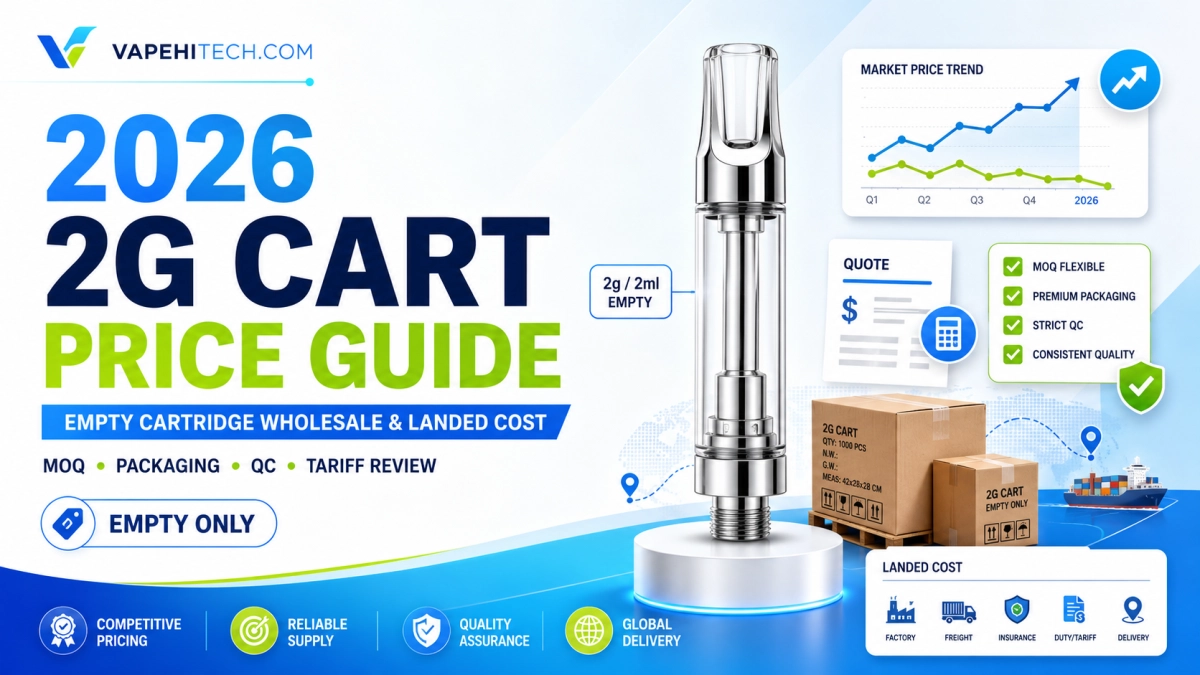
Scope: This guide is written for empty only 2g cart sourcing. It explains wholesale cost drivers, MOQ tiers, capacity wording, material files, packaging proof, QC planning, landed-cost math, tariff review, supplier evidence, and RFQ readiness. It does not cover filling steps, consumption guidance, potency claims, health claims, or end-user instructions.
Why 2g cart pricing is not one number
A low unit quote can look attractive until the buyer adds packaging, inspection, rejected lots, carton dimensions, freight, import review, taxes, brokerage, storage, relabeling, and claim handling. For that reason, a 2026 price review should start with a full buyer file, not a screenshot of a per-piece quote.
The phrase 2g cart can describe different empty only routes: a 2ml disposable cart, a 2g cartridge listing, a stock lot, a custom pack, an overseas warehouse lot, or a factory bulk order. Each route can carry a different MOQ, packaging basis, inspection rule, lead time, and landed-cost result.
The key idea
Do not compare 2g cart quotes unless the capacity wording, empty only scope, material file, package route, inspection rule, carton basis, trade term, and destination-market review are the same.
Quick answer for buyers
2g cart price is affected by capacity wording, tank route, battery file, coil route, mouthpiece route, material selection, stock status, MOQ tier, packaging route, inspection level, carton basis, freight class, trade term, tariff review, tax exposure, and claim risk. The lowest unit price is not always the lowest total landed cost.
Unit quote
Check whether the quote is per piece, per tray, per inner box, per master carton, or per lot.
MOQ tier
Price breaks can change at sample, pilot, carton, warehouse, and bulk levels.
QC cost
Inspection, leak checks, carton review, and rework can change the true cost.
Landed cost
Freight, duties, taxes, broker fees, and storage can matter more than a small unit-price gap.
| Buyer stage | Main question | File to keep |
|---|---|---|
| BOFU quote review | Are two suppliers quoting the same empty only route? | Spec sheet, price tier, package route, carton basis, trade term, and lead time. |
| Sample approval | Does the approved sample match the quoted route and package proof? | Sample photos, capacity note, material note, basic function check, and defect rule. |
| PO release | Is the total cost clear before payment or production release? | Quote, invoice draft, inspection plan, packing list draft, freight estimate, tariff review, and claim rule. |
What 2g cart price means in a buyer file
In this guide, 2g cart price means the empty only wholesale cost file for a 2g or 2ml cart route, including the base unit price and the cost items that sit around it. A buyer should treat 2g, 2 gram, 2000mg, and 2ml as separate wording fields until the supplier confirms the exact quote basis.
A buyer file should define the route in writing: empty only scope, capacity wording, tank route, battery file, coil route, mouthpiece route, material declaration, packaging route, MOQ tier, inspection rule, carton basis, trade term, and destination-market review.
Recommended pricing file wording
Use “2g cart empty only price review” in the RFQ, then request a separate line for base unit price, packaging cost, inspection cost, carton basis, freight assumption, trade term, tariff review, and quote validity date.
For a broader empty format comparison, buyers can review empty disposable vape pen cost before choosing a 2g cart route.
Main cost drivers
The wholesale price of an empty 2g cart is usually built from several cost layers. The most important layers are product route, production basis, materials, packaging, inspection, stock location, freight path, import requirements, and after-sale claim exposure.
| Cost driver | What changes the price | Buyer question |
|---|---|---|
| Capacity route | 2g, 2 gram, 2000mg, and 2ml wording may refer to different catalog or pack routes. | Which wording controls the quote, package proof, invoice, and carton mark? |
| Cart construction | Tank material, mouthpiece route, seal route, coil route, and finish can change the base cost. | Is the sample built from the same route as the bulk quote? |
| Battery file | Rated mAh, port route, indicator route, protection note, and sample test rule affect quotation scope. | Are these fields included in the unit quote or listed as a separate route? |
| Packaging | Plain pack, stock pack, buyer-approved pack, inserts, labels, trays, and carton marks can shift cost. | Is the quote for bare units, packed units, inner boxes, or master cartons? |
| QC level | AQL plan, leak check, appearance check, resistance check, pack count, and carton photo records add labor. | Is inspection included, optional, or arranged by the buyer? |
| Stock route | Factory order, overseas warehouse stock, mixed lots, and small-lot stock can have different price logic. | Is the quote based on current stock, new production, or a reserved lot? |
| Trade term | EXW, FOB, FCA, DAP, and DDP can move freight, clearance, risk, and local costs between seller and buyer. | What named place and cost responsibility are written in the pro forma invoice? |
For a category-level comparison with standard cartridge routes, buyers can also review vape cartridges wholesale cost.
Capacity, tolerance, and label wording
Capacity wording is one of the easiest ways to misread a price. A 2g listing may not be cost-equivalent to a 2ml listing if the tank route, packaging wording, inspection rule, and market label basis differ. The buyer should request the controlling phrase for every document: quote, sample approval, packaging proof, invoice, packing list, and carton mark.
| Capacity field | Cost impact | Buyer record |
|---|---|---|
| 2g wording | Can affect catalog naming, buyer search terms, and pack wording. | RFQ, quote, sample photo, and buyer approval. |
| 2ml wording | Can affect tank selection, material cost, inspection tolerance, and carton count. | Spec sheet, drawing where available, and receiving checklist. |
| 2000mg wording | Can create market-review questions and should not be copied into every document without approval. | Claim review, package proof, and listing note. |
| Tolerance | Loose tolerance may lower cost but raise rejection or dispute risk. | Supplier tolerance note and inspection checklist. |
| Mixed wording | Using 2g in one file and 2ml in another can create receiving confusion. | Document map showing which wording controls each file. |
Materials, parts, and compliance files
Materials can change both the base quote and the document cost. Glass route, metal parts, ceramic core route, seals, mouthpiece material, printed parts, labels, and cartons can each require a supplier declaration or restricted-substance review, depending on the destination market.
| Material area | Cost question | File to request |
|---|---|---|
| Tank material | Is the tank glass, plastic, covered, or mixed material? | Material note, sample photos, and supplier declaration. |
| Ceramic core | Is the coil route ceramic, and does the supplier confirm the exact route? | Spec sheet, close-up photos, and sample approval record. |
| Metal parts | Are metal parts standard, upgraded, plated, or market-specific? | Material declaration and buyer-side restricted-substance review. |
| Seals | Does the seal route support the selected capacity and leak-check method? | Seal placement photos, leak-check rule, and change-control note. |
| Change control | Will the supplier notify the buyer before changes to parts, package, carton, or inspection rule? | Written change-control rule and buyer approval record. |
MOQ tiers and price breaks
MOQ can be the largest visible driver of 2g cart price. A sample quote, 150-piece quote, 500-piece quote, 1,000-piece quote, and 5,000-piece quote may represent different labor, packaging, stock allocation, inspection, and freight assumptions. A buyer should not compare a 150-piece stock quote with a 5,000-piece factory quote unless the file clearly normalizes those assumptions.
| MOQ layer | What to compare | Why it matters |
|---|---|---|
| Sample MOQ | Sample price, sample shipping, and sample lead time. | Useful for approval, but not a bulk price benchmark. |
| Pilot MOQ | Small-lot price, package availability, inspection rule, and stock status. | Useful before a larger PO, but can carry higher handling cost. |
| Carton MOQ | Full carton count, inner-box count, and master-carton basis. | Helps reduce repacking and warehouse discrepancy risk. |
| Bulk MOQ | Price break, payment term, production slot, and inspection schedule. | Best for stable demand, but requires stronger QC and claim rules. |
| Package MOQ | Custom carton, label, insert, and print minimums. | Packaging MOQ can be higher than product MOQ. |
For a live example of quantity-based pricing, a 2ml empty disposable price tier page can be used as a reference file for price-break structure.
Another live reference, 2g disposable price tier, shows how per-piece price can change across larger quantity breaks.
Packaging, carton basis, and warehouse records
Packaging can make two quotes look different even when the base cart is similar. A plain-pack quote is not the same as a quote that includes small box, label, sticker, insert, tray, master carton, carton mark, and warehouse-ready packing list. The buyer should require packaging proof before the final PO is approved.
| Packaging field | Cost impact | Approval file |
|---|---|---|
| Pack route | Plain pack is usually simpler; buyer-approved pack adds proofing, printing, and revision control. | Package proof, revision date, and approval record. |
| Small box | Box material, print method, finish, inserts, and labels can change cost. | Box proof, print file, and unit photos. |
| Tray and inner box | Tray layout and inner-box count affect labor and carton volume. | Pack-count table and packing list draft. |
| Master carton | Carton dimensions and gross weight affect freight and storage. | Carton photo set, dimensions, gross weight, and carton mark. |
| Claim photos | Clear photo rules reduce disputes for shortage, mixed item, breakage, leakage, or package damage. | Claim instruction sheet and time window. |
Inspection cost, AQL, and reject risk
Inspection is a cost-control tool, not only an added fee. A weak inspection plan can create higher landed cost through rework, late shipment, repacking, customer claims, and held inventory. A strong plan defines lot size, sample size, defect categories, acceptance rule, rejection rule, and release evidence before packing starts.
| QC item | What affects cost | Buyer rule |
|---|---|---|
| Identity check | Wrong route, wrong capacity wording, wrong pack, or mixed cartons create rework and claims. | Compare the lot to the approved sample, package proof, and carton mark. |
| Appearance check | Scratches, dents, cracks, dust, print errors, and color mismatch can change acceptance rate. | Define minor, major, and critical defects before inspection. |
| Function check | Basic response, indicator behavior, port condition, and continuity checks add sample labor. | Set sample count and pass/fail rules in the inspection plan. |
| Leak check | Rest period, orientation, pressure, packaging condition, and seal review add time. | Use a repeatable method and photo evidence for failed samples. |
| Carton check | Wrong count, wrong carton mark, missing labels, or damaged cartons affect receiving. | Record inner-box count, master-carton count, dimensions, and gross weight. |
| Hold and release | Ambiguous hold rules delay shipment and increase storage or freight cost. | Write the release rule and rejection rule before PO release. |
Pricing tip
Ask whether the supplier price includes inspection labor, sample measurement, leak checks, package review, carton photos, and a release report. If not, treat those items as separate cost lines.
Landed cost, tariff review, and trade terms
Landed cost is the cost picture after the buyer accounts for the original product price, insurance, freight, tariffs, taxes, and other fees. For a 2g cart order, landed cost can change more from carton volume, trade term, freight route, tariff classification, and import documentation than from a few cents of unit-price difference.
| Landed-cost field | Buyer question | File to keep |
|---|---|---|
| Trade term | Is the quote EXW, FOB, FCA, DAP, DDP, or another agreed term with a named place? | Pro forma invoice, purchase order, and delivery-term note. |
| Freight basis | Which carton dimensions, gross weight, route, and service level are used? | Carton file, freight quote, and packing list sample. |
| Tariff classification | Which HS or HTS code is being reviewed by the broker or importer? | Broker note, classification basis, and current tariff screenshot where allowed. |
| Declared value | What value is shown on the commercial invoice, and does it match the transaction file? | Commercial invoice, purchase order, payment proof, and broker notes. |
| Taxes and local fees | Which duties, VAT, sales tax, brokerage, storage, or handling fees may apply? | Landed-cost worksheet and importer-side checklist. |
| Claim cost | Who pays for shortage, delay, rework, repacking, mixed cartons, or rejected lots? | Claim rule, photo rule, time window, and credit note process. |
How to compare supplier quotes
A normalized quote sheet makes suppliers easier to compare. Put every quote into the same columns and leave a blank where the supplier did not answer. Missing information is a risk signal because it can become an added cost later.
| Quote column | Why it matters | Red flag |
|---|---|---|
| Base unit price | Shows the starting point before packaging and logistics. | Price is quoted without MOQ, currency, or validity date. |
| MOQ and price breaks | Shows how price changes from pilot to bulk. | Supplier gives one price but no tier table. |
| Capacity wording | Prevents mismatch between 2g, 2ml, and 2000mg documents. | Product title, spec sheet, and carton mark use conflicting wording. |
| Packaging basis | Shows whether packaging cost is included or separate. | Quote says packed, but no proof or pack-count table is provided. |
| Inspection rule | Shows whether release checks are included. | No defect categories, sample count, or release record. |
| Carton basis | Controls freight, storage, and receiving count. | No dimensions, gross weight, or pieces per carton. |
| Trade term | Controls cost responsibility and risk point. | Quote says shipping included but no named place or responsibility split. |
| Import readiness | Shows whether files are ready for broker and market review. | No invoice draft, packing list draft, or material files where relevant. |
Buyer price scorecard
Use this scorecard to compare suppliers beyond the visible per-piece quote. Each score should be supported by written evidence.
| Score area | Suggested weight | Evidence to review |
|---|---|---|
| Scope clarity | 15 | Empty only wording across RFQ, quote, sample approval, invoice, packing list, and carton mark. |
| Price transparency | 15 | Unit price, MOQ tiers, package cost, inspection cost, quote validity, and currency. |
| Spec match | 15 | Capacity wording, tank route, battery file, coil route, mouthpiece route, and approved sample. |
| Packaging control | 10 | Package proof, revision date, pack count, inner box, master carton, and carton mark. |
| QC readiness | 15 | AQL basis, defect categories, leak-check rule, sample count, release photos, and hold rule. |
| Landed-cost clarity | 15 | Trade term, named place, carton dimensions, gross weight, freight quote, tariff review, and tax notes. |
| Supplier evidence | 10 | Material files, sample photos, stock proof, inspection record, and change-control note. |
| Claim process | 5 | Shortage rule, mixed-carton rule, leak claim rule, photo requirement, and credit timeline. |
RFQ template
Use this RFQ template to collect comparable pricing before approving a sample order, pilot order, or bulk purchase order.
Subject: RFQ for 2g Cart Empty Only - 2026 Wholesale Price, MOQ, Packaging, QC, and Landed-Cost Review
Scope: Empty only
Destination market: [insert country, state, province, or licensed-market route]
Buyer role: [wholesaler / distributor / licensed operator / brand owner / importer]
Requested route: [2g cart / 2ml disposable cart / buyer-approved wording]
Capacity wording: [2g / 2 gram / 2ml / 2000mg / buyer-approved wording]
Tank tolerance: [supplier to confirm]
Battery file: [rated mAh / port route / indicator route / protection note / sample check rule]
Coil route: [ceramic / mesh / other supplier route]
Resistance range: [ohm value and tolerance]
Mouthpiece route: [flat / round / ceramic / plastic / metal / snap-fit / screw-on / press-on]
Package route: [plain pack / supplier stock pack / buyer-approved pack]
Quantity target: [sample / pilot / carton / warehouse stock / bulk / reorder]
MOQ request: [sample MOQ / pilot MOQ / bulk MOQ / package MOQ / stock MOQ / reorder MOQ]
Price basis: [piece / tray / inner box / master carton / total lot]
Separate cost lines: [packaging / inspection / labeling / carton / freight / broker / storage / claim handling]
Sample review: [sample quantity / sample photos / appearance check / function check / resistance check / leak check / package check]
Carton record: [pieces per pack / packs per carton / carton dimensions / gross weight / carton mark]
QC request: [AQL basis / appearance / identity check / resistance check / leak check / pack count / carton count / photo record / release rule]
Document request: [quote sheet / spec sheet / material declaration / package proof / inspection report / packing list / commercial invoice draft / lab file where relevant]
Delivery term: [EXW / FOB / FCA / DAP / DDP / buyer-specified term with named place]
Quote validity: [insert required validity period]
Target receiving window: [insert date range]
Claim process: [shortage, mixed item, appearance defect, leakage, packaging issue, carton issue, late release, or price discrepancy process]
Official references
These references support a neutral buyer file. They do not replace legal, import, tax, trademark, packaging, restricted-substance, or licensed-market review.
| Reference area | Use in the buyer file | Source |
|---|---|---|
| Landed cost | Supports buyer-side estimation of product price, insurance, freight, tariffs, taxes, and other fees. | landed cost estimate |
| Delivery terms | Supports named-place wording, cost responsibility, document responsibility, and risk review. | Incoterms cost responsibilities |
| US tariff schedule | Supports broker review of current US tariff classification before PO approval. | current HTS schedule |
| HS classification | Supports global HS classification review before import planning. | HS classification review |
| Commercial invoice value | Supports invoice-value review for US import files. | commercial invoice value |
| ENDS component scope | Supports review of category scope, components, import, packaging, labeling, advertising, sale, and distribution language. | FDA ENDS components and parts |
| Import review | Supports importer-side review of FDA-regulated tobacco product requirements where applicable. | FDA tobacco product import review |
| Sampling inspection | Supports lot-by-lot inspection by attributes, AQL planning, sample size, and acceptance rules. | ISO 2859-1 AQL sampling |
| Leak check context | Supports packaging gross-leak discussions and seal-integrity thinking for sample plans. | ASTM F2096 gross leak test |
| Glass material review | Supports buyer questions about borosilicate glass 3.3 where the supplier claims that material route. | ISO 3585 borosilicate glass 3.3 |
| Stainless material review | Supports buyer questions about flat-rolled stainless steel requirements where relevant. | ASTM A480/A480M stainless steel requirements |
| Restricted substances | Supports buyer-side review of restricted substances for EU routes where relevant. | EU RoHS restricted substances |
| Quality management | Supports supplier process review, document control, internal audit, and corrective-action discussions. | ISO 9001 QMS |
| Lab competence | Supports review of test-report context, competence, sampling, and calibration where applicable. | ISO/IEC 17025 laboratories |
FAQ
What affects 2g cart price the most?
The largest drivers are MOQ tier, capacity route, material selection, battery file, coil route, packaging basis, QC level, carton basis, freight path, trade term, tariff review, and claim risk.
Why can two 2g cart quotes differ so much?
Two quotes may use different capacity wording, stock route, packaging route, inspection level, carton count, trade term, and freight assumption. A lower unit quote can become more expensive after landed-cost review.
Is 2g the same as 2ml in pricing?
No. 2g is a mass phrase, while 2ml is a volume phrase. They may appear together in product names, but buyers should ask which wording controls the quote, package proof, invoice, packing list, and carton mark.
How should a buyer compare MOQ price breaks?
Put every supplier into one table with the same columns: quantity, unit price, packaging basis, inspection basis, carton count, trade term, lead time, freight assumption, and quote validity.
Should inspection be counted as part of the cost?
Yes. Inspection can reduce rework, rejected lots, packaging disputes, mixed cartons, late claims, and receiving problems. If inspection is not included in the quote, it should be listed as a separate cost line.
What does empty only mean in this guide?
Empty only means this pricing file is limited to the empty cart format, packaging, QC, carton records, trade terms, and business documentation. It does not cover filling steps, consumption guidance, potency claims, health claims, or end-user instructions.
What documents should a buyer request before approving a bulk order?
The buyer should request the RFQ reply, quote sheet, spec sheet, sample photos, material declaration where relevant, package proof, inspection plan, carton file, commercial invoice draft, packing list draft, freight estimate, and change-control note.
Is this legal or import advice?
No. This is an educational B2B pricing guide. Buyers should use qualified legal, import, tax, trademark, packaging, restricted-substance, and licensed-market support before final approval.
0 Comments